1.1 - Atoms & Subatomic Particles
The atom and its particles
- Every substance is made of atoms. An atom is the smallest part of an element that can exist.
- Atoms are extremely small - far too small to see even under a microscope.
- Each atom is built from three kinds of particle: protons, neutrons, and electrons.
The nucleus and the shells
- At the centre of the atom is the nucleus, which holds the protons and neutrons packed tightly together.
- The nucleus carries a positive charge (because of the protons), and almost the whole mass of the atom is concentrated there.
- The electrons move around the nucleus in shells (also called energy levels).
- Most of an atom is empty space, with the outermost electrons setting how big the atom is.

The three particles compared
The particles are compared on a relative scale, where a proton and a neutron each have a mass of 1 and a proton has a charge of +1.
| Particle | Relative mass | Relative charge | Where it is |
|---|---|---|---|
| Proton | 1 | +1 | In the nucleus |
| Neutron | 1 | 0 | In the nucleus |
| Electron | Very small (about 0.0005) | -1 | In the shells around the nucleus |
Why atoms are neutral
- An atom always has the same number of electrons as protons.
- The total negative charge on the electrons matches the total positive charge on the protons, so they cancel out.
The size of atoms and their nucleus
- An atom has a radius of about 0.1 nanometres, which is 1 × 10⁻¹⁰ m.
- The nucleus is far smaller: its radius is less than 1/10,000 of the radius of the whole atom, about 1 × 10-14 m.
Atomic number, mass number and nuclide notation
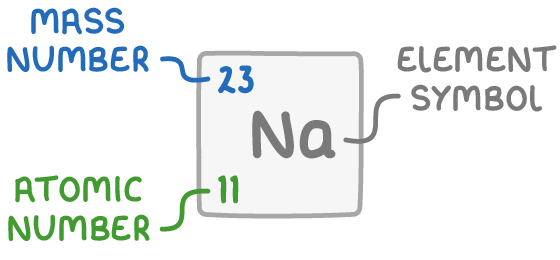
- Atomic number (also called the proton number) - The number of protons in the atom. Every atom of a given element has the same number of protons.
- Mass number (also called the nucleon number) - The total number of protons and neutrons in the nucleus.
Nuclide notation
- In nuclide notation (or the nuclear symbol), the mass number is above and the atomic number is below, to the left of the element's symbol.
- Example: sodium is written (11 protons, and 23 protons and neutrons in total).
Working out the particles
- Number of protons = atomic number
- Number of neutrons = mass number - atomic number
- Number of electrons = number of protons (in a neutral atom)
Worked example - The particles in an atom
An atom of iron is written . How many protons, neutrons, and electrons does it contain?
Step 1 - Read the two numbers off the symbol
-
Atomic number (lower number) = 26
-
Mass number (upper number) = 56
Step 2 - Find the protons
Number of protons = the atomic number = 26 protons
Step 3 - Find the neutrons
Number of neutrons = mass number - atomic number:
56 - 26 = 30 neutrons
Step 4 - Find the electrons
This is a neutral atom, so number of electrons = number of protons = 26 electrons
Check: protons + neutrons should equal the mass number, and 26 + 30 = 56.
Counting the particles in an ion
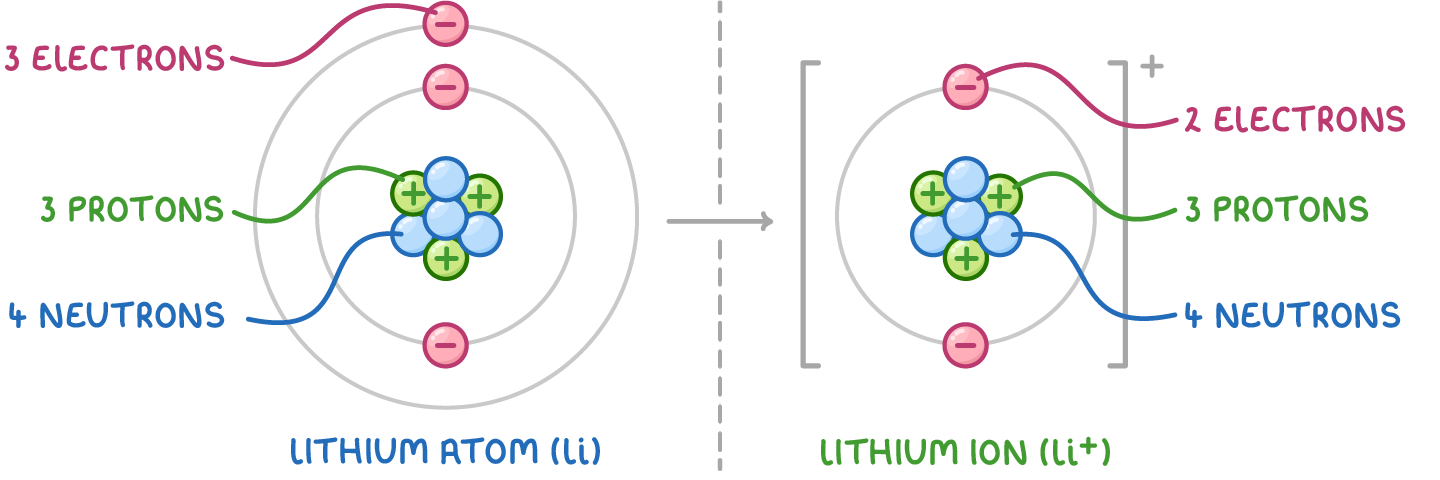
- An ion is an atom, or group of atoms, that has lost or gained electrons.
- Because the number of protons and electrons no longer match, an ion carries an overall charge.
- An atom that loses electrons becomes a positive ion (more protons than electrons).
- An atom that gains electrons becomes a negative ion (more electrons than protons).
The nucleus stays the same
- Only electrons are lost or gained, so the nucleus is untouched.
- An ion has the same number of protons and neutrons as the atom it came from.
- In nuclide notation, the charge is written at the top right, as in or the lithium ion shown below.
Working out the particles in an ion
- Number of protons = atomic number
- Number of neutrons = mass number - atomic number
- Number of electrons = atomic number minus the charge (for positive ions) or plus the charge (for negative ions)
For a chloride ion, : 17 protons, 35 - 17 = 18 neutrons, and 17 + 1 = 18 electrons.
TermDefinition
Atom
Nucleus
Atomic number
Mass number
Ion