4.1 - The Reactivity Series
The reactivity series
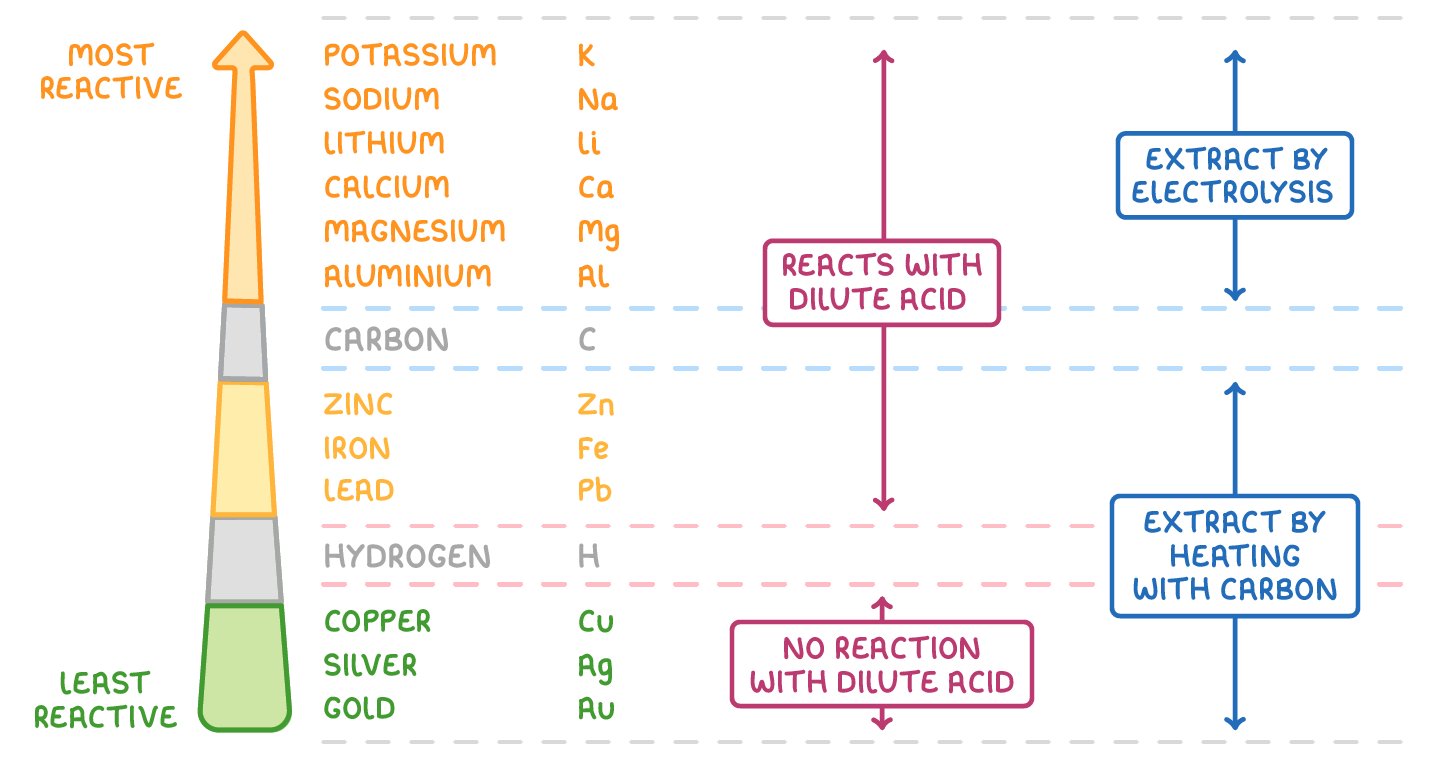
- Setting metals out in order of how readily they react gives the reactivity series: most reactive at the top, least reactive at the bottom.
- The order is the same whichever reaction is used to find it, so the series predicts what any of these metals will do.
The order to know
Why the order comes out this way
- When a metal reacts, its atoms lose electrons to form positive ions (cations).
- How reactive a metal is depends on how easily its atoms lose those outer electrons.
- Potassium gives up its outer electron very easily, so it reacts vigorously.
- Gold holds on to its electrons so tightly that it's found in the Earth unreacted as the native metal.
- The same electron loss happens in every reaction, which is why a metal's position stays the same across different reactions.
Carbon and hydrogen are the two markers
- Carbon and hydrogen aren't metals - they're put into the series as two fixed markers:
- Hydrogen marks the line for dilute acids - A metal above hydrogen reacts with a dilute acid and displaces the hydrogen (e.g. magnesium, zinc and iron all fizz in dilute hydrochloric acid). A metal below hydrogen does not react with dilute acids (copper, silver and gold sit in acid unchanged).
- Carbon marks the line for extracting a metal from its ore - A metal below carbon can be extracted from its ore by heating with carbon. A metal above carbon cannot, and must be extracted using electrolysis instead.
Metals with cold water and dilute acid
With a dilute acid
- A metal that reacts with a dilute acid produces a salt and hydrogen gas:
- metal + dilute acid → salt + hydrogen
- magnesium + hydrochloric acid → magnesium chloride + hydrogen
- Mg(s) + 2HCl(aq) → MgCl2(aq) + H2(g)
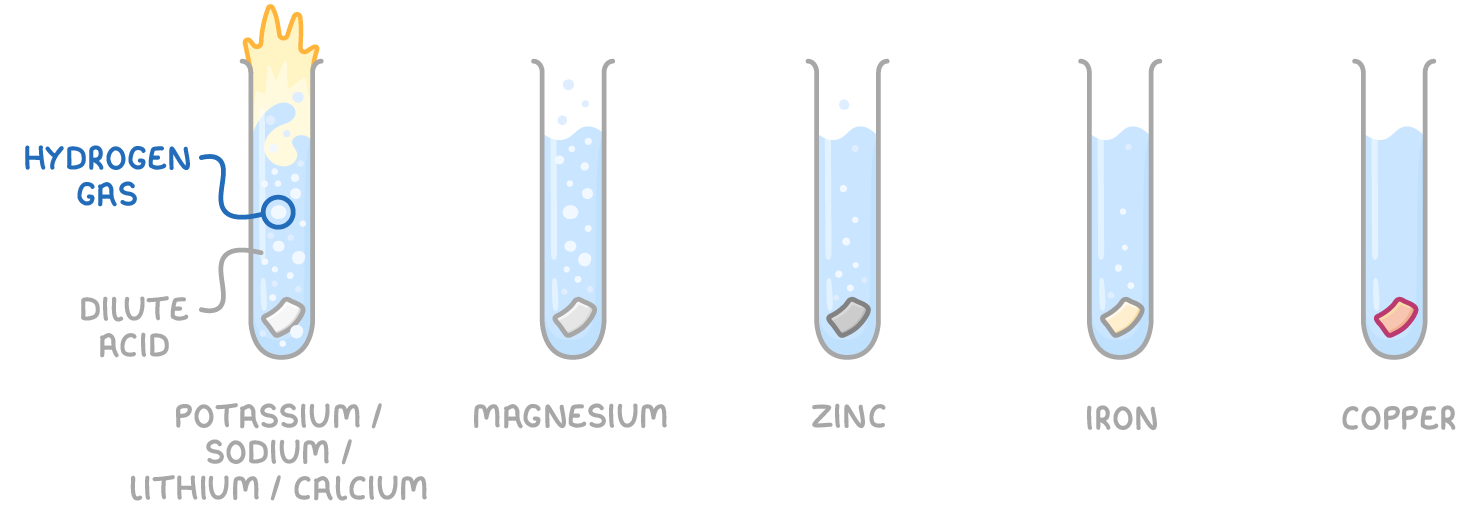
- The hydrogen comes off as bubbles, and the rate of bubbling indicates how fast the reaction is going.
| Metal | Reaction with cold dilute acid |
|---|---|
| Potassium, sodium, lithium, calcium | React explosively - dangerously fast |
| Magnesium | Reacts vigorously, producing a steady stream of bubbles |
| Zinc | Reacts slowly in the cold, faster if warmed |
| Iron | Reacts very slowly, giving only a few bubbles |
| Copper | No reaction |
With cold water
- A reactive metal with cold water produces a metal hydroxide and hydrogen:
- metal + water → metal hydroxide + hydrogen
- calcium + water → calcium hydroxide + hydrogen
- Ca(s) + 2H2O(l) → Ca(OH)2(aq) + H2(g)
- Only the most reactive metals react with cold water:
- Potassium, sodium and lithium react vigorously, floating and moving across the surface.
- Calcium reacts steadily, producing bubbles and a cloudy white precipitate.
- Magnesium reacts extremely slowly with cold water.
- Zinc, iron and copper do not react with cold water.
Making it a fair comparison
- To compare reactivity fairly, keep the following variables constant:
- Mass and surface area of the metal
- Volume and concentration of the acid or water
- Starting temperature
- Measuring the temperature rise over a set time provides a quantitative comparison: the more reactive the metal, the greater the temperature rise.
Metals reacting with oxygen
- Metals react with oxygen to form metal oxides:
- metal + oxygen → metal oxide
- magnesium + oxygen → magnesium oxide
- 2Mg(s) + O2(g) → 2MgO(s)
- The ease and vigor of this reaction follows the reactivity series.
Metals heated in air
| Metal | Observation on heating |
|---|---|
| Potassium | Burns with a lilac flame, forming a white solid |
| Sodium | Burns with a yellow flame, forming a white solid |
| Magnesium | Burns with a bright white flame, forming a white powder |
| Zinc | Burns to form a solid that is yellow when hot, white when cold |
| Iron | Filings glow and produce orange sparks, forming a black solid |
| Copper | Does not burn; surface coats with black copper(II) oxide |
Slow reaction at room temperature
- Reactive metals like potassium and sodium tarnish rapidly in air at room temperature and must be stored under oil to prevent contact with oxygen and moisture.
- When a metal oxidises, it gains mass because oxygen atoms from the air bond to the metal atoms.
Metal displacement
A displacement reaction occurs when a more reactive metal takes the place of a less reactive metal in a solution of its salt:
A more reactive metal will displace a less reactive metal from a solution of its salt.
Iron and copper(II) sulfate
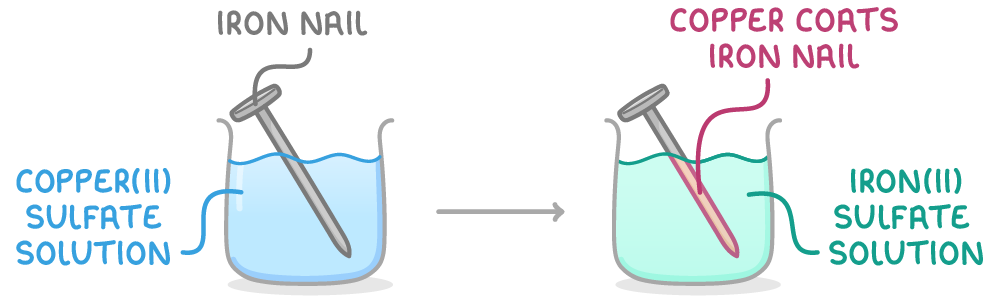
- Iron is higher in the reactivity series than copper, so iron displaces copper:
- iron + copper(II) sulfate → iron(II) sulfate + copper
- Fe(s) + CuSO4(aq) → FeSO4(aq) + Cu(s)
- Observations:
- The blue solution fades to pale green as Cu2+ ions are replaced by Fe2+ ions.
- A pink-brown solid (copper) coats the iron nail and falls to the bottom.
- The temperature rises because displacement reactions are exothermic.
Predicting displacement reactions
- A less reactive metal cannot displace a more reactive metal (e.g. copper added to iron(II) sulfate gives no reaction).
- The greater the difference in reactivity between the two metals, the larger the temperature rise during the reaction.
Deducing an order of reactivity
To determine an unknown reactivity series experimentally:
- React each metal with the same substance under identical conditions.
- Observe and record the rate of reaction (e.g. rate of bubbling, temperature change).
- Rank the metals - The metal producing the fastest reaction or highest temperature rise is the most reactive.
Fair testing
The following variables must be kept constant across all tests:
- Mass and surface area of the metal - Powders react faster than lumps of the same mass.
- Concentration and volume of acid or solution
- Starting temperature
Displacement tests
Adding each metal to salt solutions of the other metals reveals the full order: the metal that displaces the most other metals is highest in the series.
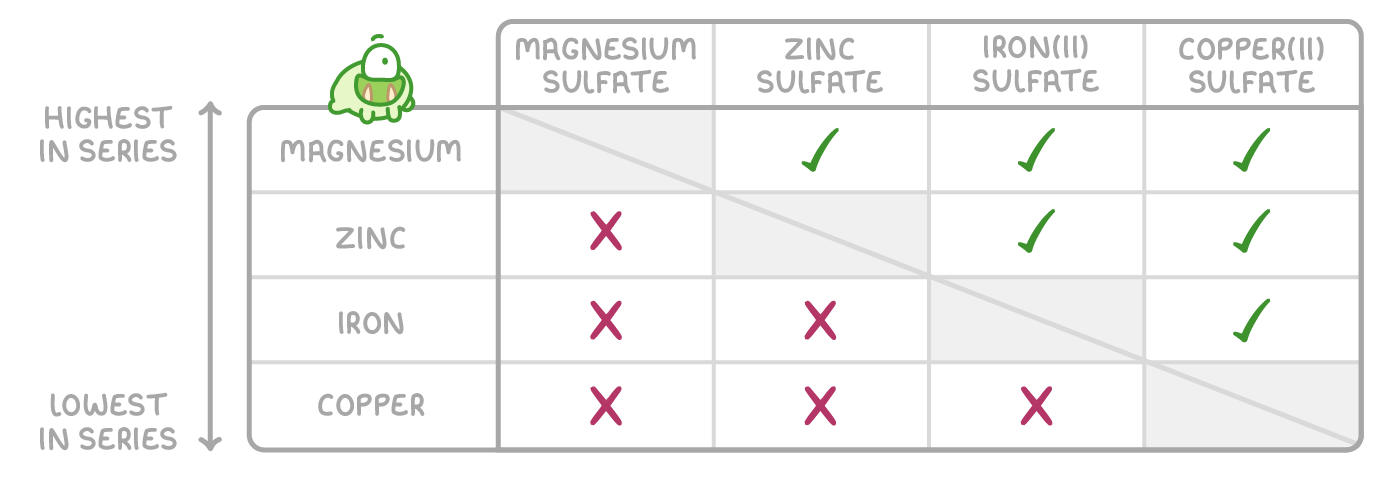
A tick means the metal in that row displaces the metal in that solution.
Worked example - An order from results
Four unidentified metals, A, B, C and D, were each added to dilute hydrochloric acid under the same conditions. Put the four metals in order of reactivity, most reactive first.
| Metal | Observations |
|---|---|
| A | A few bubbles form slowly |
| B | No reaction |
| C | Rapid stream of bubbles; metal disappears quickly |
| D | Steady bubbling, faster than A but slower than C |
Step 1 - Compare the rates of reaction
The rate of hydrogen gas production indicates the rate of reaction.
Step 2 - Rank the metals
- C produces bubbles fastest → most reactive.
- D bubbles faster than A but slower than C → second.
- A produces bubbles slowly → third.
- B shows no reaction → least reactive (sits below hydrogen in the reactivity series).
Order of reactivity: C > D > A > B