6.1 - Rate of Reaction & Measuring It
Rate of reaction
- The rate of a reaction is how quickly it happens.
- Reactions can be very slow (e.g. iron rusting, over months or years), fast (e.g. burning), or over in a fraction of a second (e.g. a firework exploding).
- A rate can be followed by measuring either how fast a reactant is used up or how fast a product is formed - either can be used.
Calculating average rate
Average rate of reaction = quantity of reactant used (or product formed) ÷ time taken
The unit of rate depends on how the quantity is measured: g/s for a mass in grams, cm3/s for a volume of gas in cm3, and mol/s for an amount in moles.
Rate graphs
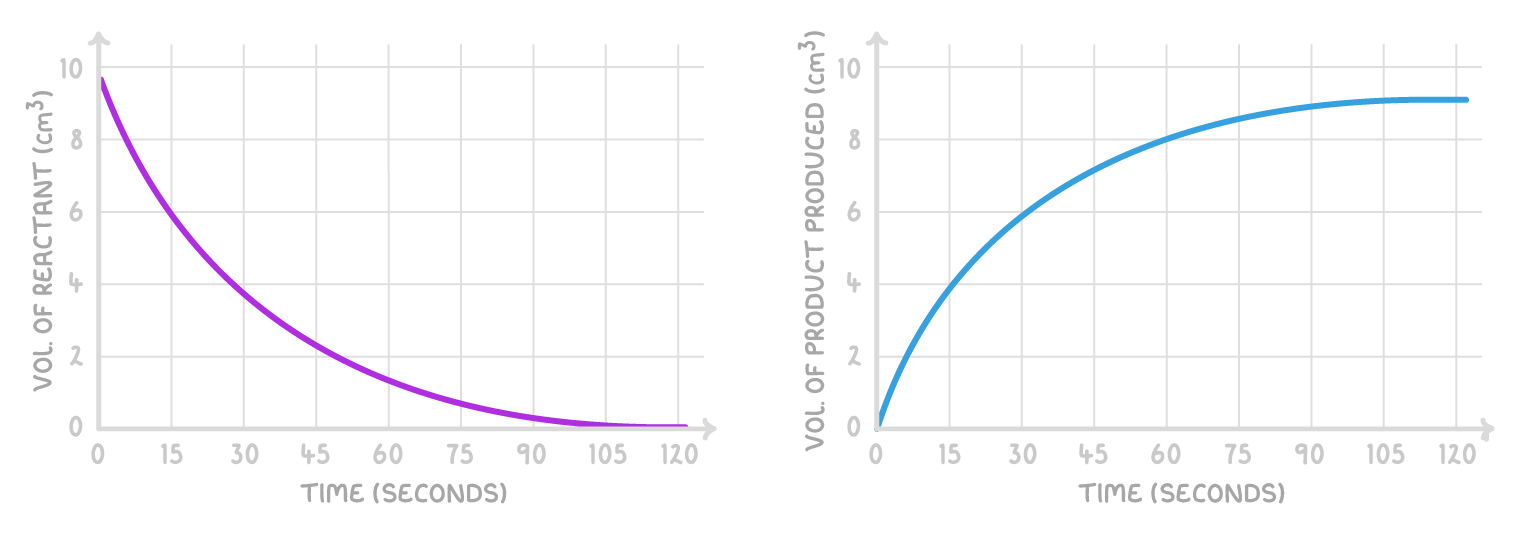
- A rate graph shows how fast a reaction is going at any particular time.
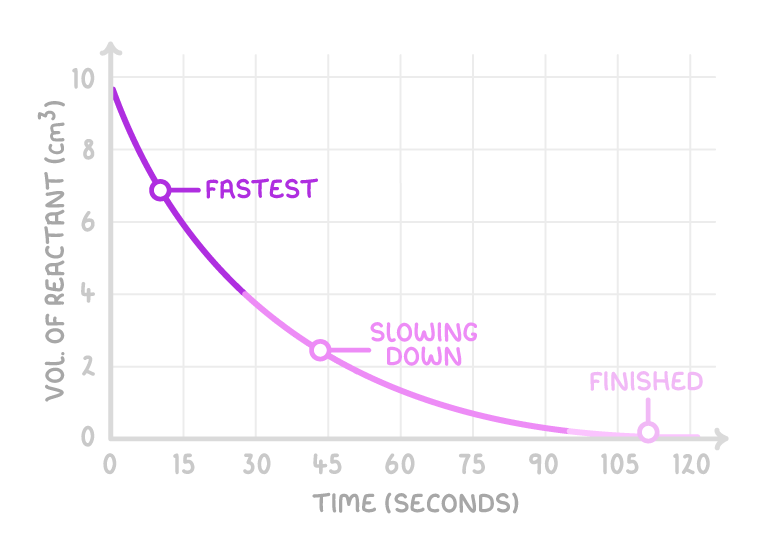
- The steeper the line, the faster the reaction at that point.
The line changes shape as the reaction runs
- Steepest at the start, when there's most reactant and the reaction is going fastest.
- Less steep as the reactants get used up and the reaction slows down.
- Flat once the reactants are used up and the reaction has stopped.
Measuring a rate of reaction
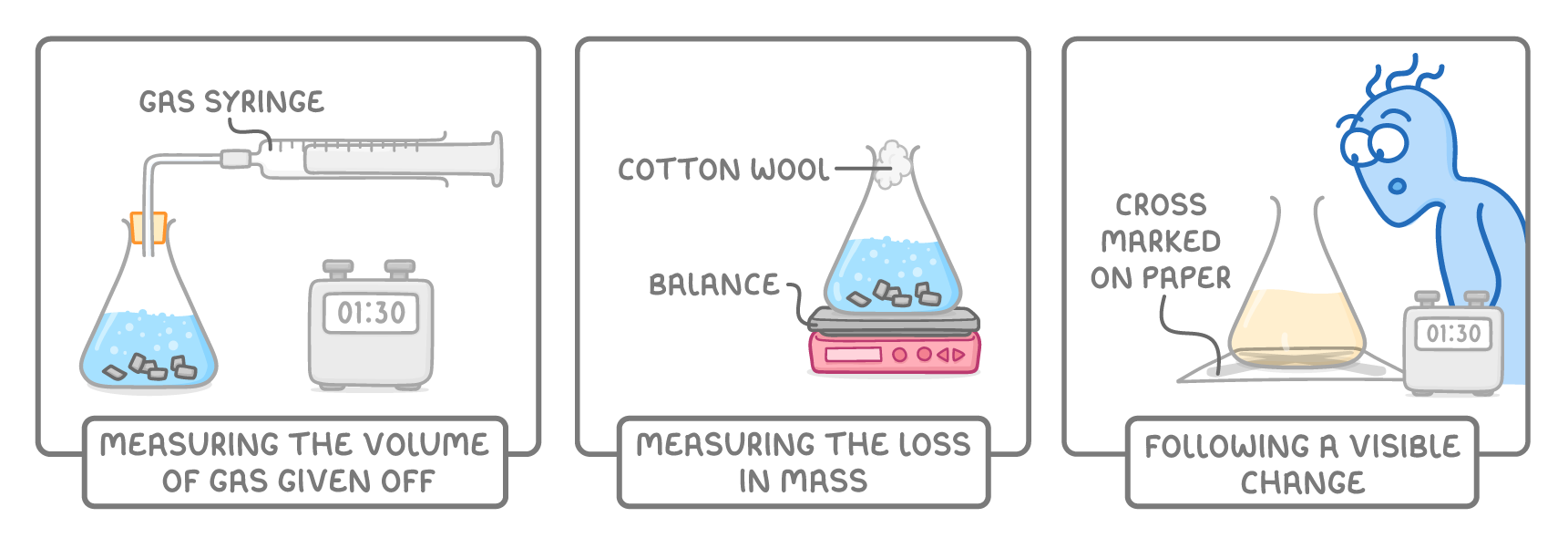
1. Measuring the volume of gas given off
- Used for reactions that produce a gas by measuring the volume collected at regular time intervals.
- A gas syringe measures the volume directly as the gas pushes the plunger out.
- The gas can also be collected over water in an upturned measuring cylinder.
- Typical example: marble chips + dilute hydrochloric acid, collecting the carbon dioxide gas produced.
2. Measuring the loss in mass
- Used when a produced gas escapes into the room rather than being collected.
- As gas escapes, the flask and its contents lose mass, so the balance reading falls over time.
- A loose plug of cotton wool in the neck lets gas escape while stopping liquid spitting out.
3. Following a visible change
- Used for reactions that produce a precipitate or colour change in solution.
- Standard example: sodium thiosulfate + dilute hydrochloric acid forms a cloudy yellow precipitate of sulfur.
- Time how long a cross marked on paper under the flask takes to disappear through the cloudy mixture - the shorter the time, the faster the reaction.
- For a reaction that changes colour, time how long the colour change takes.
- Either change can be judged by eye, or timed with apparatus:
- A colorimeter for a colour change.
- A light sensor connected to a data logger for the cloudiness of a precipitate.
Calculating rate from time
- Whichever method is used, timing begins the moment the reactants are mixed.
- Gas volume and mass loss give continuous measurements to plot against time.
- When timing a single end point (like the disappearing cross), the rate is proportional to 1 ÷ time (in s-1): the shorter the time, the faster the reaction.
TermDefinition
Rate of reactionHow quickly a reaction happens, measured by how fast a reactant is used up or a product is formed.
Key points to remember
How were these notes?