2.6 - Simple & Giant Covalent Structures
Simple molecular and giant covalent structures
Covalent bonding is where atoms share pairs of electrons. It builds two very different kinds of substance, depending on how far the bonding runs.
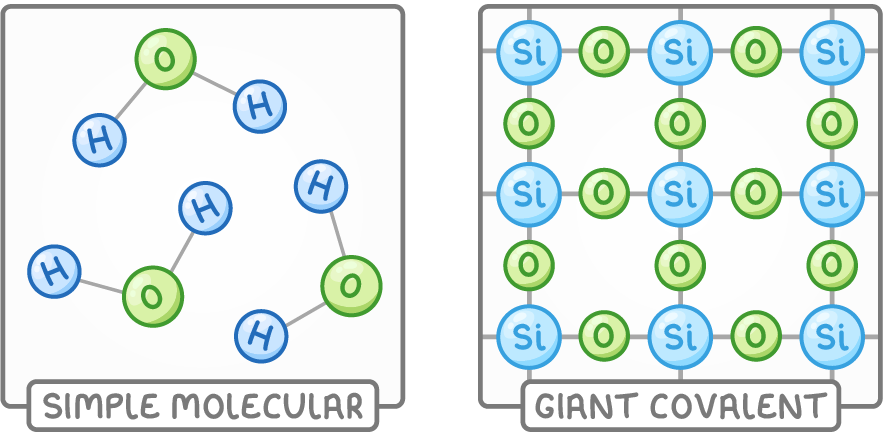
Simple molecular substances
- Covalent bonds hold a small, fixed number of atoms together into a separate molecule, and there the bonding stops.
- Examples include hydrogen, water, carbon dioxide, methane and ammonia. Each is made of separate, identical molecules with only weak attractions between them.
- A molecular formula gives the exact number of atoms in one molecule (for example, H2O has two hydrogen atoms and one oxygen atom).
- Molecules are tiny - atoms and small molecules are of the order of 10-10 metres across, about the length of a typical covalent bond.
Giant covalent structures
- Huge numbers of atoms are linked by covalent bonds running continuously right through the whole structure in a giant lattice.
- Silicon dioxide (silica) is a giant covalent structure found in sand. Each silicon atom bonds to four oxygen atoms, and each oxygen bridges two silicon atoms.
- Diamond has carbon atoms each bonded to four others in a rigid 3D tetrahedral pattern.
- Graphite is also made entirely of carbon atoms, bonded into hexagonal layers.
Formulas of giant structures
- Giant covalent structures have no individual molecules, so their formula gives the simplest ratio of the atoms present.
- Silicon dioxide's formula SiO2 shows a 1:2 ratio of silicon to oxygen throughout the lattice, not a separate three-atom molecule.
Comparing their properties, and why they differ
| Simple molecular | Giant covalent | |
|---|---|---|
| Melting and boiling point | Low | Very high |
| Conducts electricity? | No | No |
| Dissolves in water? | Many do not, though some do | No |
| What breaks on melting | Weak intermolecular forces between molecules | Covalent bonds throughout the lattice |
Two kinds of bond - And which one breaks
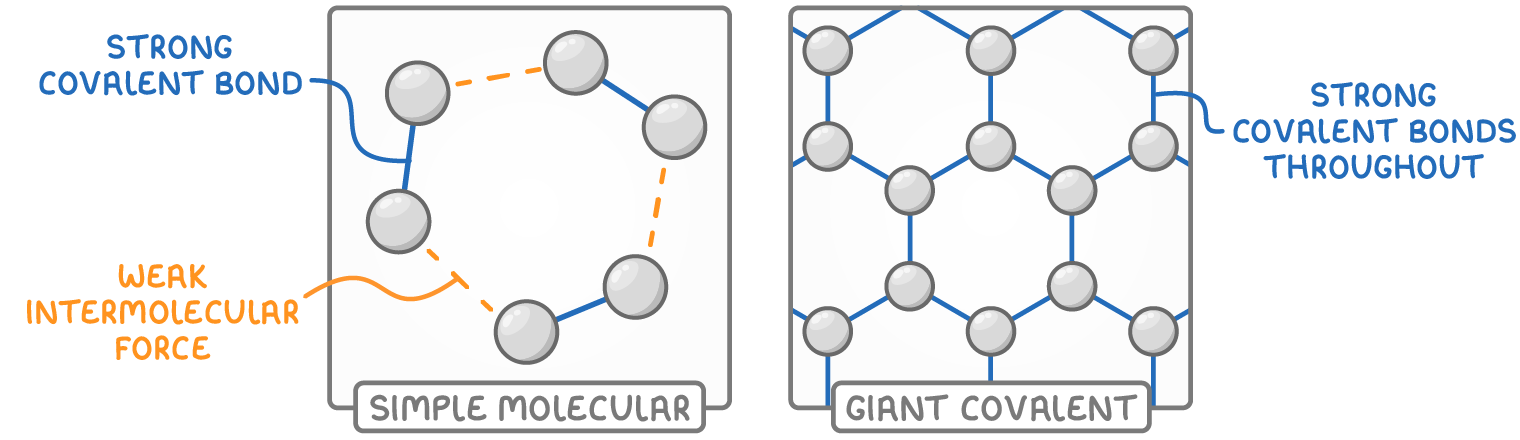
- The atoms inside a molecule are held by strong covalent bonds.
- Between separate molecules there are only weak intermolecular forces.
- When a simple molecular substance melts or boils, only these weak intermolecular forces break. The covalent bonds within the molecules remain intact, so very little energy is needed and melting and boiling points are low.
- Melting a giant covalent structure requires breaking huge numbers of strong covalent bonds throughout the lattice. This requires large amounts of energy, so melting and boiling points are very high.
Molecule size affects melting and boiling point
- The bigger a molecule, the stronger the intermolecular forces between molecules, so bigger molecules have higher melting and boiling points.
- Chlorine (a small molecule) is a gas at room temperature, whereas iodine (a much larger molecule) is a solid.
- Melting and boiling points increase down Group 7 and Group 0 because the molecules (in Group 0, single atoms) get larger and the intermolecular forces become stronger.
Why neither conducts electricity
- Simple molecules carry no overall charge, so there are no mobile ions or delocalised electrons.
- Giant covalent structures contain no free ions or delocalised electrons to carry a charge through the structure (graphite is the exception).
TermDefinition
Covalent bondA strong bond formed when two atoms share a pair of electrons.
MoleculeA particle made of two or more atoms joined together by covalent bonds.
Giant covalent structureA structure in which a very large number of atoms are joined by strong covalent bonds in a continuous network.
Intermolecular forcesThe weak forces of attraction between separate molecules.
Key points to remember
How were these notes?