7.4 - Cracking
Cracking and how it is done
- Fractional distillation sorts crude oil hydrocarbons by carbon-chain length, but doesn't change them. This leaves a refinery with far more long-chain molecules than it can use.
- Long-chain molecules are the least useful part of crude oil - they're thick, don't catch light easily, and make poor fuels.
- Cracking breaks these long molecules down into shorter, more useful ones.
Cracking is thermal decomposition
- Thermal decomposition means breaking down a substance into two or more new ones by heating it.
- The bonds broken are the strong covalent bonds inside the hydrocarbon molecule, so a lot of energy must be put in.
Two ways to carry it out
Both methods start the same way: the long-chain hydrocarbons are heated until they vaporise (turn into a gas).
- Catalytic cracking - The vapour is passed over a hot catalyst. The catalyst is a powder, and the long molecules split apart on its surface.
- Steam cracking - The vapour is mixed with steam, then heated to a very high temperature, making the long molecules split apart.
The products
Either way, the products are a mixture. A cracking reaction gives two kinds of hydrocarbon:
- Shorter alkanes - Short-chain hydrocarbons that make good fuels.
- Alkenes - A second kind of hydrocarbon, whose molecules contain a carbon-carbon double bond.
Alkanes are saturated (every carbon-carbon bond is a single bond) and alkenes are unsaturated. The double bond makes alkenes more reactive than alkanes.
A small amount of hydrogen (H2) is given off as well.
Cracking only breaks bonds within the starting molecule and adds nothing, so no atom is gained or lost. The products together hold the same number of carbon and hydrogen atoms as the original molecule.

Why fractions are cracked
- Crude oil comes out of the ground as a mixture, and fractional distillation only separates that mixture.
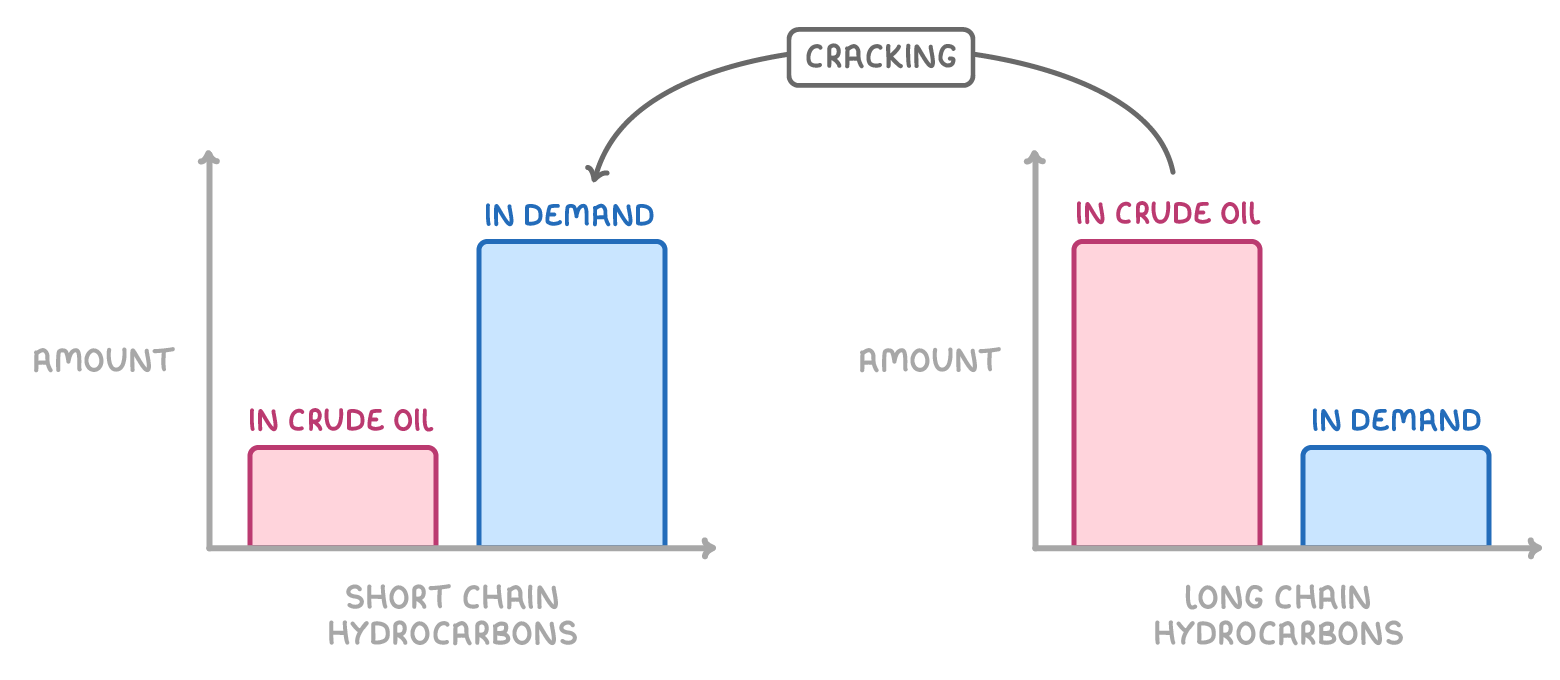
- Distillation can't change how much of each kind of molecule there is, so what a refinery gets doesn't match what consumers need.
Short chains run short and long chains pile up
- Short-chain hydrocarbons vaporise and catch light easily, so they make good fuels and are in high demand.
- Long-chain hydrocarbons are thick and hard to ignite, and crude oil yields far more of them than are needed.
| Chain length | Crude oil contains | Amount wanted | Result |
|---|---|---|---|
| Short chains (about 3 to 10 carbons) | little | a great deal | in short supply |
| Long chains (more than about 20 carbons) | a great deal | little | in surplus |
Cracking resolves the mismatch by turning surplus long molecules into useful short ones.
Alkenes are useful raw materials
- Cracking also produces alkenes, the starting material for making polymers (including plastics) and many other chemicals.
- Cracking is the main industrial source of alkenes, connecting the oil refinery to the chemical industry.
Worked example - A cracking equation
Write the balanced symbol equation for the cracking of a long-chain alkane C10H22, given that one of the two products is the alkane C8H18.
Step 1 - Write down what is known
Put the long-chain alkane on the left and the known product on the right, with a gap for the missing product:
C10H22 → C8H18 + ?
Step 2 - Find the carbon atoms in the missing product
- Cracking adds nothing, so the products together hold exactly the atoms of the reactant.
- Reactant has 10 carbons; known product has 8.
- Missing product: 10 − 8 = 2 carbon atoms.
Step 3 - Find the hydrogen atoms in the missing product
- Reactant has 22 hydrogens; known product has 18.
- Missing product: 22 − 18 = 4 hydrogen atoms.
- So its molecular formula is C2H4.
Step 4 - Check what kind of hydrocarbon it is
- An alkane with n carbons has (2 × n) + 2 hydrogens.
- An alkane with 2 carbons would have (2 × 2) + 2 = 6 hydrogens.
- This product has only 4 - two short - so it's not an alkane. It's an alkene.
Step 5 - Write the equation and check it
C10H22 → C8H18 + C2H4
- Carbon: 10 on the left, 8 + 2 = 10 on the right.
- Hydrogen: 22 on the left, 18 + 4 = 22 on the right.
- Both match, so the equation balances.
Step 6 - Interpretation
- An alkane carries two hydrogens over and above twice its number of carbons.
- The single molecule going in carries that surplus of two once; two alkanes coming out would need it twice.
- So there are never enough hydrogen atoms for every product to be an alkane, and at least one product must be an alkene.
- Where a question names both products, the atoms may not match one molecule to one - a number written in front of a formula fixes that, as in any balanced equation.