10.1 - Finite Resources & Sustainability
Natural, finite and renewable resources
- Natural resources come from the Earth, sea, and air.
- They provide food, timber, clothing, and fuels for warmth, shelter, and transport.
- Agriculture provides conditions to grow and harvest natural resources (e.g. crops, livestock, and timber).
- Synthetic products can supplement or replace natural resources:
- Rubber is naturally tapped from tree sap, but synthetic polymers now replace it in tyres.
- Cotton is a natural fibre, and synthetic fibres are used alongside it in clothing.
Renewable vs finite resources
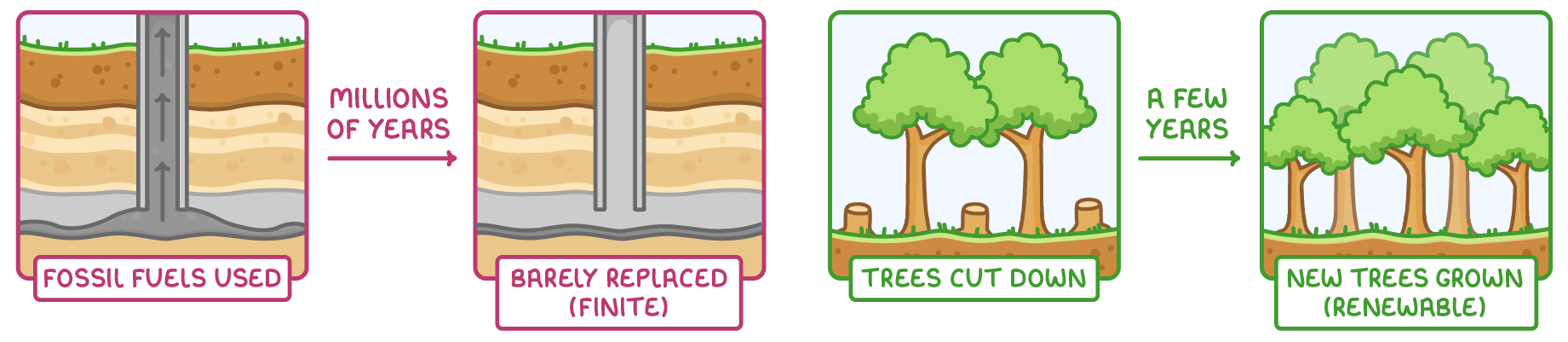
- Renewable resources form at least as fast as they're used, so they will not run out (e.g. timber, fresh water, food crops, solar and wind energy).
- Finite resources (or non-renewable resources) aren't formed quickly enough to replace what is used, so they will eventually run out (e.g. fossil fuels, nuclear fuels, and metal ores dug from the ground).
- Finite resources from the Earth, oceans, and atmosphere are processed to provide energy and useful materials.
Sustainable development
- Sustainable development is development that meets the needs of current generations without compromising the ability of future generations to meet their own needs.
- To be sustainable:
- Finite resources must not be used up so quickly that there's little left for future generations.
- Environmental damage must not be so great that it harms the lives of future generations.
The role of chemistry
- Chemists improve agricultural and industrial processes and develop new products.
- They develop routes that use fewer finite resources, require less energy, and produce less waste and environmental damage.
Worked example - Reading resource data
The table gives data for two natural resources, A and B. Which is renewable, and which is finite?
| Resource | Energy density | Time taken to form |
|---|---|---|
| A | 14.5 to 17.7 MJ/kg | 1 year |
| B | 40.1 to 44.8 MJ/kg | 108 years |
Step 1 - Identify the quantities and units
- Energy density is given in MJ/kg.
- Time taken to form is given in years.
Step 2 - Read off the values
- Resource A: 14.5 to 17.7 MJ/kg, 1 year.
- Resource B: 40.1 to 44.8 MJ/kg, 108 years.
Step 3 - Compare orders of magnitude
An order of magnitude is a factor of 10.
- Resource B takes 108 (100,000,000) years to form.
- Comparing 108 years to 1 year is a difference of eight orders of magnitude.
- Both energy densities are in the tens (the same order of magnitude).
Step 4 - Determine the category for each resource
- A resource taking 1 year to form is replaced as fast as it's used, so it's renewable.
- A resource taking 100,000,000 years to form is used up much faster than it's replaced, so it's finite.
Answer: Resource A is renewable and Resource B is finite.
TermDefinition
Renewable resourceA resource that forms at least as fast as it is used, so it will not run out.
Finite resourceA resource that is not formed quickly enough to replace what is used, so it will eventually run out.
Sustainable developmentDevelopment that meets the needs of current generations without reducing the ability of future generations to meet their own needs.
Key points to remember
How were these notes?