11.1 - Paper Chromatography & Rf Values
The technique
Aim
To separate the dyes in a set of inks or food colourings by paper chromatography, and to calculate an Rf value for each one.
Background
- Many inks and food colourings are mixtures of several dyes.
- In paper chromatography a solvent soaks up the paper and carries the dyes with it. Each dye spends a different amount of time dissolved in the solvent (the mobile phase) and stuck to the paper (the stationary phase), so the dyes travel different distances and separate.
- How far a dye travels depends on how far the solvent went, so the distance changes from run to run. Its Rf value, the distance moved by the dye divided by the distance moved by the solvent, stays the same for that dye in that solvent.
- So in this practical you separate the dyes, measure how far each one and the solvent travelled, and calculate an Rf value for each dye.
Method
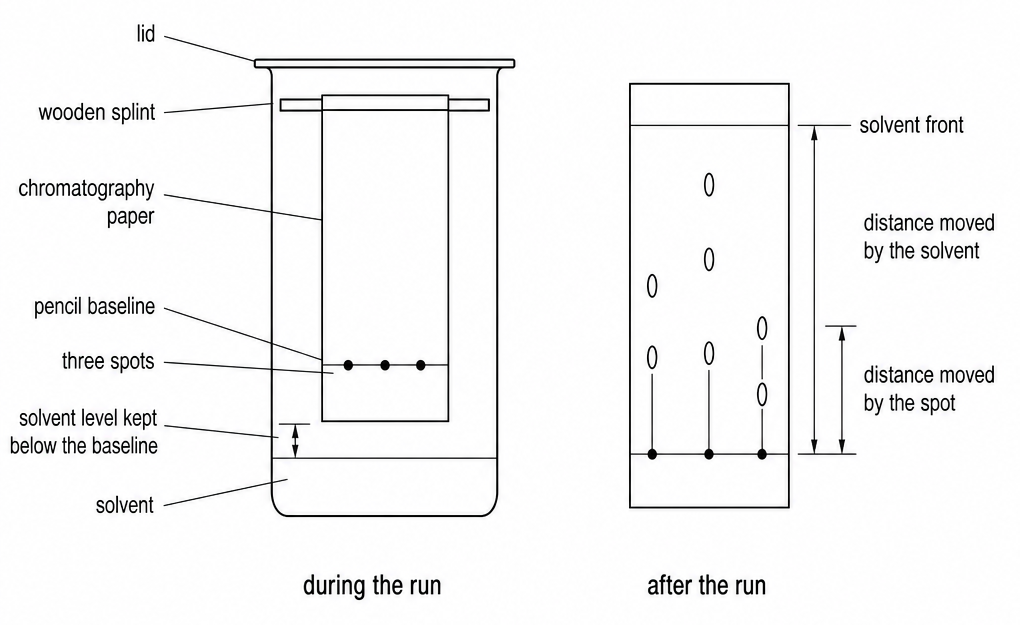
- Draw the baseline - Draw a pencil line about 2 cm from the bottom of the chromatography paper.
- Spot the samples - Use a capillary tube to put a small spot of each ink on the baseline, well apart and away from the edges, and label each one in pencil.
- Add the solvent - Pour the solvent, usually water, into a beaker to a depth of no more than 1 cm.
- Stand the paper in the solvent - The bottom edge dips into the solvent, the baseline stays above it, and the paper doesn't touch the sides of the beaker.
- Cover the beaker - Put a lid on, so the solvent doesn't evaporate from the paper as it rises.
- Mark the solvent front - When the solvent is about 1 cm from the top, take the paper out and mark how far the solvent reached in pencil, before it dries.
- Dry and measure - Let the paper dry, then measure the distance from the baseline to the solvent front, and from the baseline to the centre of each spot.
Safety
- Eye protection - Wear it throughout, and follow any extra instructions if you use a solvent other than water, since some are flammable.
- Capillary tubes - They're thin glass, so handle them carefully.
Worked example - Identifying dyes in a mixture
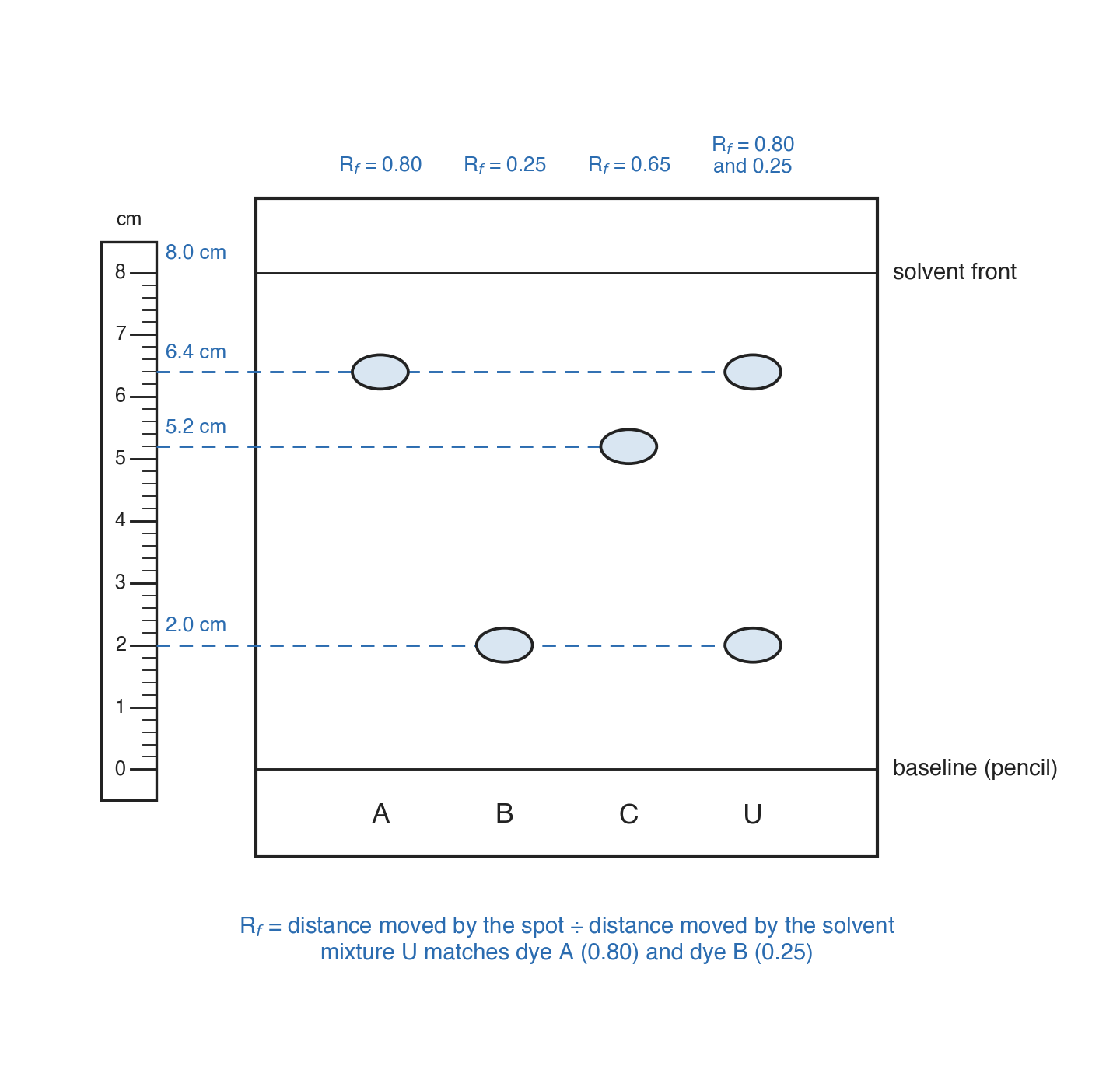
A student ran a chromatogram of three known food dyes, A, B, and C, and an unknown mixture, U, in the same solvent. The solvent front was 8.0 cm from the baseline. Dyes A, B, and C each gave one spot, at 6.4 cm, 2.0 cm and 5.2 cm. Mixture U gave two spots, at 6.4 cm and 2.0 cm.
Calculate the Rf value of each spot, then say which dyes are in mixture U and which samples are pure.
Step 1 - Find the distance moved by the solvent
The solvent moved 8.0 cm, from the baseline to the pencil line marking the solvent front.
Step 2 - Calculate the Rf of each known dye
Use this equation.
Give each answer as a decimal, not as a fraction.
Step 3 - Calculate the Rf of each spot in mixture U
- The spot at 6.4 cm has an Rf of 6.4 ÷ 8.0 = 0.80.
- The spot at 2.0 cm has an Rf of 2.0 ÷ 8.0 = 0.25.
Step 4 - Match the spots in U to the known dyes
A spot with the same Rf value as a known dye, in the same solvent, is most likely that dye. Mixture U's spots at 0.80 and 0.25 match dyes A and B, so U contains dyes A and B but not dye C.
Step 5 - Identify the pure samples
A pure substance gives a single spot. Dyes A, B, and C each gave one spot, so all three are pure. Mixture U separated into two spots, so it's a mixture.
Common exam questions
Question 1
Why is the baseline drawn in pencil rather than pen?
Pencil doesn't dissolve in the solvent, so the line stays where it was drawn. Ink would dissolve and run up the paper, adding extra spots to the chromatogram.
Question 2
Why must the level of the solvent be below the baseline?
If the solvent covers the baseline, the spots dissolve into the solvent in the beaker instead of travelling up the paper.
Question 3
A spot has not moved from the baseline. What does this show?
The substance is insoluble in the solvent used, so it stays on the paper. A different solvent might move it.
Question 4
A spot in a mixture has the same Rf value as a known dye. Does this prove they are the same substance?
Not on its own. Two different substances can have the same Rf value in one solvent. A match in a second, different solvent makes the identification much more certain.
Question 5
Why does an Rf value have no units?
It's one distance divided by another, both measured in the same units, so the units cancel.