2.8 - Diamond & Graphite
Diamond
- Allotropes are different structural forms of the same element in the same physical state. Diamond and graphite are allotropes of carbon.
- Diamond is a giant covalent structure - a vast network of atoms held together by covalent bonds.
Structure of diamond
- Every carbon atom forms four covalent bonds to four neighbouring carbon atoms.
- Each bond points towards the corner of a tetrahedron, forming a rigid three-dimensional lattice.
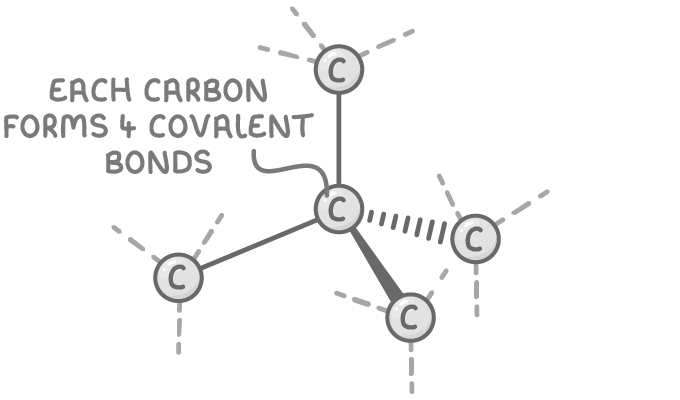
The wedge bond points towards you and the striped bond points away from you.
Properties of diamond
- Very hard - Every atom is locked in place by four strong covalent bonds in a rigid 3D lattice.
- Very high melting point - Breaking the huge number of strong covalent bonds throughout the structure requires a huge amount of energy.
- Does not conduct electricity - All four outer electrons are used in covalent bonds, so none are free to move and carry charge.
Uses of diamond
- Cutting tools - Its hardness makes it ideal for industrial drill bits and saw blades.
- Jewellery - It's lustrous and colourless.
Graphite
- Graphite is a giant covalent allotrope of carbon.
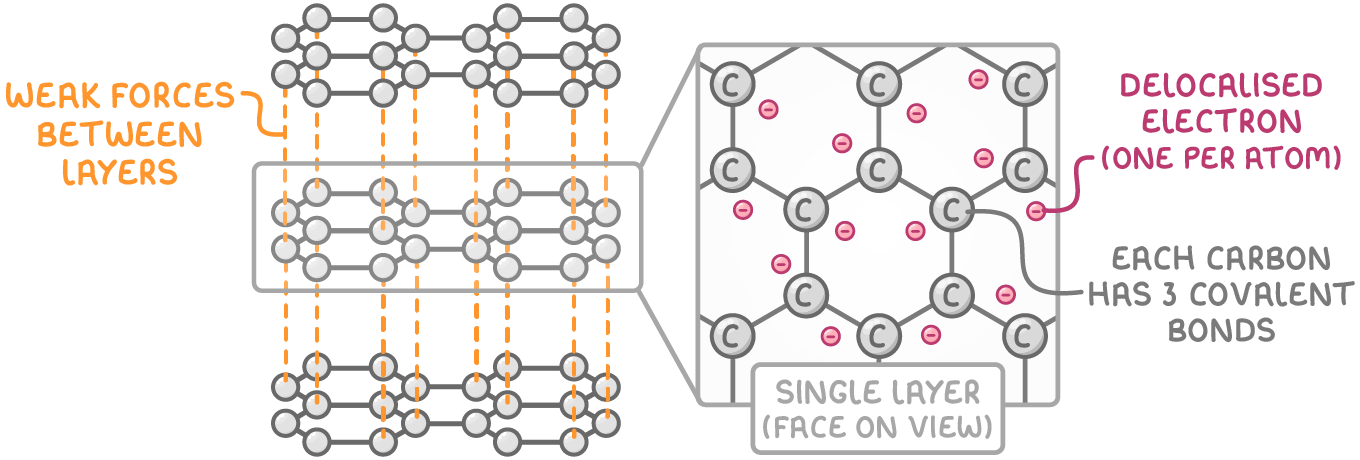
- Each carbon atom forms three covalent bonds, joining into flat sheets of hexagonal rings.
- These sheets stack on top of one another in layers.
Properties of graphite
- Soft and slippery - There are no covalent bonds between layers, only weak forces (van der Waals' forces), so the layers can slide over each other.
- Very high melting point - Breaking the huge number of strong covalent bonds within the layers requires a huge amount of energy.
- Conducts electricity and thermal energy - Each carbon uses only three of its four outer electrons in bonds, leaving one delocalised electron per atom that is free to move and carry charge along the layers.
Uses of graphite
- Lubricants and pencil lead - the weak forces between layers allow them to slide off easily.
- Electrodes - It conducts electricity and is unreactive.
TermDefinition
AllotropeOne of two or more forms of the same element in the same physical state, with the atoms arranged in a different structure, such as diamond and graphite.
Giant covalent structureA structure in which a very large number of atoms are joined by strong covalent bonds in a continuous network.
Delocalised electronAn electron that is not attached to a particular atom or bond and is free to move through a structure.
Key points to remember
How were these notes?