4.5 - Acids, Bases & the pH Scale
Acids, bases and alkalis in water
- An acid dissolves in water to give a solution containing hydrogen ions, H+(aq). These make the solution acidic, with a pH below 7.
- A base reacts with an acid to form a salt, usually with water. Common bases are metal oxides, metal hydroxides, and ammonia.
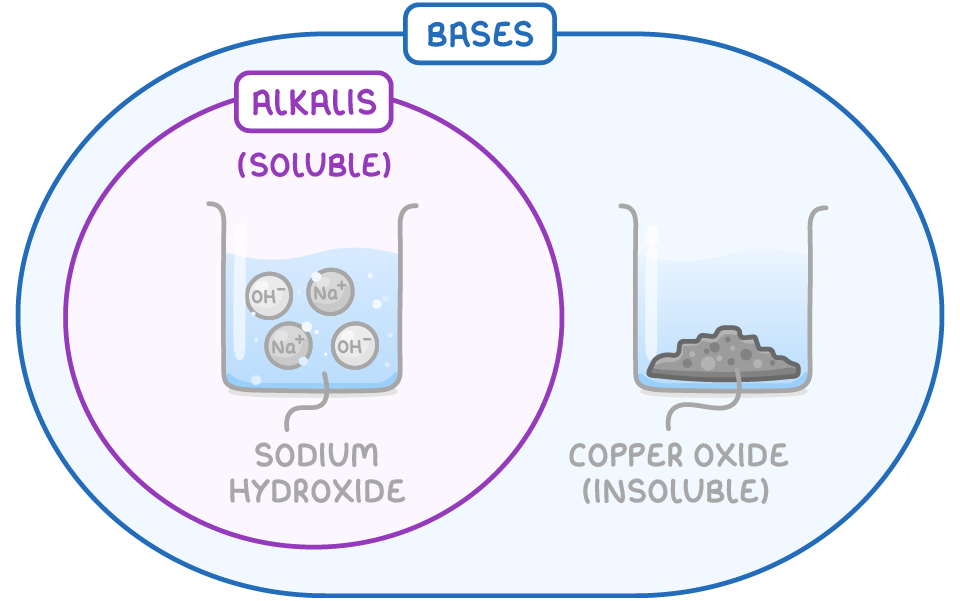
- An alkali is a base that dissolves in water. It forms a solution containing hydroxide ions, OH-(aq), with a pH above 7.
- Every alkali is a base, but only soluble bases are alkalis:
- Sodium hydroxide is soluble, so it's a base and an alkali.
- Copper oxide is insoluble, so it's a base but not an alkali.
Neutralisation
The reaction between an acid and a base is called neutralisation:
acid + base → salt + water
- When just enough acid and base react, they cancel each other out to form a neutral solution at pH 7.
- When an acid reacts with an alkali, the hydrogen ions from the acid join with the hydroxide ions from the alkali to form water molecules.
The pH scale and measuring pH
The pH scale measures how acidic or alkaline a solution is, running from 0 to 14:
- Below 7 - Acidic (pH 0 to 3 is strongly acidic, pH 4 to 6 is weakly acidic)
- Exactly 7 - Neutral (pure water is neutral)
- Above 7 - Alkaline (pH 8 to 10 is weakly alkaline, pH 11 to 14 is strongly alkaline)
Indicators
- An indicator is a dye that changes colour depending on the pH of the solution.
- Universal indicator is a mixture of dyes that changes colour gradually across the whole pH scale:
- Red (strongly acidic) → orange/yellow (weakly acidic) → green (neutral) → blue (weakly alkaline) → purple (strongly alkaline).
- It comes as a solution or as pH paper, and the colour is matched against a printed colour chart to find the approximate pH.
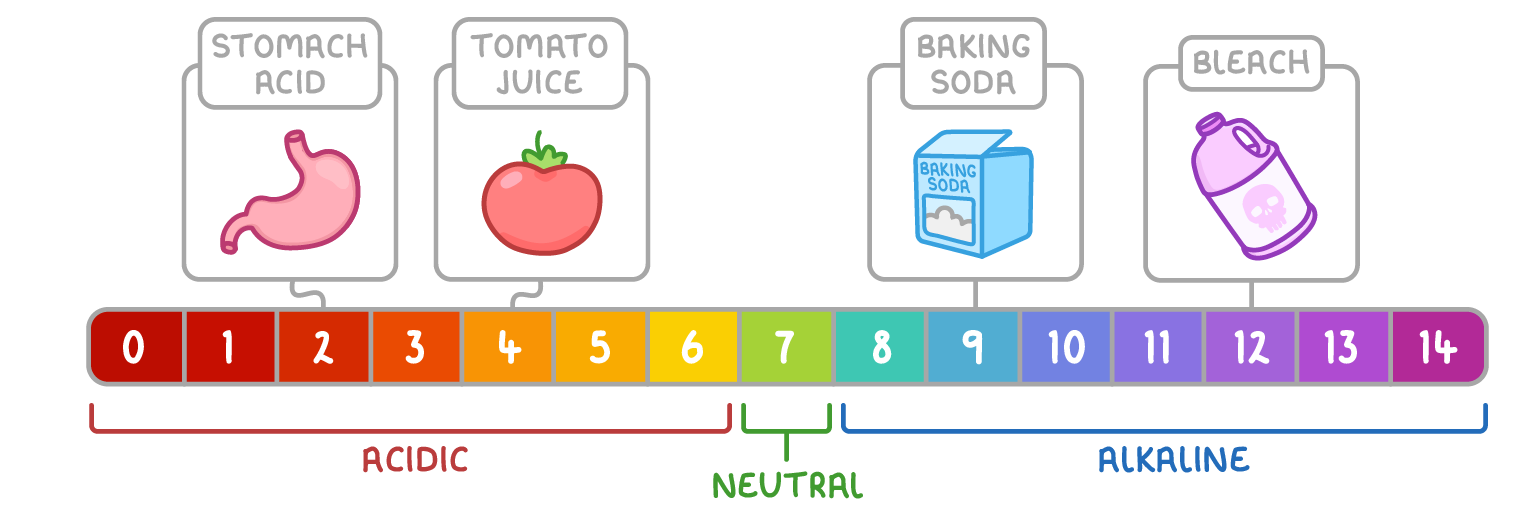
Everyday substances are shown at their typical pH values.
pH probe and meter
- A pH probe connects to a digital pH meter to display the pH as a number, usually to one or two decimal places.
- This is more precise than an indicator because it gives a numerical reading and removes human judgment in matching colours.
TermDefinition
AcidA substance that releases hydrogen ions when dissolved in water, forming a solution with a pH below 7.
BaseA substance that neutralises an acid, such as a metal oxide, a metal hydroxide or ammonia. It reacts with an acid to form a salt, usually along with water.
AlkaliA base that dissolves in water to form a solution containing hydroxide ions, with a pH above 7.
NeutralisationThe reaction between an acid and a base to form a salt and water.
pH scaleA measure of how acidic or alkaline a solution is, running from 0 to 14.
IndicatorA dye that changes colour depending on the pH of the solution it is in.
Key points to remember
How were these notes?