1.4 - Elements, Compounds & Mixtures
Elements, compounds and mixtures
Every substance is an element, a compound, or a mixture.
Elements
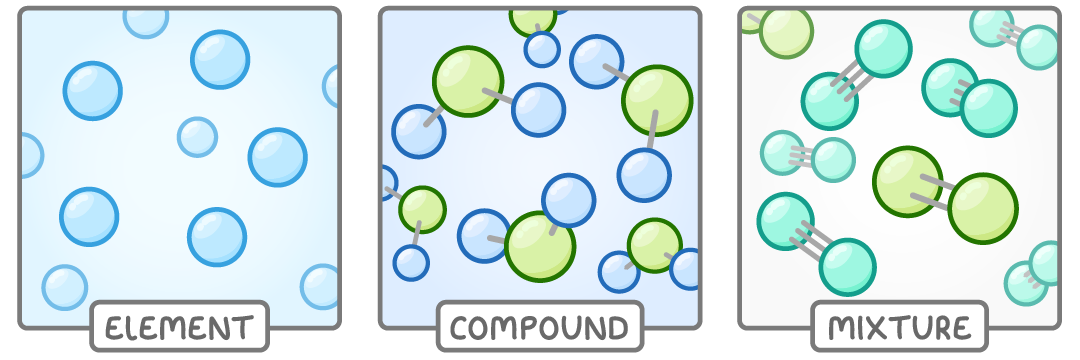
- An element is a substance made of only one type of atom.
- It can't be broken down into anything simpler by chemical means.
- There are about 100 different elements, all shown in the periodic table.
- The atoms in an element can exist as separate atoms (e.g. helium) or joined in pairs (e.g. oxygen gas, O2).
Compounds
- A compound is a substance made of two or more different elements chemically combined in fixed proportions.
- The atoms are held together by chemical bonds, so separating a compound back into its elements requires a chemical reaction.
- A compound has a fixed chemical formula (e.g. H2O always has two hydrogen atoms for every oxygen atom).
- A compound's properties are very different from the elements it's made from:
- Iron is a magnetic metal and sulfur is a yellow powder.
- Heated together, they react to form iron sulfide - a dull grey solid that isn't magnetic.
Mixtures
- A mixture contains two or more substances that are not chemically combined.
- There are no chemical bonds between the substances, so each keeps its own properties.
- The parts of a mixture can be separated by physical means (such as filtration or distillation) without a chemical reaction.
- Air and sea water are examples of mixtures.
Molecules
- A molecule is a particle made of two or more atoms joined together by covalent bonds.
- A molecule containing two atoms is a diatomic molecule.
- The atoms in a molecule can be the same element (e.g. oxygen, O2) or different elements (e.g. water, H2O).
- Single, separate atoms (like helium) are not molecules.
Molecule vs compound
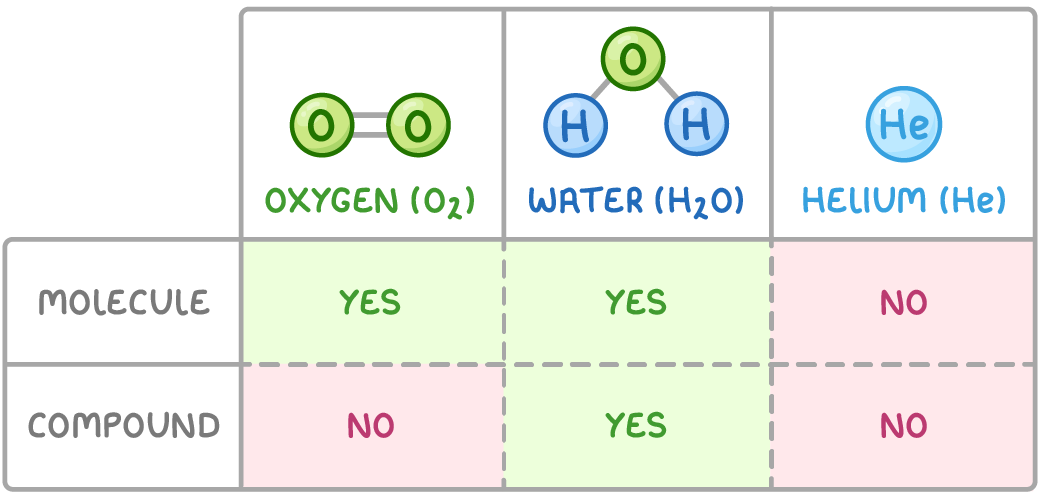
- A particle is a molecule if it has two or more atoms covalently bonded together.
- A substance is a compound if it contains two or more different elements.
- For example:
- Water (H2O) is both a molecule and a compound.
- Oxygen gas (O2) is a molecule, but it is not a compound because it contains only one type of atom.
Classifying substances
From a chemical formula
- One element symbol → it's an element (e.g. He, O2).
- Two or more different element symbols → it's a compound (e.g. H2O, NaCl).
- A mixture contains multiple substances, so it can't be written as a single chemical formula.
From a particle diagram
- All particles alike:
- Element if each particle contains only one type of atom.
- Compound if each particle contains two or more different types of atom.
- More than one kind of particle → mixture.
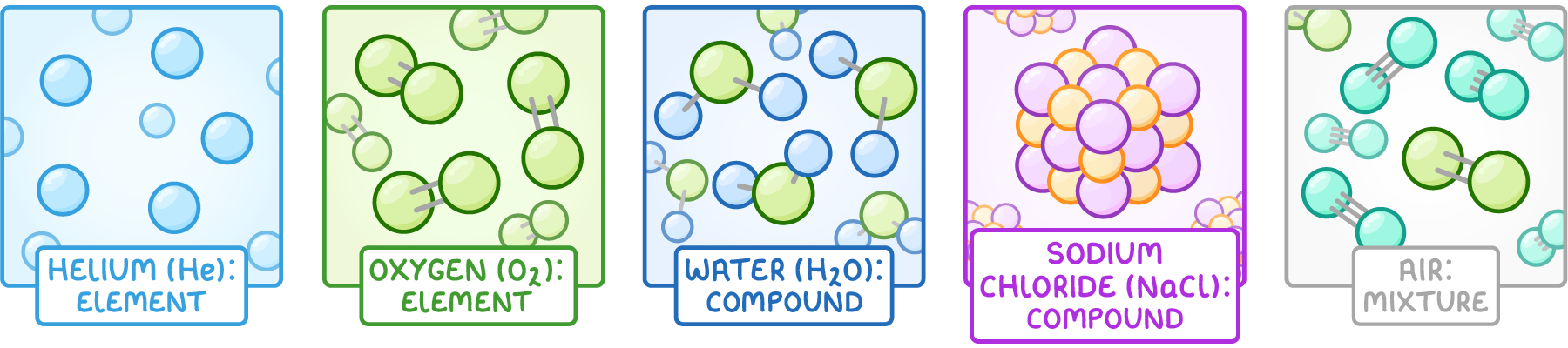
| Substance | What it contains | Class |
|---|---|---|
| Helium, He | Single atoms of one type | Element |
| Oxygen, O2 | Bonded pairs of one type of atom | Element |
| Water, H2O | Hydrogen and oxygen chemically joined | Compound |
| Sodium chloride, NaCl | Sodium and chlorine chemically joined | Compound |
| Air | Different substances not chemically joined | Mixture |
TermDefinition
ElementA substance made of only one type of atom.
CompoundA substance made of two or more different elements chemically combined in fixed proportions.
MixtureA combination of two or more substances that are not chemically combined.
MoleculeA particle made of two or more atoms joined together by covalent bonds.
Diatomic moleculeA molecule made of two atoms covalently bonded together, such as H2, O2 or Cl2.
Key points to remember
How were these notes?