1.1 - Atoms & Subatomic Particles
The atom and its particles
- Every substance is made of atoms. An atom is the smallest part of an element that can exist.
- Atoms are extremely small - far too small to see even under a microscope.
- Each atom is built from three kinds of particle: protons, neutrons, and electrons.
The nucleus and the shells
- At the centre of the atom is the nucleus, which holds the protons and neutrons packed tightly together.
- The nucleus carries a positive charge (because of the protons), and almost the whole mass of the atom is concentrated there.
- The electrons move around the nucleus in shells (also called energy levels).
- Most of an atom is empty space, with the outermost electrons setting how big the atom is.

The three particles compared
The particles are compared on a relative scale, where a proton and a neutron each have a mass of 1 and a proton has a charge of +1.
| Particle | Relative mass | Relative charge | Where it is |
|---|---|---|---|
| Proton | 1 | +1 | In the nucleus |
| Neutron | 1 | 0 | In the nucleus |
| Electron | Very small (about 0.0005) | -1 | In the shells around the nucleus |
Why atoms are neutral
- An atom always has the same number of electrons as protons.
- The total negative charge on the electrons matches the total positive charge on the protons, so they cancel out.
The size of atoms and their nucleus
- An atom has a radius of about 0.1 nanometres, which is 1 × 10⁻¹⁰ m.
- The nucleus is far smaller: its radius is less than 1/10,000 of the radius of the whole atom, about 1 × 10-14 m.
Atomic number, mass number and nuclide notation
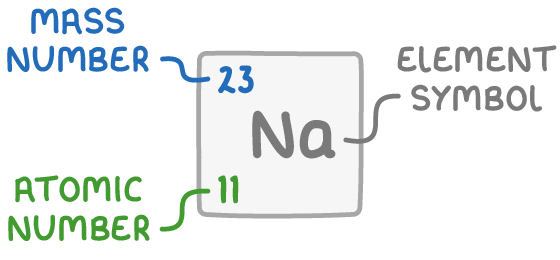
- Atomic number (also called the proton number) - The number of protons in the atom. Every atom of a given element has the same number of protons.
- Mass number (also called the nucleon number) - The total number of protons and neutrons in the nucleus.
Nuclide notation
- In nuclide notation (or the nuclear symbol), the mass number is above and the atomic number is below, to the left of the element's symbol.
- Example: sodium is written (11 protons, and 23 protons and neutrons in total).
Working out the particles
- Number of protons = atomic number
- Number of neutrons = mass number - atomic number
- Number of electrons = number of protons (in a neutral atom)
Worked example - The particles in an atom
An atom of iron is written . How many protons, neutrons, and electrons does it contain?
Step 1 - Read the two numbers off the symbol
-
Atomic number (lower number) = 26
-
Mass number (upper number) = 56
Step 2 - Find the protons
Number of protons = the atomic number = 26 protons
Step 3 - Find the neutrons
Number of neutrons = mass number - atomic number:
56 - 26 = 30 neutrons
Step 4 - Find the electrons
This is a neutral atom, so number of electrons = number of protons = 26 electrons
Check: protons + neutrons should equal the mass number, and 26 + 30 = 56.
Counting the particles in an ion
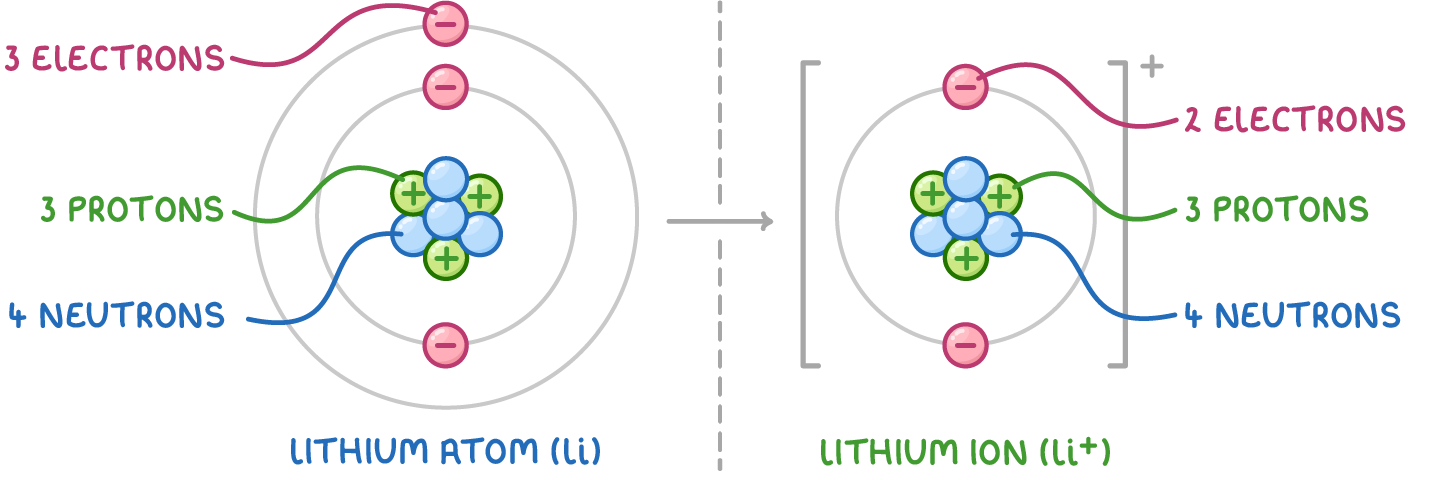
- An ion is an atom, or group of atoms, that has lost or gained electrons.
- Because the number of protons and electrons no longer match, an ion carries an overall charge.
- An atom that loses electrons becomes a positive ion (more protons than electrons).
- An atom that gains electrons becomes a negative ion (more electrons than protons).
The nucleus stays the same
- Only electrons are lost or gained, so the nucleus is untouched.
- An ion has the same number of protons and neutrons as the atom it came from.
- In nuclide notation, the charge is written at the top right, as in or the lithium ion shown below.
Working out the particles in an ion
- Number of protons = atomic number
- Number of neutrons = mass number - atomic number
- Number of electrons = atomic number minus the charge (for positive ions) or plus the charge (for negative ions)
For a chloride ion, : 17 protons, 35 - 17 = 18 neutrons, and 17 + 1 = 18 electrons.
TermDefinition
AtomThe smallest part of an element that can exist.
NucleusThe tiny, positively charged centre of an atom, which contains the protons and neutrons and almost all of the atom's mass.
Atomic numberThe number of protons in the nucleus of an atom.
Mass numberThe total number of protons and neutrons in the nucleus of an atom.
IonA charged particle formed when an atom or a group of atoms loses or gains electrons.
Key points to remember
How were these notes?