4.4 - Ionic & Half Equations
Writing an ionic equation for a displacement
- When a more reactive metal reacts with a solution of a less reactive metal's compound, it displaces the less reactive metal.
- For example, an iron nail in copper(II) sulfate solution forms iron(II) sulfate solution and copper:
- Fe(s) + CuSO4(aq) → FeSO4(aq) + Cu(s)
An ionic equation shows only the particles that actually change during a reaction.
The method
-
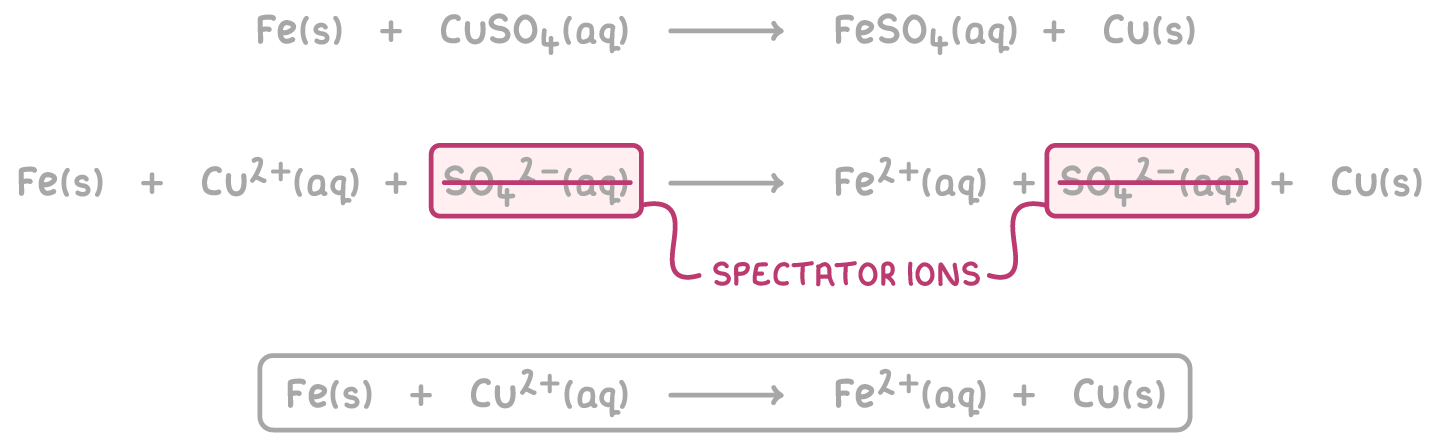
Start from the balanced symbol equation, with state symbols.
- Fe(s) + CuSO4(aq) → FeSO4(aq) + Cu(s)
-
Rewrite every dissolved (aq) ionic compound as its separate ions. Solids, liquids, and gases are left whole.
- Fe(s) + Cu2+(aq) + SO42-(aq) → Fe2+(aq) + SO42-(aq) + Cu(s)
-
Cross out spectator ions - Ions that appear unchanged on both sides and take no part in the reaction (here, SO42-(aq)).
-
Write what's left as the ionic equation.
- Fe(s) + Cu2+(aq) → Fe2+(aq) + Cu(s)
Check the atoms and the total charge (2+ on each side).
Reading the electron transfer
- Iron loses two electrons to form Fe2+, so it's oxidised.
- Copper ions (Cu2+) gain two electrons to form copper atoms, so they're reduced.
- Every displacement is a redox reaction: the metal atom is oxidised and the metal ion in solution is reduced.
Worked example - Zinc and copper(II) sulfate
Zinc is added to copper(II) sulfate solution. Write the ionic equation for the reaction.
Step 1 - Balanced symbol equation with state symbols
Zn(s) + CuSO4(aq) → ZnSO4(aq) + Cu(s)
One zinc, one copper and one sulfate on each side.
Step 2 - Split every dissolved ionic compound into its ions
CuSO4(aq) becomes Cu2+(aq) and SO42-(aq); ZnSO4(aq) becomes Zn2+(aq) and SO42-(aq). The zinc and copper metal are solids, so they stay whole.
Zn(s) + Cu2+(aq) + SO42-(aq) → Zn2+(aq) + SO42-(aq) + Cu(s)
Step 3 - Cross out spectator ions
SO42-(aq) is unchanged on both sides, so it's deleted.
Step 4 - Write the ionic equation
Zn(s) + Cu2+(aq) → Zn2+(aq) + Cu(s)
Check the atoms and the charge: one zinc and one copper on each side, and a total charge of 2+ on each side.
Combining half equations into a redox equation
A half equation (also called an ion-electron equation) shows one half of a redox reaction: either the substance being oxidised or the substance being reduced.
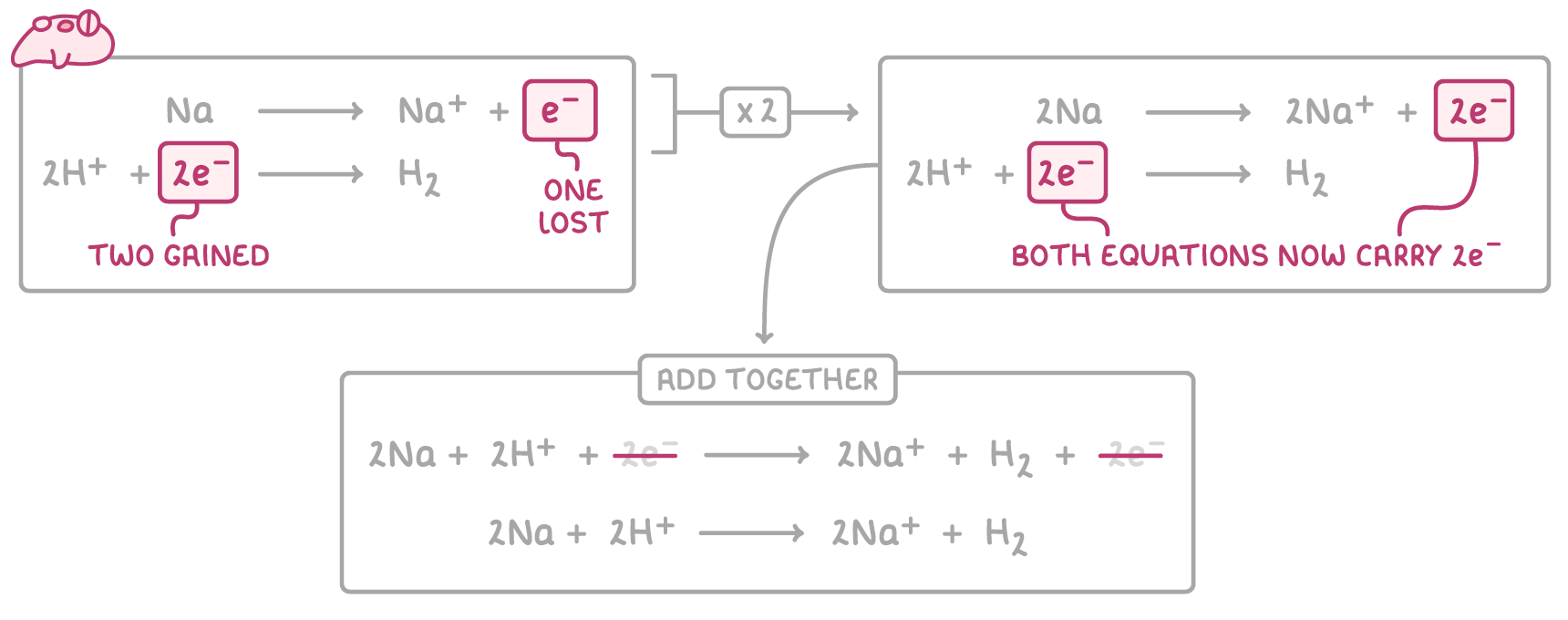
Na → Na+ + e- (oxidation: electrons lost, written on the right)
2H+ + 2e- → H2 (reduction: electrons gained, written on the left)
Adding two half equations together
- In an overall reaction, the number of electrons lost must equal the number of electrons gained.
- Multiply one or both half equations so they contain the same number of electrons, then add them together so the electrons cancel out completely.
Worked example - Combining two half equations
Potassium reacts with a dilute acid, the potassium being oxidised and the hydrogen ions reduced. Combine the two half equations into one redox equation.
Step 1 - Write the two halves and count the electrons
K → K+ + e-
2H+ + 2e- → H2
The potassium equation has one electron and the hydrogen equation has two, so they won't cancel as they stand.
Step 2 - Multiply so the electron counts match
Doubling everything in the potassium equation gives two electrons on each side:
2K → 2K+ + 2e-
2H+ + 2e- → H2
Step 3 - Add the two equations together
Everything on the left of both arrows goes left; everything on the right goes right:
2K + 2H+ + 2e- → 2K+ + 2e- + H2
Step 4 - Cancel the electrons
They now appear in the same number on both sides:
2K + 2H+ → 2K+ + H2
Check it: two potassiums and two hydrogens on each side, and a total charge of 2+ on each side.
Step 5 - Interpretation
The potassium lost electrons, so it was oxidised, and the hydrogen ions gained them, so they were reduced. Cancelling the electrons is simply the record that every electron the potassium lost was taken by a hydrogen ion. If the electrons won't cancel, step 2 wasn't finished.