3.6 - Concentration of Solutions
Concentration and the g/dm3 formula
- A solution forms when a substance dissolves in a liquid:
- Solute - The substance that dissolves
- Solvent - The liquid it dissolves in
- Solution - The mixture of solute and solvent
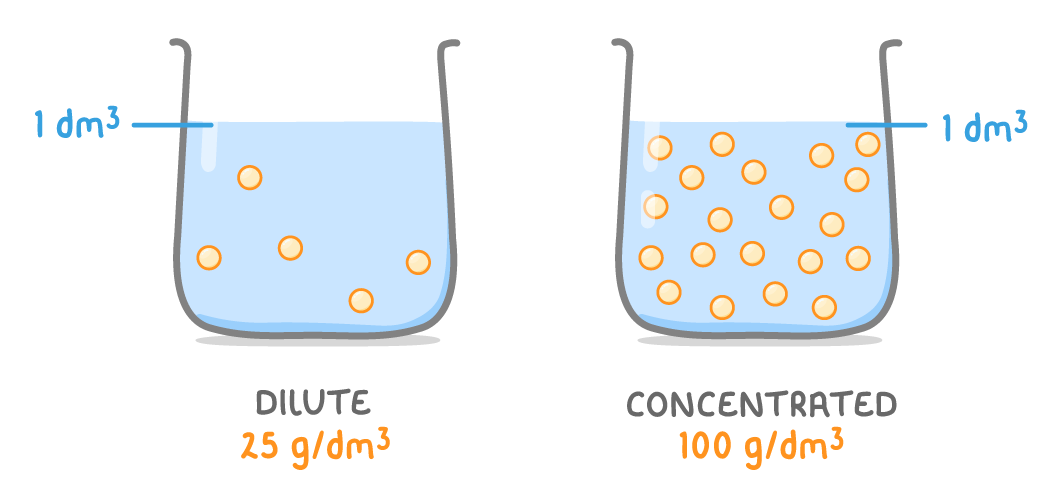
- Concentration is a measure of how much solute is dissolved in a given volume of solution.
- More solute in the same volume makes a solution more concentrated; more solvent for the same solute makes it more dilute.
Measuring volume in dm3
- 1 dm3 = 1,000 cm3 = 1 litre
- To convert cm3 to dm3, divide by 1,000.
Formula for concentration in g/dm3
Where:
- Concentration is in grams per cubic decimetre (g/dm3)
- Mass of solute is in grams (g)
- Volume of solution is in cubic decimetres (dm3)
Worked example - Mass of solute in a solution
A solution of sodium chloride has a concentration of 12.5 g/dm3. Calculate the mass of sodium chloride dissolved in 175 cm3 of this solution.
Step 1 - Identify the values
- Concentration = 12.5 g/dm3
- Volume of solution = 175 cm3
Step 2 - Convert the volume to dm3
The concentration is a mass per cubic decimetre, so the volume must also be in dm3 (1,000 cm3 = 1 dm3):
175 cm3 = 175 ÷ 1,000 = 0.175 dm3
Step 3 - Rearrange the formula
Mass of solute = concentration × volume of solution
Step 4 - Substitution and calculation
Mass of solute = 12.5 × 0.175 = 2.1875 g
Step 5 - Round the answer
The concentration and volume are both given to three significant figures, so:
Mass of sodium chloride = 2.19 g
TermDefinition
SolutionThe mixture formed when a solute dissolves in a solvent.
SoluteThe substance that dissolves in a liquid to form a solution.
SolventThe liquid in which a solute dissolves to form a solution.
ConcentrationA measure of how much of a substance is present in a given volume, usually how much solute is dissolved in a given volume of solution.
Key points to remember
How were these notes?