11.7 - Analysing & Purifying a Water Sample
The experiment
Aim
To compare the purity of three water samples from different sources by testing their pH and measuring the dissolved solids they contain, then to purify a sample by distillation and test how pure the distillate is.
Background
- A pure substance is a single element or a single compound, with nothing else mixed in with it.
- Water from a tap, the rain, or the sea usually has substances dissolved in it.
- Distillation separates water from the solids dissolved in it.
- You can't see what's dissolved in water, but you can measure its pH, evaporate it and weigh the solid left behind, and check its boiling point.
- So in this practical you test the pH and dissolved solids of three water samples, then distil each one and check how close the distillate is to pure water.
Variables
- Independent variable - Which water sample is tested.
- Dependent variable - The pH, the mass of dissolved solids in a measured volume, and the boiling point of the distillate.
- Control variables - The volume of water tested, how the basin is heated and cooled before weighing, and the balance used.
Method
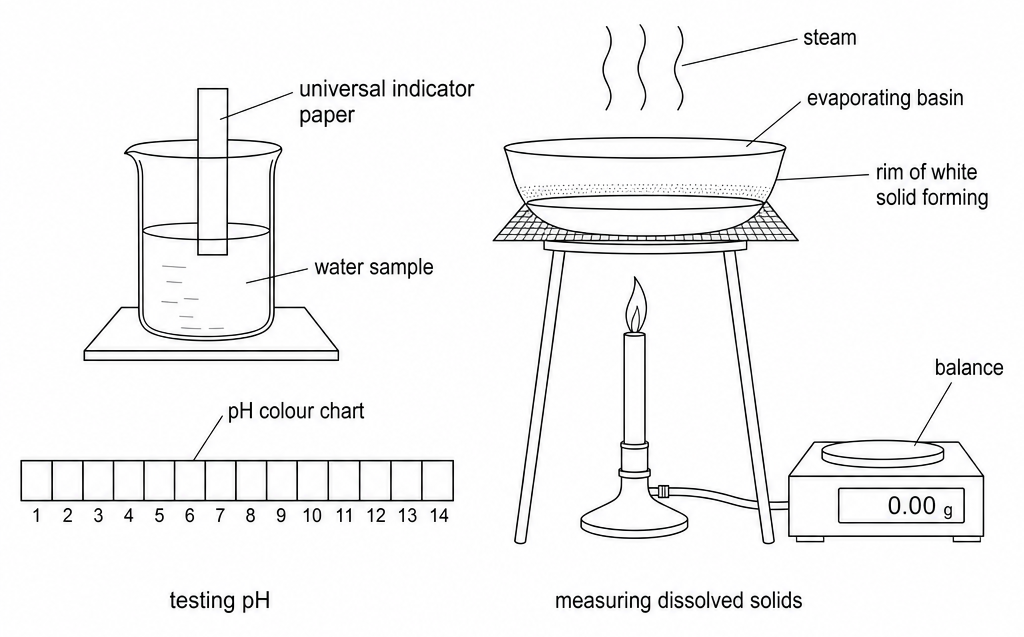
- Test the pH - Test each water sample with universal indicator paper or a pH probe, and record the pH.
- Weigh an empty evaporating basin - Record its mass to three decimal places.
- Evaporate a measured volume - Pour 10 cm3 of one sample into the basin, and heat it gently on a tripod and gauze until all the water has evaporated and only dry solid is left.
- Cool and weigh again - Let the basin cool completely, then weigh it. The mass of dissolved solids is the second mass minus the first.
- Repeat for each sample - Use the same volume each time, and clean and dry the basin between samples.
- Distil each sample - Use simple distillation apparatus to distil some of the sample, and collect the distillate.
- Measure the boiling point - Heat the distillate, and record the temperature at which it boils.
- Evaporate a drop of the distillate - On a watch glass, and look for any solid left behind.
Safety
- Eye protection - Wear it throughout.
- Hot basin - Move it with tongs.
- Suck-back - Keep the end of the delivery tube at least 2 cm clear of the collected distillate, so it can't be drawn back into the hot flask.
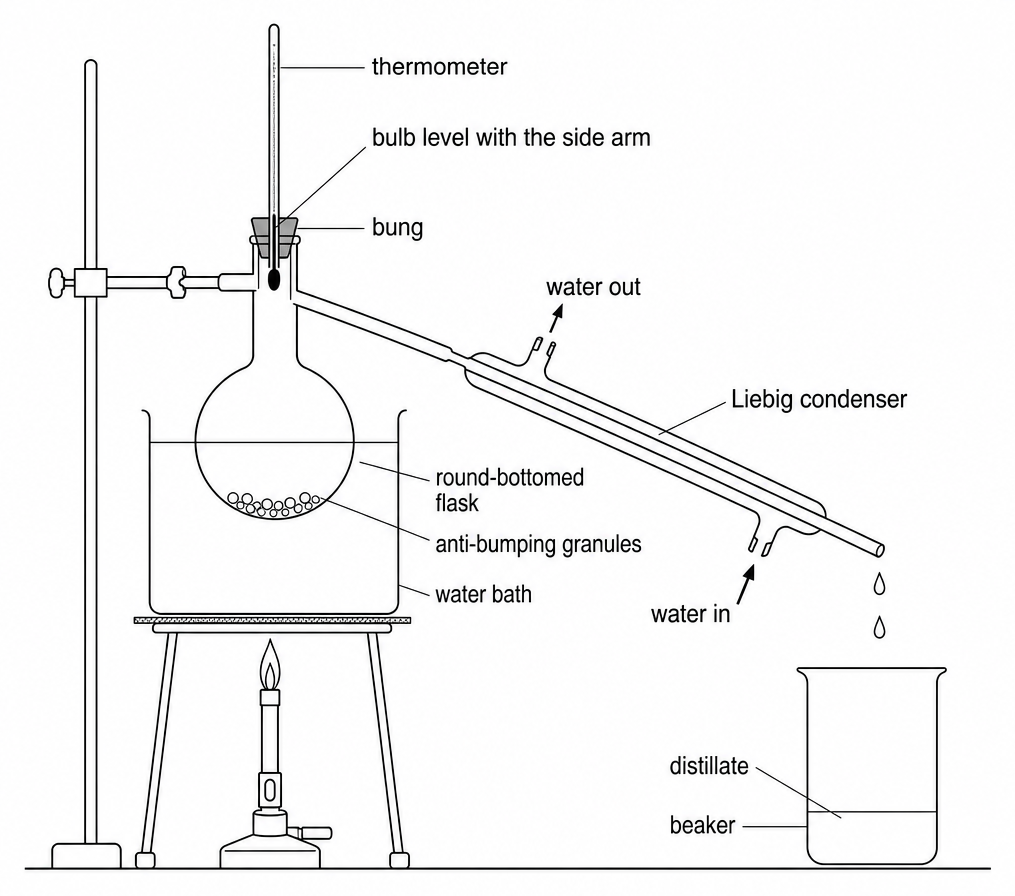
The thermometer bulb must sit level with the side arm to read the vapour's temperature.
Worked example - Comparing water sample purity
A student tested 10 cm3 of three water samples, A, B, and C, for pH and dissolved solids. They then distilled some of each sample and measured the boiling point of the distillate.
| Sample | pH | Mass of dissolved solids in 10 cm3 (g) | Boiling point of distillate (°C) |
|---|---|---|---|
| A | 7.5 | 0.015 | 100 |
| B | 7.0 | 0.002 | 100 |
| C | 8.0 | 0.320 | 100 |
Scale each sample's dissolved solids to 100 cm3, identify which sample is closest to pure water, and explain why potable water isn't necessarily chemically pure.
Step 1 - Scale each mass to 100 cm3
100 cm3 is 10 times 10 cm3, so multiply each mass by 10.
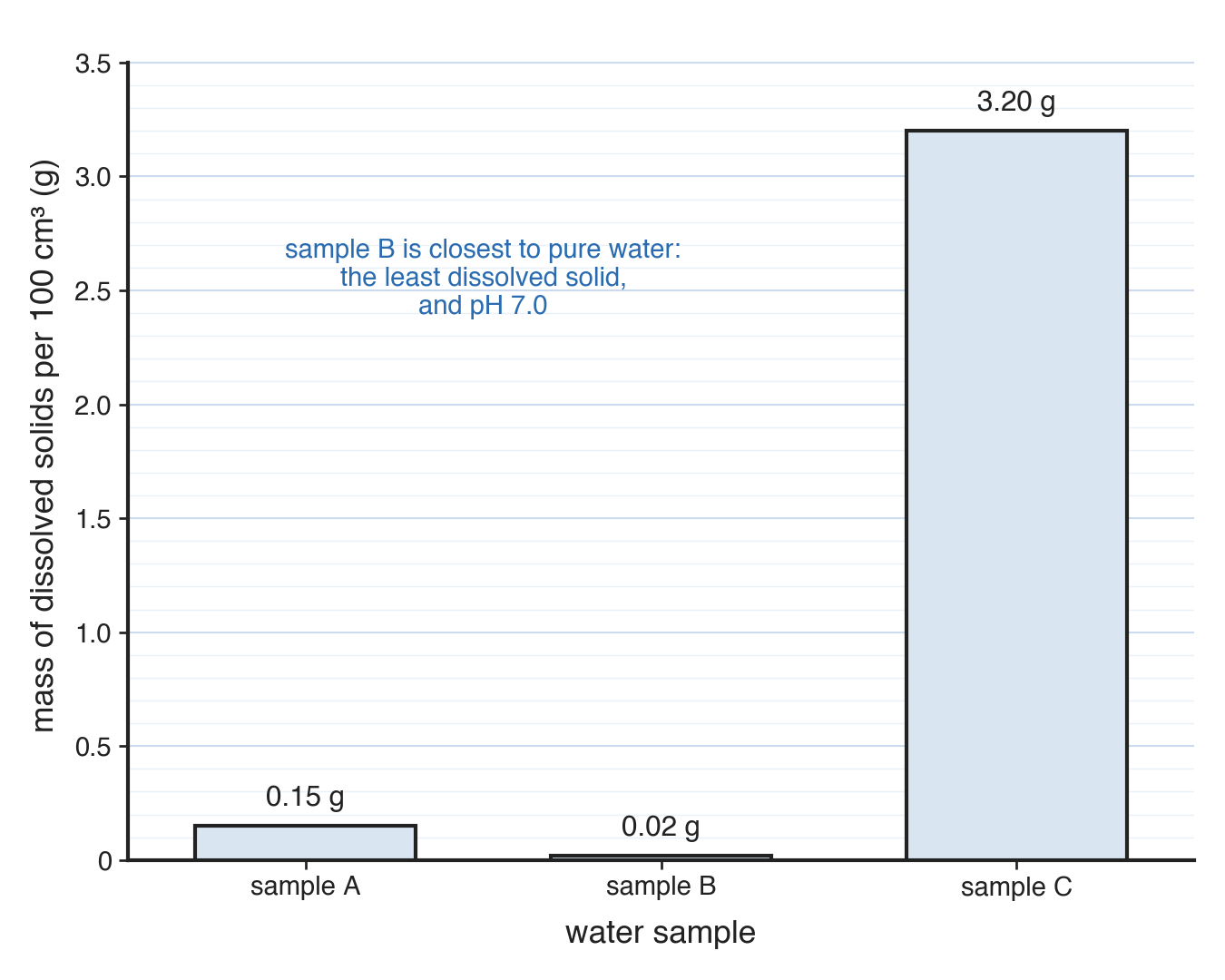
- Sample A has 0.015 × 10 = 0.15 g in 100 cm3.
- Sample B has 0.002 × 10 = 0.02 g in 100 cm3.
- Sample C has 0.320 × 10 = 3.20 g in 100 cm3.
Step 2 - Compare the pH values
Pure water has a pH of 7.0. Sample B is neutral, at pH 7.0. Sample A is slightly alkaline, at pH 7.5, and sample C is more alkaline, at pH 8.0.
Step 3 - Identify the sample closest to pure water
Sample B is closest to pure water, because it has a pH of 7.0 and the least dissolved solid, 0.02 g per 100 cm3.
Step 4 - Compare the distillates
All three distillates boiled at 100 °C. This shows distillation separated the water from the dissolved solids in all three samples.
Step 5 - Explain why potable water isn't pure water
Potable water is water that's safe to drink. It often contains small amounts of dissolved mineral ions, so it isn't chemically pure. Chemically pure water contains nothing dissolved in it at all.
Common exam questions
Question 1
Why is the same volume of each water sample used in the dissolved solids test?
So the masses of dissolved solid can be compared. A larger volume of the same water would leave more solid behind.
Question 2
Why should the evaporating basin cool before it's weighed the second time?
A hot basin warms the air around it, and the rising warm air makes the balance reading inaccurate. It could also burn you.
Question 3
Why is the boiling point of the distillate measured?
A pure liquid boils at a fixed temperature. A distillate that boils at a steady 100 °C is behaving like pure water, and one that boils at a different or changing temperature still has something dissolved in it.
Question 4
Why is a drop of the distillate evaporated, as well as measuring its boiling point?
It's a second check for dissolved solids. If the distillate were still impure, a solid would be left behind when the water evaporated.
Question 5
Suggest why the sea water sample gives a much larger mass of dissolved solids than the other samples.
Sea water contains a high concentration of dissolved salts, mainly sodium chloride, so evaporating it leaves far more solid behind.