4.9 - Electrolysis - Aqueous Solutions
What forms in an aqueous electrolysis
- A dissolved ionic compound has ions that are free to move, so its solution can be electrolysed without melting it.
- Water breaks up slightly into hydrogen and hydroxide ions:
- H2O(l) ⇌ H+(aq) + OH-(aq)
- This means four kinds of ion are present: the positive and negative ions of the dissolved compound, plus H+ and OH- from the water.
- At each electrode, only one of the two competing ions is discharged to form an element, while the other stays in solution.
- Inert electrodes (such as platinum or graphite) are used so they don't react.
Three example solutions
- Dilute sulfuric acid contains H+, SO42- and OH-. Hydrogen forms at the cathode and oxygen at the anode. OH- is discharged in preference to SO42-, so water is decomposed.
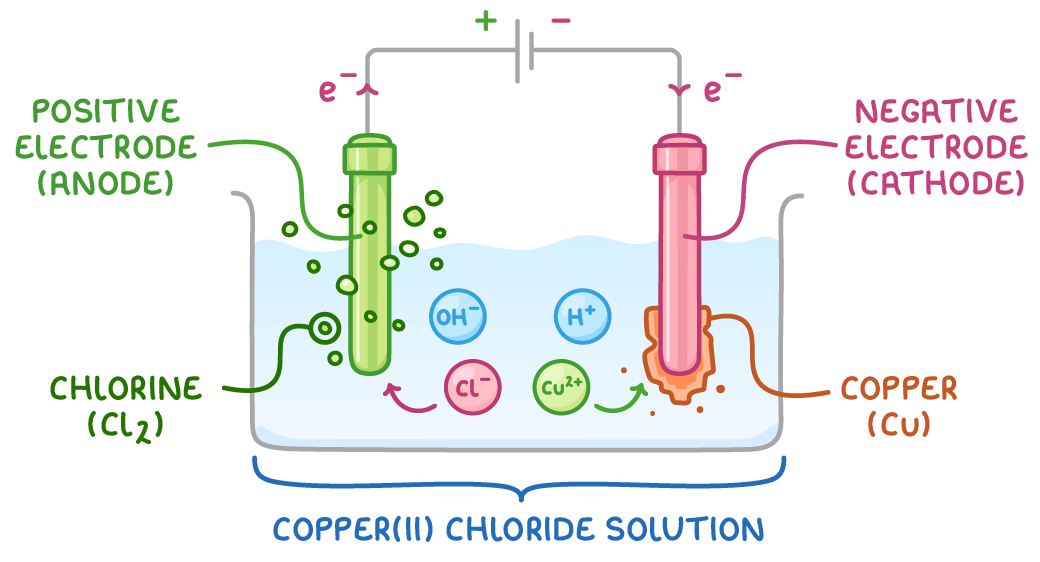
- Copper(II) chloride contains Cu2+, Cl-, H+ and OH-. Copper is deposited at the cathode and chlorine forms at the anode.
- Concentrated sodium chloride contains Na+, Cl-, H+ and OH-. Hydrogen forms at the cathode and chlorine at the anode. Na+ and OH- stay in solution, leaving sodium hydroxide.
| Solution | Ions present | At the cathode | At the anode | Left in the solution |
|---|---|---|---|---|
| Dilute sulfuric acid | H+, SO42-, OH- | Hydrogen | Oxygen | Sulfate ions |
| Copper(II) chloride | Cu2+, Cl-, H+, OH- | Copper | Chlorine | Water, as the compound is used up |
| Concentrated sodium chloride | Na+, Cl-, H+, OH- | Hydrogen | Chlorine | Sodium hydroxide |
Industrial use of sodium chloride electrolysis
Electrolysing concentrated sodium chloride produces three useful products:
- Sodium hydroxide - Used to make soap.
- Chlorine - Used for bleach and plastics.
- Hydrogen - Used as a fuel.
The discharge rules at each electrode
At the cathode
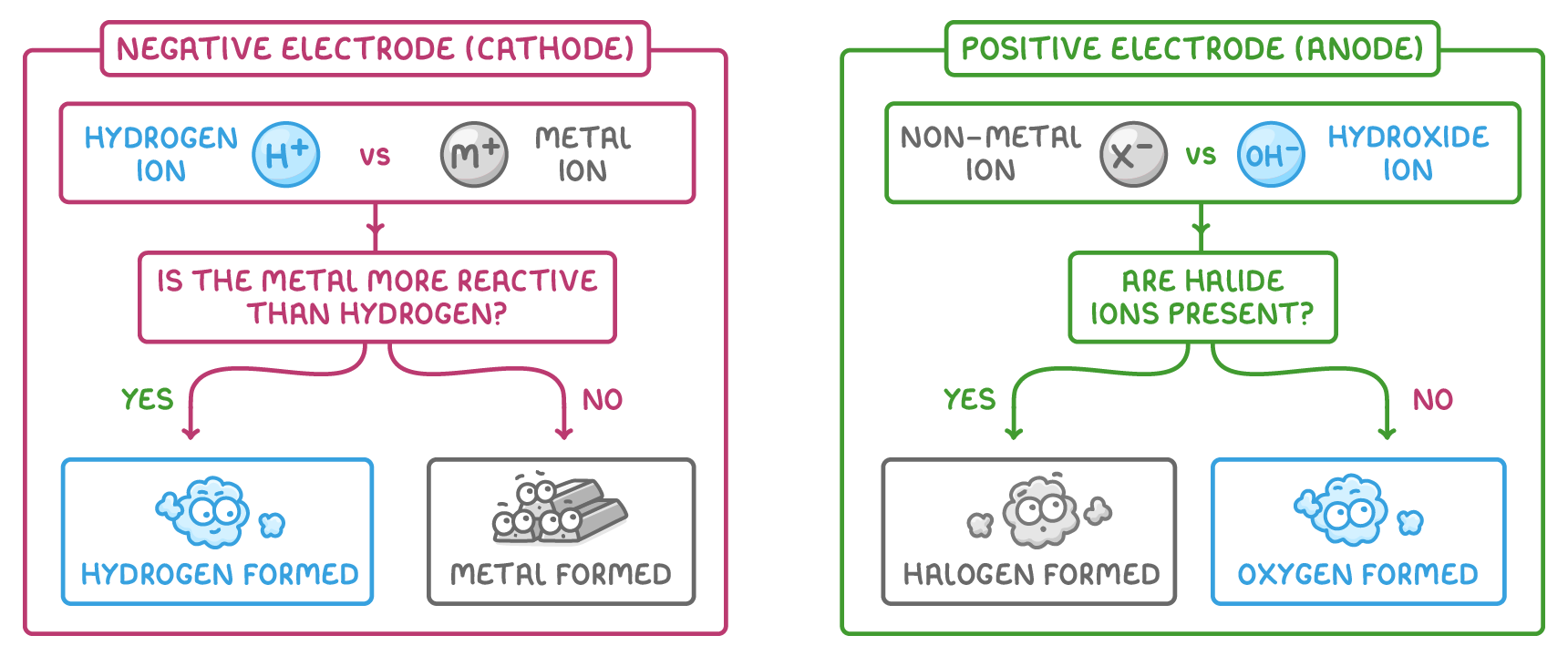
- The positive ions are the metal ion and the hydrogen ion (H+).
- The ion of the less reactive element is discharged:
- If the metal is more reactive than hydrogen, hydrogen gas is produced.
- If the metal is less reactive than hydrogen, the metal is deposited.
At the anode
The negative ions are the non-metal ion and the hydroxide ion (OH-):
- If halide ions (Cl-, Br-, I-) are present in a concentrated solution, the halogen (chlorine, bromine, or iodine) is formed.
- If no halide is present (or if the solution is very dilute), oxygen is formed from the hydroxide ions. Sulfate and nitrate ions are not discharged.
Worked example - Products of potassium bromide
Predict the products of electrolysing concentrated potassium bromide solution, and what is left in the beaker.
Step 1 - List every ion present
- From potassium bromide: K+ and Br-
- From the water: H+ and OH-
Step 2 - Work out the cathode product
- The positive ions are K+ and H+.
- Potassium is more reactive than hydrogen, so hydrogen ions are discharged.
- Hydrogen gas is formed at the cathode.
Step 3 - Work out the anode product
- The negative ions are Br- and OH-.
- Bromide is a halide and the solution is concentrated, so bromide ions are discharged.
- Bromine is formed at the anode, turning the solution around it orange-brown.
Step 4 - Check what is left behind
K+ and OH- are not discharged and remain in solution, forming potassium hydroxide (making the solution alkaline).
Worked example - Electrolysing copper(II) sulfate
Copper(II) sulfate solution is electrolysed using inert carbon electrodes. What forms at each electrode, and what happens to the solution?
Step 1 - List every ion present
- From copper(II) sulfate: Cu2+ and SO42-
- From water: H+ and OH-
Step 2 - Apply the cathode rule
- Copper is less reactive than hydrogen, so copper ions are discharged.
- A pinkish-brown layer of copper builds up on the cathode.
Step 3 - Apply the anode rule
- There are no halide ions, so hydroxide ions are discharged.
- Oxygen gas bubbles off at the anode.
Step 4 - Identify what happens to the solution
As Cu2+ ions are removed from the solution and deposited on the cathode, the blue colour of the solution gradually fades.
TermDefinition
Inert electrode