3.1 - Mitosis
What mitosis is and why the body needs it
- Most body cells have a nucleus holding genetic material as chromosomes - coiled-up lengths of DNA.
- Each chromosome carries many genes, and different genes control the development of different characteristics.
- Body cells normally carry two copies of each chromosome, one from each parent, which makes them diploid.
What mitosis produces
- Mitosis is a type of cell division in which one cell divides to produce two new cells (daughter cells).
- The daughter cells are genetically identical to each other and to the original parent cell - each has exactly the same chromosomes, and so the same genes.
- The chromosome number is kept constant: because the body cell is diploid, each daughter cell is also diploid, with the full set, and no genetic information is lost.
- The full number of chromosomes, counting both copies, is the diploid chromosome complement.
Why the body needs mitosis
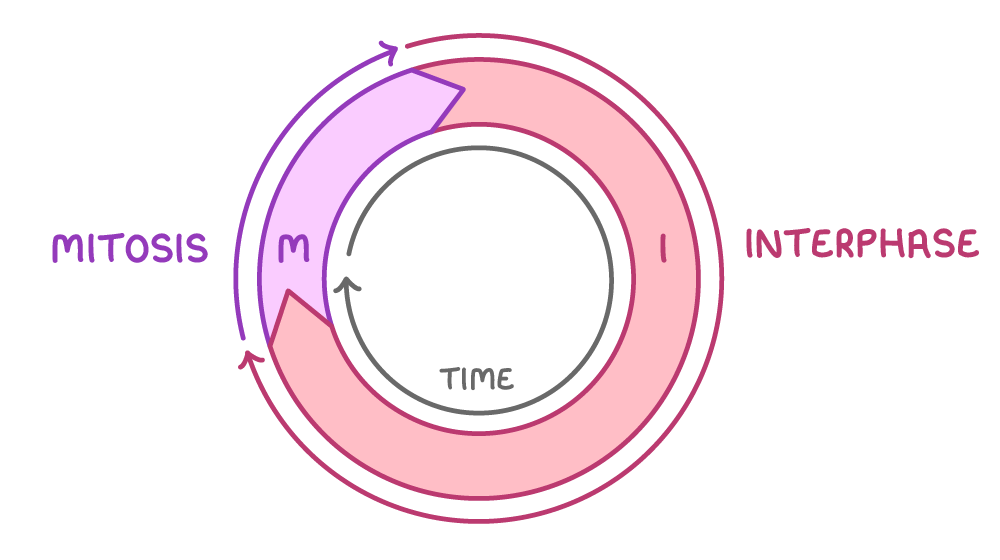
- Mitosis is the stage of a repeating sequence called the cell cycle at which the cell actually divides.
- Multicellular organisms use it to:
- Grow - By increasing the number of body cells
- Replace cells that have worn out or been damaged, repairing the tissue
- Mitosis is also how some organisms reproduce asexually, producing offspring genetically identical to the single parent.
The cell cycle
- The cell cycle is the repeating sequence a cell goes through: grow, copy its DNA, divide, and round again.
- A cell that isn't dividing has its DNA spread out in long strings.
- Before a cell can divide, it must prepare so there's enough of everything to share between the two new cells.
Preparing to divide
- The cell grows and increases the number of its sub-cellular structures, such as mitochondria and ribosomes, so there's enough for both new cells.
- It then duplicates its DNA, making one full copy for each new cell.
- The copied DNA forms X-shaped chromosomes, where each half is an exact copy of the other.
- Once its contents and DNA have been copied, the cell is ready for mitosis.
Interphase takes up most of the cycle
- The long growth-and-preparation period is called interphase.
- A cell spends most of its time in interphase, with mitosis only a small part of the cycle.
The stages of mitosis
- Before mitosis, the DNA is copied to form X-shaped chromosomes.
- Each X-shaped chromosome is made of two chromatids - identical copies of each other, joined together.
- Once its contents and DNA have been copied, the cell is ready for mitosis, which happens as a set sequence of events.
The sequence of mitosis
- The chromosomes condense, getting shorter and fatter, while the membrane around the nucleus breaks down and the chromosomes lie free in the cytoplasm.
- The chromosomes line up along the equator - the centre of the cell.
- Spindle fibres (fibres in the cell) pull the two chromatids of each chromosome apart, and the separated chromosomes move to opposite ends of the cell (the poles).
- A membrane forms around each set of chromosomes to make two new nuclei - the nucleus has divided.
- The cytoplasm and cell membrane divide to form two separate cells.

The daughter cells
- Each daughter cell contains exactly the same chromosomes as the other and as the parent cell.
- The cells are therefore genetically identical diploid cells.
- The diploid chromosome complement stays the same and no genetic information is lost.
TermDefinition
MitosisA type of cell division in which one cell divides to produce two genetically identical daughter cells.
DiploidDescribes a cell or nucleus that has two sets of chromosomes, one set from each parent.
InterphaseThe long stage of the cell cycle in which a cell grows and copies its DNA, ready to divide.
ChromatidOne of the two identical copies of a chromosome that form when the DNA is copied before a cell divides. The two chromatids are joined together.