5.9 - Absorption of Food
The villus and its adaptations
- The small intestine is adapted to absorb the products of digestion quickly and efficiently.
- It is very long, giving plenty of time to digest and absorb food before what's left reaches the end.
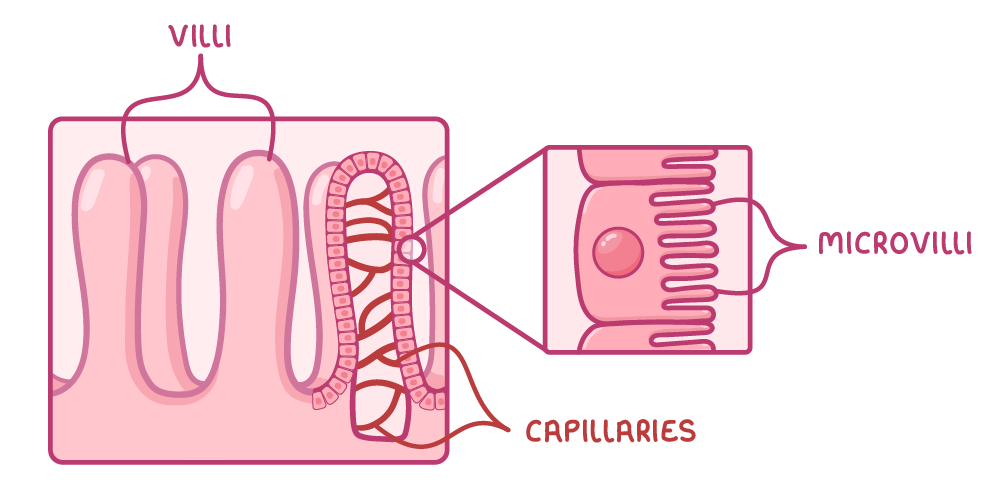
- Its inner wall has an enormous surface area - it is folded and covered in millions of tiny finger-like projections called villi.
- Each villus is a microscopic finger-like extension sticking out into the inside of the gut.
- The surface cells of each villus are themselves covered in even smaller projections called microvilli.
- Together, the length, folds, villi, and microvilli give a very large surface area, so a great deal of food can be absorbed at once.
- Most of this absorption takes place in the ileum, the last and longest part of the small intestine, whose inner wall is covered in villi.
A short diffusion distance
- A villus has a single, thin layer of surface cells - the wall is only one cell thick, and the cells have thin, permeable membranes.
- So the products of digestion have only a very short distance to travel from the gut into the blood, making absorption fast.
A rich blood supply
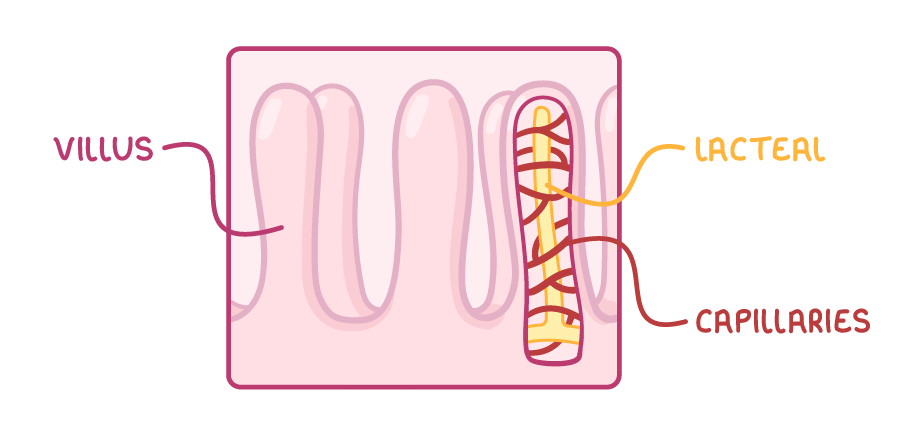
- Inside each villus is a network of blood capillaries lying very close to the thin surface.
- The capillaries absorb the soluble products - such as glucose and amino acids - and carry them away in the blood.
- This constant removal keeps the concentration inside the villus lower than in the gut, maintaining a steep concentration gradient that drives more products to diffuse in.
- Some absorption also uses active transport, which is why the surface cells contain many mitochondria to provide the energy needed.
The lacteal and fat absorption
- Inside each villus, alongside the network of blood capillaries, there is a single small vessel called a lacteal.
- The lacteal is part of the lymphatic system, not the blood system.
- Its job is to absorb the products of fat digestion - fatty acids and glycerol - which are taken up here rather than directly into the capillaries.
How absorbed fats reach the blood
- Once absorbed into the lacteal, the fatty acids and glycerol are carried away in a fluid called lymph.
- The lacteals from the many villi join up into larger lymph vessels.
- Eventually the lymph, along with the fats it carries, empties into the blood, returning the products of fat digestion to the bloodstream to be transported around the body.
Two transport routes compared
- Fatty acids and glycerol - Absorbed into the lacteal and carried away as lymph
- Glucose and amino acids - Take the more direct route through the blood capillaries
TermDefinition
VillusA microscopic finger-like extension sticking out into the inside of the gut.
LactealA single small vessel inside a villus that absorbs the products of fat digestion.