8.2 - Adaptations
Adaptations and their types
- An adaptation (or adaptive feature) is an inherited characteristic that helps an organism survive and reproduce in the environment where it normally lives.
- Because adaptations are inherited, they're passed on from parents to offspring.
- This means life can exist in a huge range of environments, from freezing poles to hot deserts.
- Adaptations are usually grouped into types.
Structural adaptations
- Also called morphological adaptations - features of an organism's body structure, such as its shape, size or colour.
- Example: the Arctic fox has white fur, so it's camouflaged against the snow. This helps it avoid predators and creep up on prey.
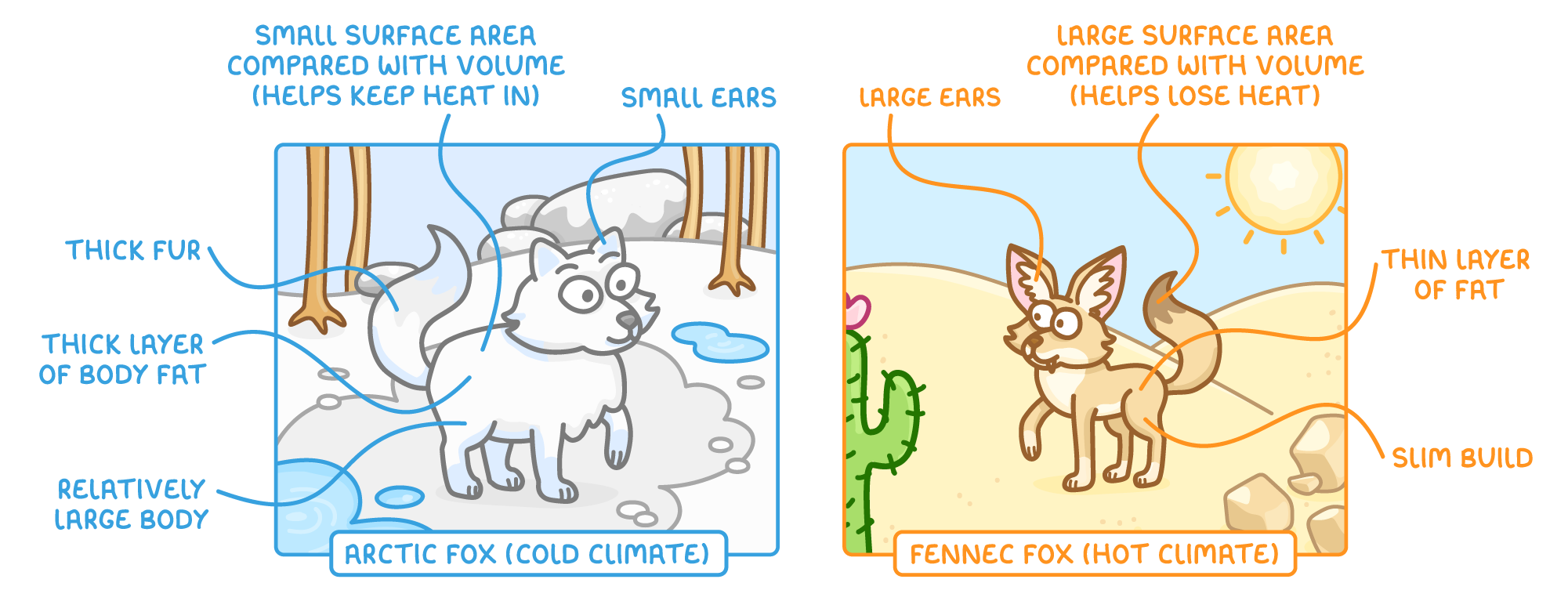
Animals in cold and hot places have contrasting features linked to keeping or losing heat:
| Cold-climate animals (e.g. Arctic fox, whale) | Hot-climate animals (e.g. fennec fox) |
|---|---|
| Thick layer of body fat or blubber | Thin layer of body fat |
| Thick fur | Large ears |
| Relatively large body, rounded compact shape, small features (e.g. small ears) | Slim build |
| Small surface area compared with volume - helps keep heat in | Large surface area compared with volume - helps lose heat |
Behavioural adaptations
- The ways in which an organism behaves.
- Living in groups - Antelope live in groups, so more eyes watch for predators, raising each individual's chance of survival.
- Migration - Many birds, such as swallows, migrate to warmer places in winter to avoid the cold and the shortage of food.
Working out an organism's adaptations
You can work out an organism's likely adaptations by thinking about:
- The environment it lives in - hot or cold, wet or dry, in water or on land.
- How it interacts with other organisms - for example, whether it needs to catch prey or escape from predators.
TermDefinition
AdaptationAn inherited characteristic that helps an organism survive and reproduce in the environment where it normally lives.