7.9 - Food Security
Food security and increasing yields
- The world's human population is rising quickly.
- To keep feeding everyone, the amount of food produced globally must rise as well - so that each person still has enough food that is safe to eat and has the right balance of nutrition.
- Food security - Reliable access to enough safe, nutritious food for everyone.
Why farmers focus on raising yield
- There is a limited amount of land available for farming, and it isn't possible to keep clearing more and more land for crops and livestock.
- So the main way to produce more food is to raise the yield - the amount of food produced from a given area of land in a given time.
- Farmers use a range of techniques to increase the yield of their crops and animals, producing more food from the same area without simply taking over more land.
Fertilisers
- Plants need mineral ions from the soil to grow properly:
- Nitrogen - For making proteins
- Phosphorus
- Potassium
- When a crop grows, it takes these mineral ions out of the soil, leaving the soil short of them for the next crop.
- Farmers add fertiliser to replace the missing mineral ions, or to provide extra - this boosts plant growth and so raises the crop yield.
Natural and artificial fertilisers
- Natural - Such as farmyard manure, slurry or compost. They release nutrients slowly and improve the soil.
- Artificial - Made industrially and usually rich in nitrogen, phosphorus and potassium (NPK). They're easy to apply and their mineral content is easy to measure accurately.
Problems caused by fertilisers
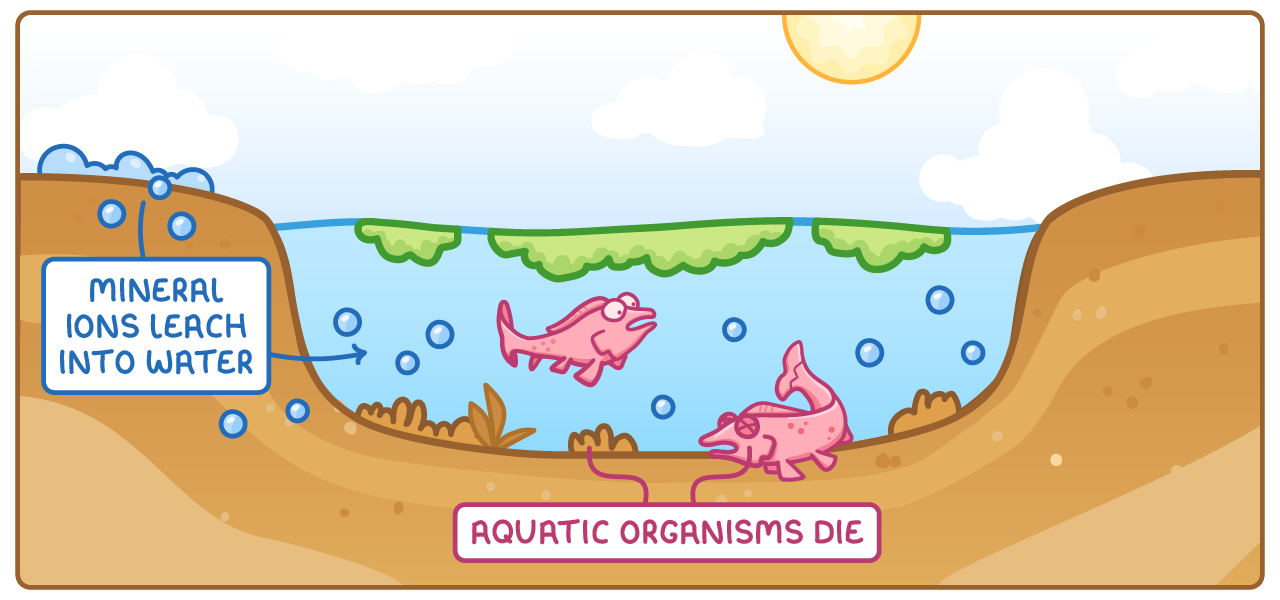
- If too much fertiliser is applied and it rains, the soluble mineral ions are easily washed off the fields.
- They leach into rivers and lakes, where the excess nutrients can lead to the death of aquatic organisms.
Pesticides and bioaccumulation
- Pesticides are a form of chemical pest control - sprayed onto crops to kill the pests that damage them.
- Fewer plants are lost, so the yield rises.
Types of pesticide
- Insecticides - Kill insects
- Herbicides - Kill weeds
- Fungicides - Kill fungi
Drawbacks of pesticides
- Often poisonous to humans, so they must be used carefully to keep the amount left in food below a safe level.
- Many harm wildlife that aren't pests, such as bees and ladybirds. This can leave less food for animals higher up the food chain.
Bioaccumulation
- Some pesticides are not broken down and persist in the bodies of organisms that take them in.
- When a sprayed plant is eaten, the pesticide passes into the animal, then into whatever eats that animal.
- At each stage up the food chain, the concentration of pesticide in the organisms increases.
- Eventually organisms at the top can receive a lethal dose.
- This build-up of a toxic substance in living organisms along a food chain is called bioaccumulation.
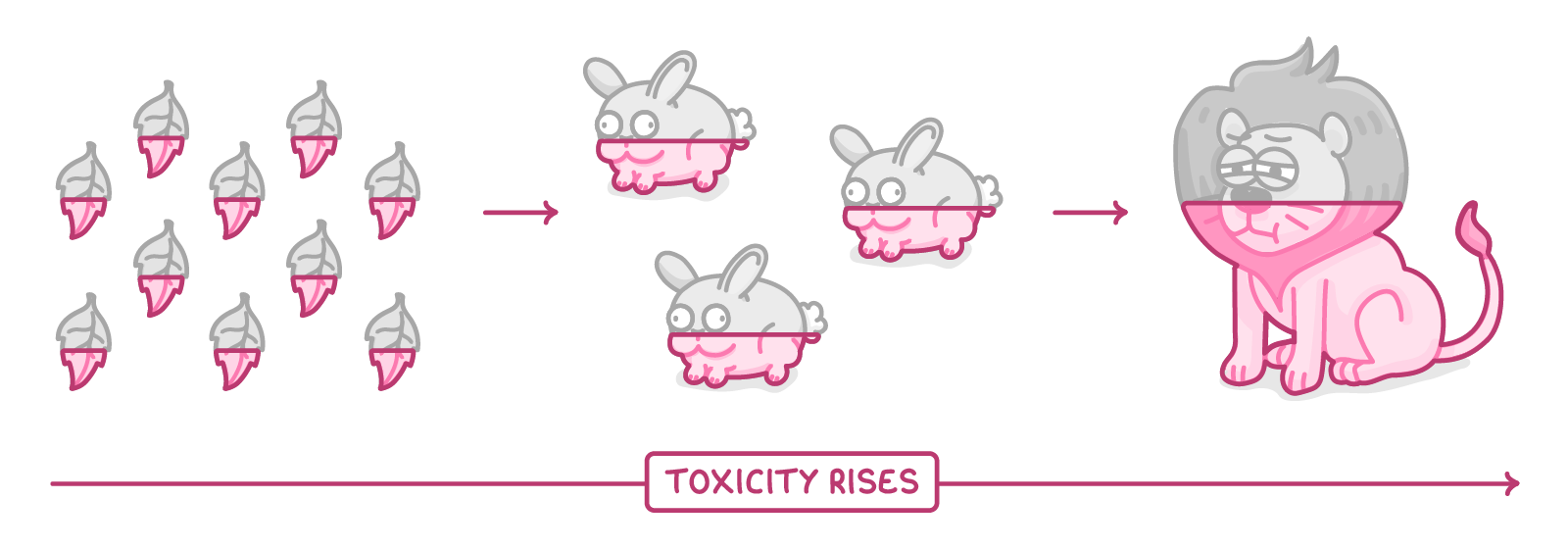
Pink shows the pesticide, more concentrated at each step up the food chain.
Reducing chemical use - Biological control and GM crops
- Farmers can cut down how much chemical pesticide and fertiliser they need to use in more than one way.
- Two approaches are biological control and growing genetically modified (GM) crops.
Biological control
- Biological control - Using other living organisms to reduce the numbers of a pest.
- This is done in two ways:
- Encouraging the pest's natural enemies that are already present
- Introducing new natural enemies
- Because no chemicals are involved, the crop is protected from pests without the pollution and food-chain build-up that come with pesticide use.
GM crops
Crops can be genetically modified in ways that reduce the chemicals a farm needs:
- Insect resistance - The crop resists insect pests, so the farmer needs to apply less pesticide.
- Efficient nutrient uptake - The crop takes up soil nutrients more efficiently, so the same yield can be grown with less fertiliser.
In these ways, GM crops act as an alternative to pesticides and a way of reducing the fertiliser a farm needs.
TermDefinition
Food securityReliable access to enough safe, nutritious food for everyone.
YieldThe amount of food or other useful product obtained, for example from a given area of land in a given time.
BioaccumulationThe build-up of a toxic substance in living organisms along a food chain, because it is not broken down or excreted.
Biological controlUsing a living organism, such as a predator or parasite, to reduce the numbers of a pest or pathogen.