4.8 - Kidneys - The Nephron
Ultrafiltration and selective reabsorption
Inside each nephron, urine is made in two stages: ultrafiltration, then selective reabsorption.
Stage 1 - Ultrafiltration
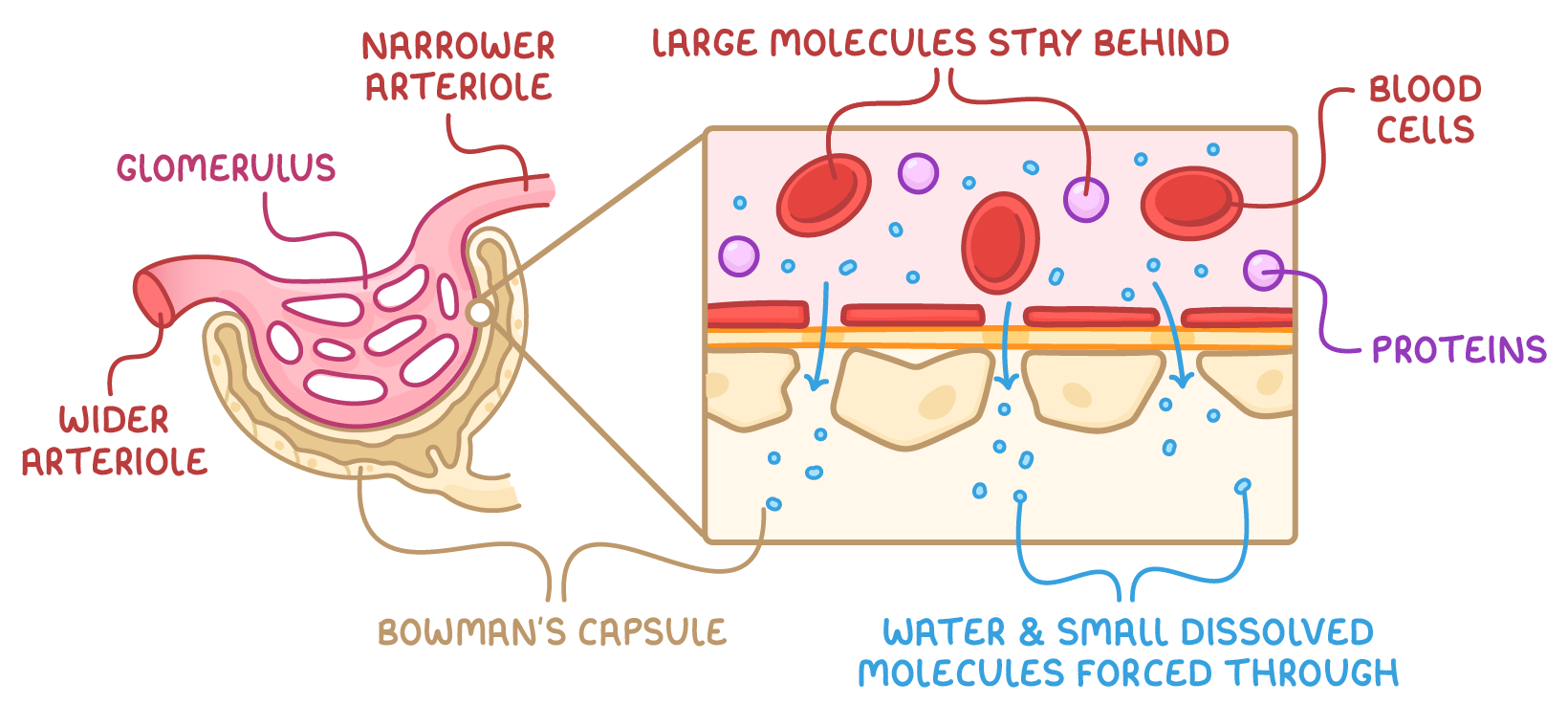
- Blood arriving at the glomerulus is under high pressure, because the arteriole leaving the glomerulus is narrower than the one entering it.
- This high pressure squeezes the liquid part of the blood - water, plus the small dissolved molecules glucose, urea, and ions - out of the glomerulus and into the Bowman's capsule.
- The membranes between the glomerulus and the capsule act like filters with very small holes:
- Larger molecules such as proteins, and the blood cells, are too big to be squeezed out and stay behind in the blood.
- The high-pressure filtration is called ultrafiltration, and the filtered liquid now in the Bowman's capsule is the glomerular filtrate.
Stage 2 - Selective reabsorption
- As the filtrate flows along the tubule, substances the body needs are taken back into the blood, while waste is left behind.
- It's called selective reabsorption because only some substances are reabsorbed:
| Substance | What happens | How |
|---|---|---|
| Glucose | All reabsorbed at the proximal convoluted tubule, so none is lost and it can be used in respiration | Active transport, against the concentration gradient |
| Ions | Sufficient reabsorbed; excess ions left in the filtrate | - |
| Water | Most reabsorbed, much of it from the collecting duct | Osmosis |
From filtrate to urine
- The substances not reabsorbed - urea, excess water, and excess ions - stay in the tubule and form urine.
- Urine passes through the collecting duct, into the ureter, and down to the bladder, where it's stored before being released through the urethra.
TermDefinition
Glomerulus
Bowman's capsule
Ultrafiltration
Selective reabsorption