7.10 - Testing a Leaf for Photosynthesis
The technique
Aim
To test a leaf for starch, and to use that test to show that light, carbon dioxide, and chlorophyll are each needed for photosynthesis.
Background
- A plant makes glucose by photosynthesis and quickly stores it as starch. So if part of a leaf contains starch, that part has been photosynthesising.
- Iodine solution is the test for starch. It stays orange-brown where there's no starch, and turns blue-black where there is.
- Photosynthesis needs light, carbon dioxide, and chlorophyll, the green pigment in leaves.
- You can't see photosynthesis happening in a leaf, but you can test the leaf for the starch it makes.
- So in this practical you stop one factor reaching a leaf, then test the leaf for starch. A part with no starch couldn't photosynthesise without that factor.
Method - Testing a leaf for starch
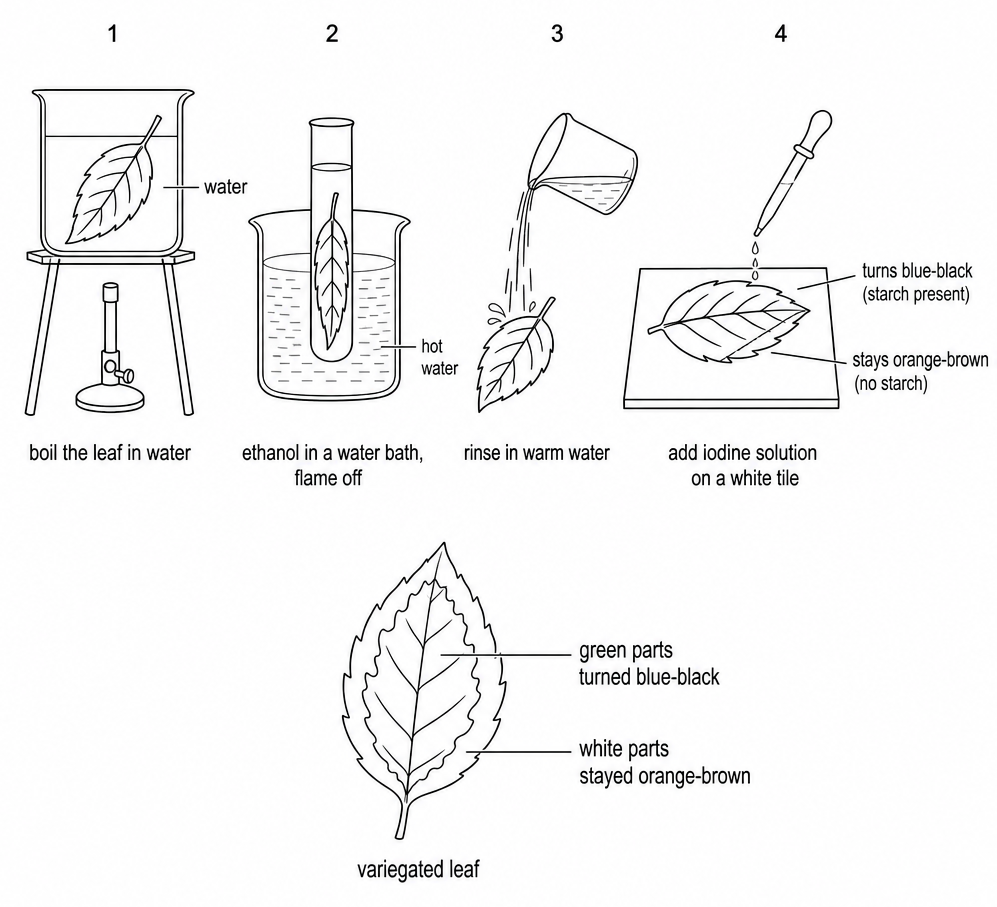
- Boil the leaf - Dip it in boiling water for about 30 seconds.
- Put the leaf in ethanol - Turn the Bunsen off. Put the leaf in a boiling tube of ethanol, and stand the tube in the hot water bath for a few minutes.
- Soften the leaf - Take the leaf out, which is now brittle, and dip it back in warm water.
- Add iodine - Spread the leaf on a white tile and add iodine solution. Where there's starch it turns blue-black, and where there's none it stays orange-brown.
Method - Showing what photosynthesis needs
First destarch the plant by leaving it in the dark for a day or two. Then set up one of these, leave the plant in the light, and test the leaf for starch.
- Light - Cover part of a leaf with aluminium foil or a black card stencil. Afterwards only the uncovered part turns blue-black, and the covered part stays orange-brown. So light is needed.
- Carbon dioxide - Seal a leaf, still on the plant, in a flask with soda lime or sodium hydroxide solution, which absorbs the carbon dioxide from the air inside. That leaf stays orange-brown, while a leaf in a matching flask without soda lime turns blue-black. So carbon dioxide is needed.
- Chlorophyll - Use a variegated leaf, green in parts and white in parts. Only the green parts, which contain chlorophyll, turn blue-black. The white parts stay orange-brown. So chlorophyll is needed.
Safety
- Ethanol is highly flammable - Turn the Bunsen off before the leaf goes into the ethanol, and warm the ethanol in the hot water bath, never over a naked flame.
- Boiling water - Take care with it, and wear eye protection.
Common exam questions
Question 1
Why is the plant left in the dark for a day or two before the experiment?
To destarch it, using up the starch already in the leaves. Then any starch found afterwards must have been made during the experiment.
Question 2
Why is the leaf put in hot ethanol?
To dissolve out the green chlorophyll, so the colour of the iodine test can be seen clearly.
Question 3
Why is the Bunsen turned off before the leaf is put in ethanol?
Ethanol is flammable, so it's heated in a hot water bath, not over a naked flame, to stop it catching fire.
Question 4
Why is the leaf first dipped in boiling water?
To kill the leaf and stop its reactions, and to break down the cell membranes so the iodine can get into the cells during the test.