6.1 - Variation
Types and causes of variation
- Variation is the differences in characteristics between individuals of the same species.
- Members of one species resemble each other but usually differ in many ways - for example, in a room full of people you'd see different hair colour, eye colour, and a range of heights.
- There are two underlying causes of variation:
- The genes an organism inherits
- The environment it lives in
- Most characteristics come from a combination of the two.
Genetic variation
- An organism's characteristics are determined by the genes inherited from its parents.
- In a sexually reproducing species, genes are carried in the gametes, and most offspring receive some genes from one parent and some from the other.
- This combining of genes from two parents means no two members of a species are genetically identical - apart from identical twins.
- The different alleles that distinguish individuals ultimately arise from mutation, the original source of all new genetic variation.
- Most mutations have no effect.
- Occasionally one produces a new allele that affects the phenotype, which may be harmful, beneficial, or neutral.
- Some characteristics are determined by genes alone, e.g. eye colour, blood group, and inherited disorders such as cystic fibrosis.
Environmental variation
- The conditions an organism lives and grows in also cause differences between members of the same species.
- Examples:
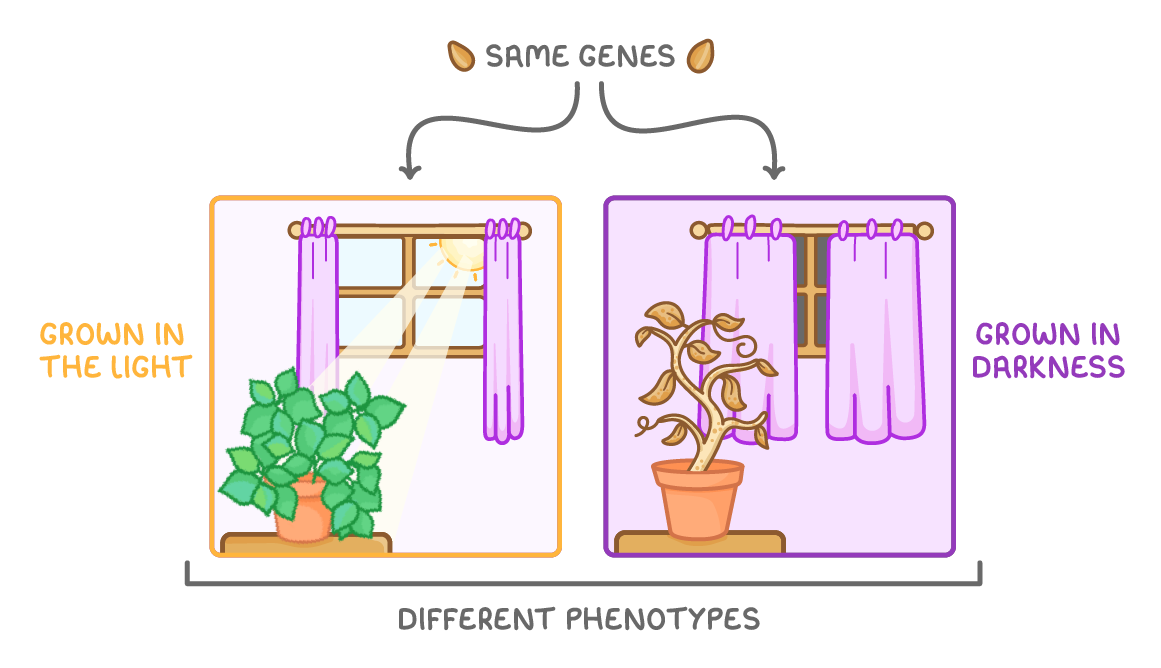
- A plant grown on a sunny windowsill grows lush and green, while a genetically identical plant grown in darkness grows tall and spindly with yellow leaves.
- In people, getting a suntan is an environmental difference.
- Features acquired during an organism's lifetime are called acquired characteristics.
A mixture of genetic and environmental factors
- Most characteristics are determined by a mixture of genetic and environmental factors rather than by one alone, e.g. body weight, height, and skin colour.
- The maximum height an organism could reach is set by its genes, but whether it actually grows that tall depends on its environment, such as how much food it gets.
- So the phenotype - the characteristics an organism actually shows - is the result of its genes interacting with its environment.
Continuous and discontinuous variation
Variation within a species falls into two patterns: continuous variation and discontinuous variation.
Continuous variation
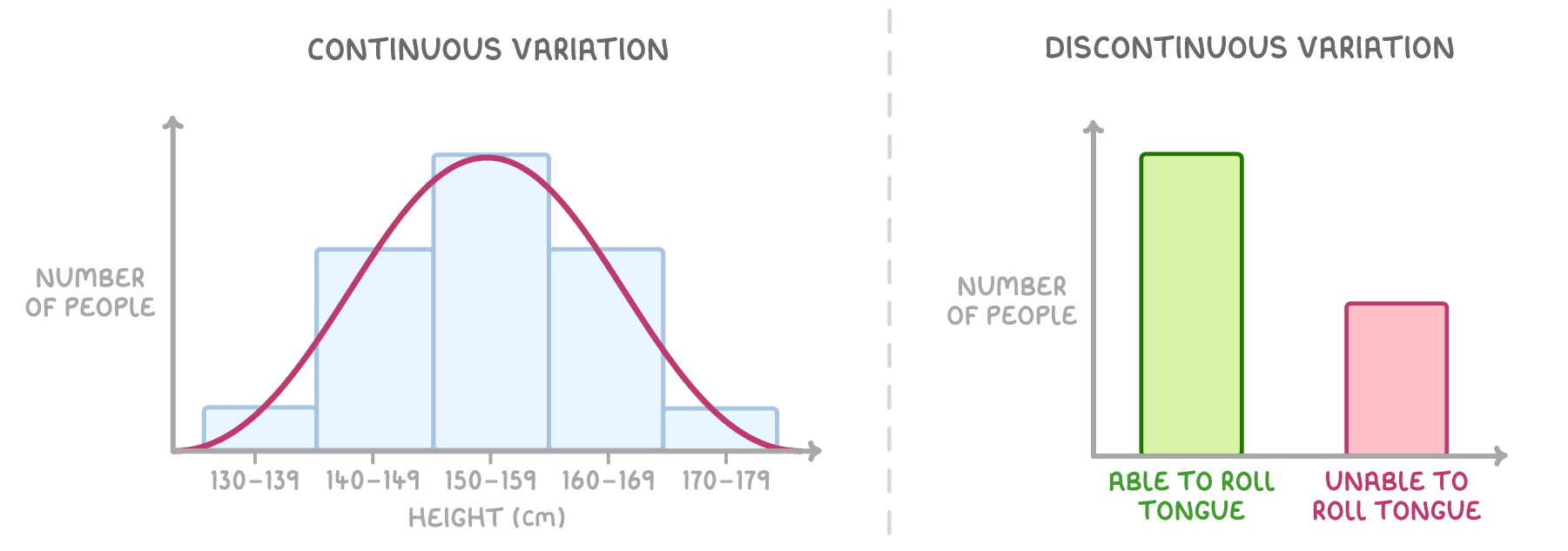
- Individuals vary across a range between two extremes, with no distinct categories - a characteristic can take any value within the range.
- Examples:
- Height - The classic example: people can be any height in a range, not simply tall or short
- Body mass
- Number of leaves on a tree
- Caused by both genes and the environment.
- Usually involves several genes acting together (polygenic inheritance) rather than a single gene.
- When plotted as a histogram (number of individuals against the measured value), it tends to form a smooth bell-shaped curve.
Discontinuous variation
- Also called discrete variation.
- There are two or more distinct categories, and each individual falls into exactly one of them, with no intermediates in between.
- Examples:
- Human ABO blood group - A person can only be group A, B, AB or O, with nothing in between
- Pea seed shape - Round or wrinkled
- Tongue rolling - Able or not able
- Usually controlled by a single gene and not affected by the environment, which is why the categories stay distinct.
- When plotted it forms a bar chart with separate bars and gaps between the categories, because the groups do not blend into one another.
TermDefinition
VariationThe differences in characteristics between individuals of the same species.
Acquired characteristicsFeatures that an organism gains during its lifetime as a result of environmental factors.
Continuous variationVariation where a characteristic can take any value across a range between two extremes, with no distinct categories.
Discontinuous variationVariation where a characteristic falls into one of a limited number of distinct categories, with no intermediates (values in between).
Key points to remember
How were these notes?