5.15 - Kidneys - Excretion & Water Balance
Excretion and the excretory organs
- Excretion is the removal of the waste products made by the body's chemical reactions, and of substances in excess of the body's needs.
- As cells carry out their metabolism, they make substances the body can't use, which would be harmful if they built up - so they must be removed.
- The main waste products are:
- Carbon dioxide - Made by respiration
- Urea - Made when the body breaks down excess amino acids
Organs involved in excretion
- Lungs - Remove carbon dioxide, which leaves the body when you breathe out
- Skin - Loses some water, ions and urea in sweat, but the body doesn't control how much is lost this way
- Kidneys - The main organs of excretion: they remove urea, excess water and excess ions from the blood and get rid of them in urine
The amount of water and ions the kidneys remove is carefully adjusted, so the kidneys both excrete waste and help keep the body's internal conditions steady.
The urinary system
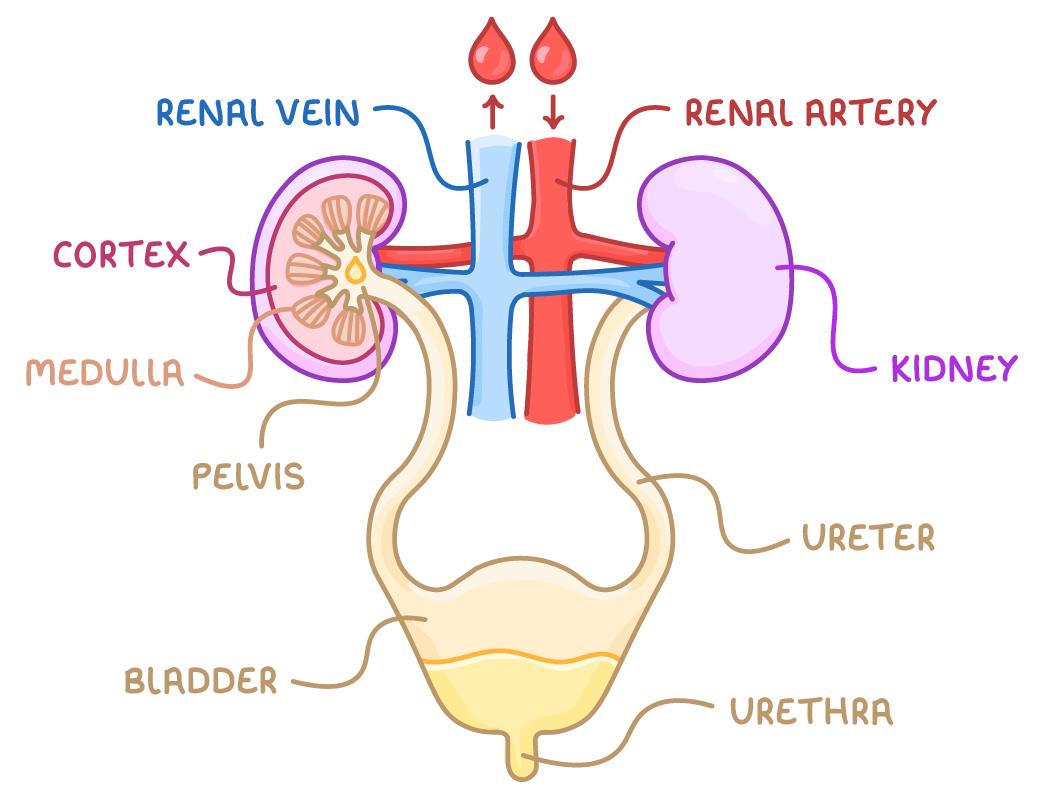
- Blood is carried to each kidney by a renal artery and returned by a renal vein.
- Inside, each kidney has an outer layer (the cortex) and an inner region (the medulla), with a space (the pelvis) where urine collects.
- Urine made by each kidney drains down a tube called the ureter to the bladder, where it is stored.
- Urine leaves the body through the urethra.
The kidney and the body's water balance
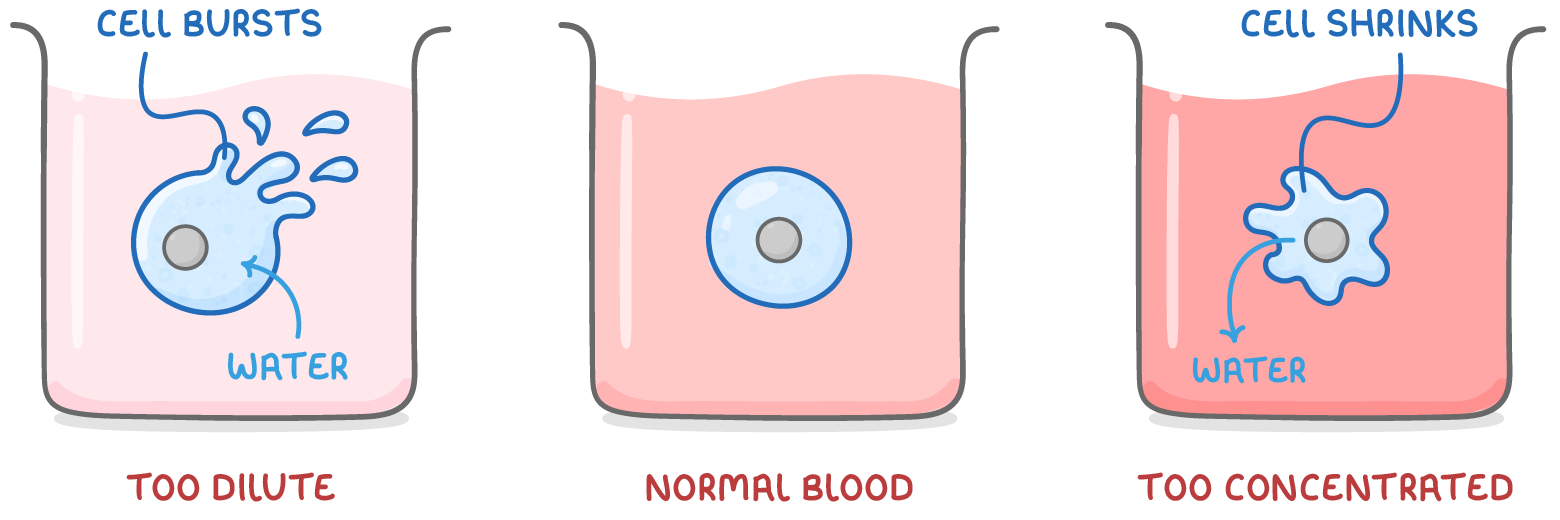
- The water content of the blood must be kept steady, because body cells are surrounded by watery fluid and water moves in and out of them by osmosis.
- If the blood becomes too dilute - too much water moves into cells, and they may swell or burst.
- If the blood becomes too concentrated - water is drawn out of cells, and they shrink.
- Either way the cells stop working properly, so the body must balance the water it takes in against the water it loses.
Water gains and losses
- Water is gained by:
- Drinking
- Food
- Respiration inside cells (produced as a product)
- Water is lost in:
- Sweat from the skin
- Water vapour breathed out from the lungs
- Urine made by the kidneys
- Losses in sweat and breath aren't controlled - they happen whatever the body needs.
- The one route the body can adjust is the amount of water lost in the urine.
How the kidney adjusts water loss
- The kidney filters the blood, then reabsorbs useful substances back into it, including a controlled amount of water.
- Filtered out - Small molecules such as water, glucose, ions, and urea pass out of the blood. Proteins and blood cells are too big to be filtered.
- Reabsorbed - All of the glucose, some of the ions, and as much water as the body needs. The urea is not reabsorbed, so it leaves in the urine.
- By reabsorbing more or less water, the kidney changes how much is kept in the blood and how much leaves in the urine:
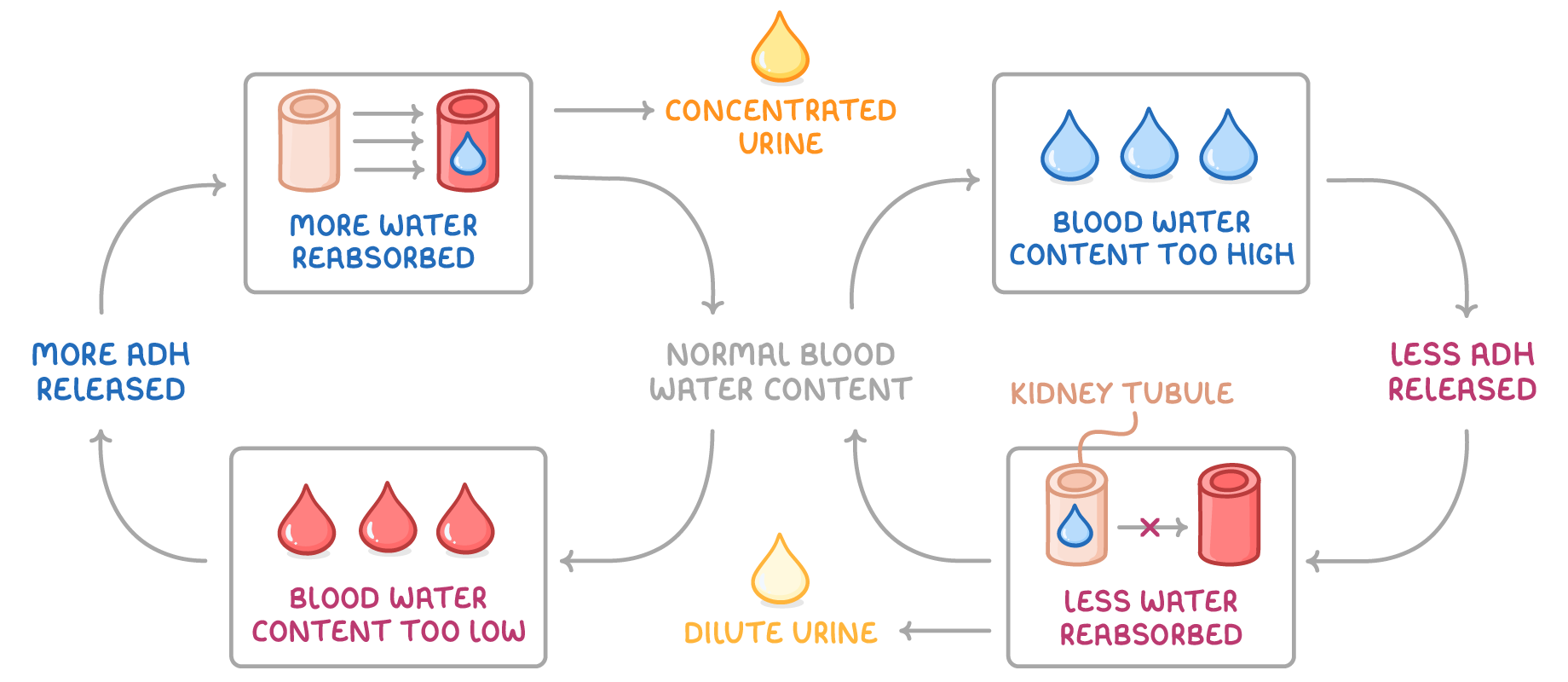
- Too much water in the blood - The kidney reabsorbs less, producing a large volume of dilute urine.
- Too little water in the blood - The kidney reabsorbs more, producing a small volume of concentrated urine.
- The waste that leaves is urine - a solution of water, urea, and excess ions - which drains from the kidneys down the ureters to the bladder.
ADH and the control of water content
- The amount of water the kidney keeps in the blood is controlled by a hormone called anti-diuretic hormone (ADH).
- The brain constantly monitors the water content of the blood and instructs the pituitary gland to release ADH into the blood in the amount the body needs.
- ADH travels in the blood to the kidneys, where it changes the permeability of the kidney tubules (in particular the collecting ducts).
- The more ADH there is, the more permeable the tubules become, so more water is reabsorbed back into the blood instead of being lost.
Control by negative feedback
- The system is run by negative feedback: a change away from normal triggers a response that reverses it.
- Because each response opposes the change that triggered it, the water content of the blood is held close to a steady level.
| Blood water content | ADH released | Tubule permeability | Water reabsorbed | Urine produced |
|---|---|---|---|---|
| Too high | Less | Less permeable | Less | Large volume of dilute urine |
| Too low | More | More permeable | More | Small volume of concentrated urine |
- Water content getting too low can happen after sweating heavily during exercise, or after eating very salty food.
- In each case the change in urine returns the blood's water level back towards normal.
TermDefinition
ExcretionThe removal of waste made by an organism's chemical reactions (metabolism), and of substances it has more of than it needs.
Anti-diuretic hormoneA hormone released by the pituitary gland that controls how much water the kidneys reabsorb.
Negative feedbackA control mechanism in which a change away from the normal level triggers a response that brings it back to normal.
Key points to remember
How were these notes?