1.13 - Genetic Engineering
What genetic engineering and GM organisms are
- Genetic engineering (also called genetic modification) is the transfer of a gene for a desirable characteristic from one organism's genome into another organism, so the second organism develops that characteristic.
- The genome is the complete set of genetic material in an organism.
- Genetic engineering changes the genome by removing, changing, or inserting individual genes - most often by adding a gene taken from a different organism.
GM and transgenic organisms
- An organism changed in this way is described as genetically modified (GM).
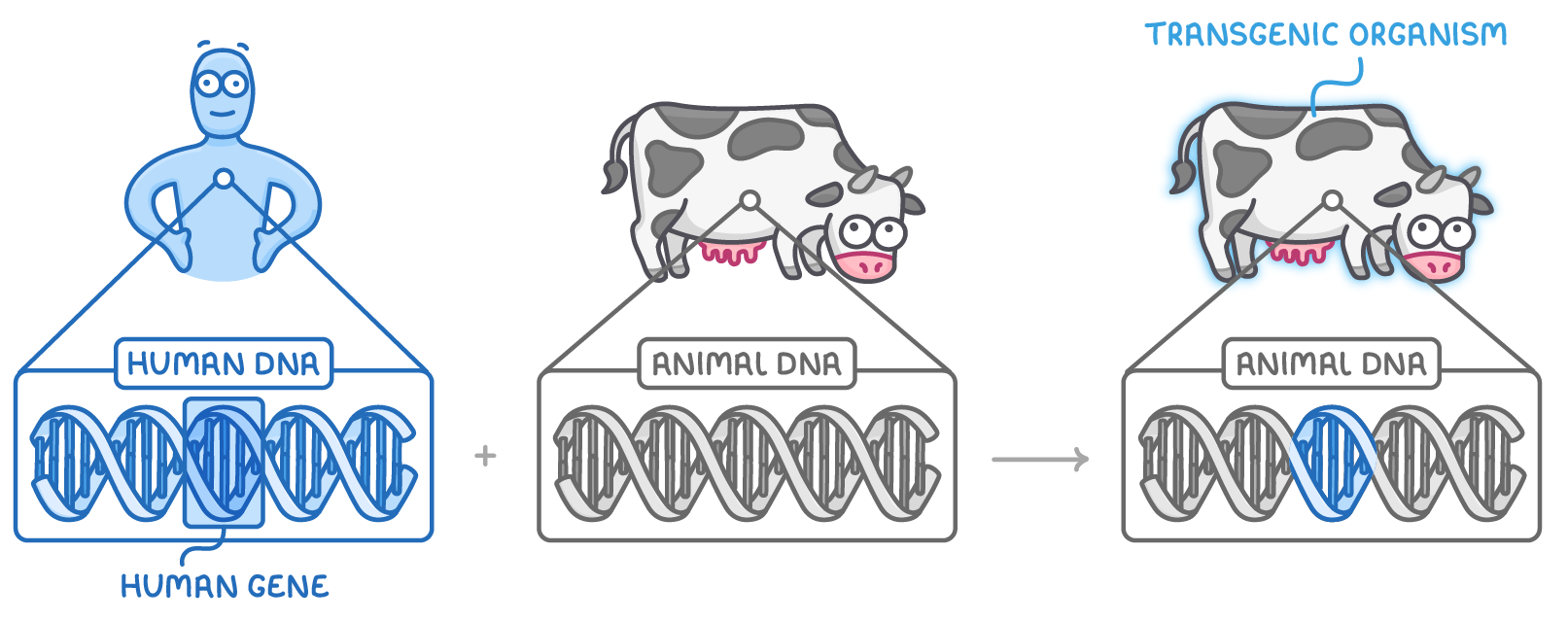
- Because the gene often comes from a different species, it's also called a transgenic organism - one that contains genes brought in from another type of organism.
- You can have transgenic bacteria, animals, and plants.
- Sometimes the gene is transferred while the organism is at an early stage of development (such as an egg or embryo), so the whole organism grows with the new characteristic in all its cells.
How genetic engineering is used
- Bacteria - Modified to make human insulin to treat diabetes
- Crops - Modified to resist insects, herbicides, or disease, or to improve the size and quality of their fruit
- Sheep - Modified to make useful substances such as drugs in their milk
The genetic-engineering process
- Genetic engineering moves a gene from one organism into another through a sequence of enzyme steps, ending with a step that picks out the cells that worked.
- Two key enzymes are used:
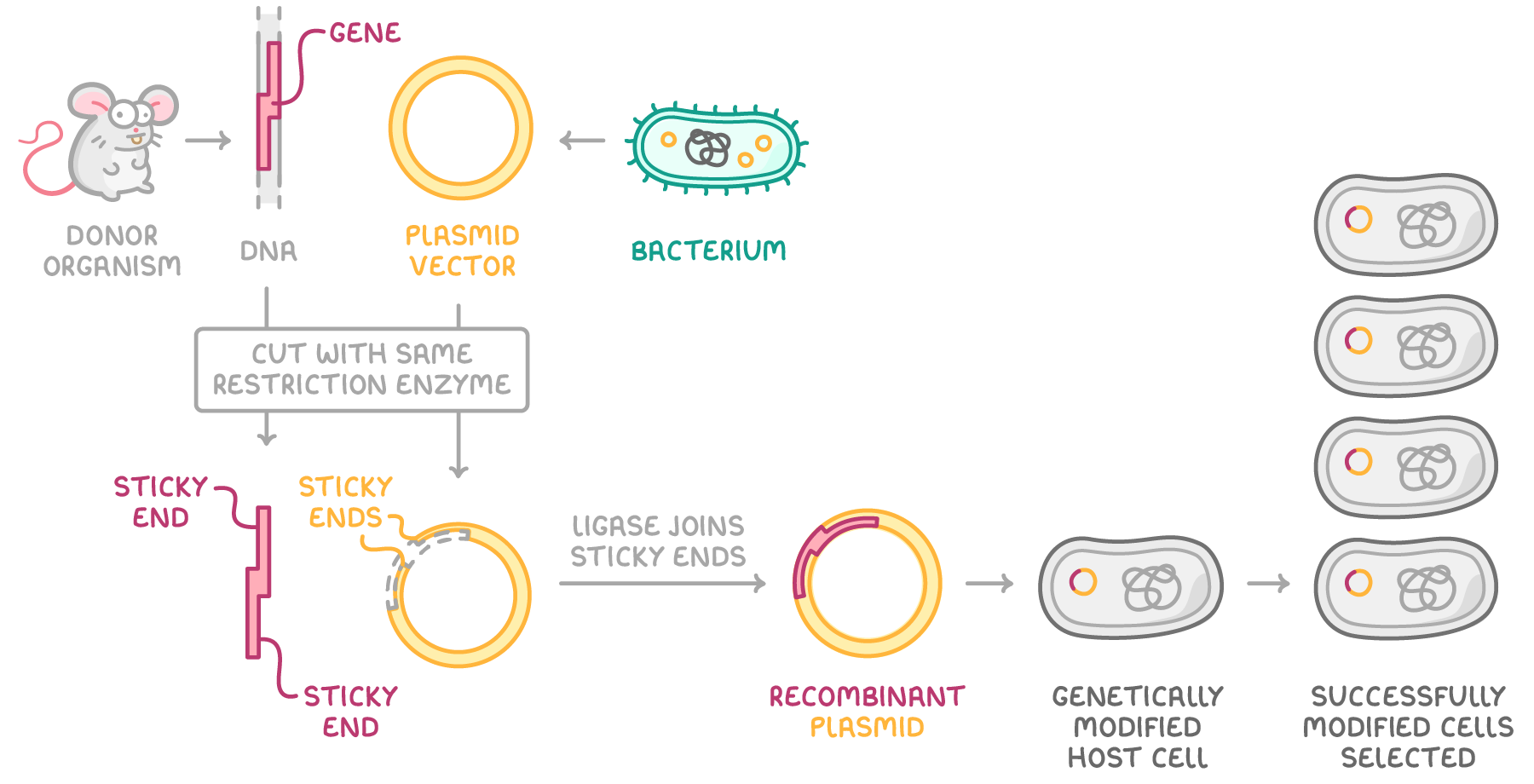
- Restriction enzyme - Recognises a specific base sequence and cuts the DNA, leaving short tails of unpaired bases called sticky ends
- Ligase - Joins sticky ends together
The steps
- The required gene is cut out of the donor DNA with a restriction enzyme, leaving sticky ends.
- A plasmid is cut open with the same restriction enzyme, giving it complementary sticky ends.
- The gene and the plasmid are mixed with ligase, which joins their sticky ends to form a recombinant plasmid.
- The recombinant plasmid acts as a vector and is put into host cells, such as bacteria.
- The successfully modified cells are selected (not all host cells take up the new DNA).
Choice of vector
- The recombinant plasmid is the usual vector.
- A virus can be used as the vector instead.
- For modifying plants, the soil bacterium Agrobacterium tumefaciens - which naturally inserts its genes into plant DNA - can carry the gene in.
Selecting the modified cells
- Not all host cells take up the new DNA, so the ones that did must be picked out.
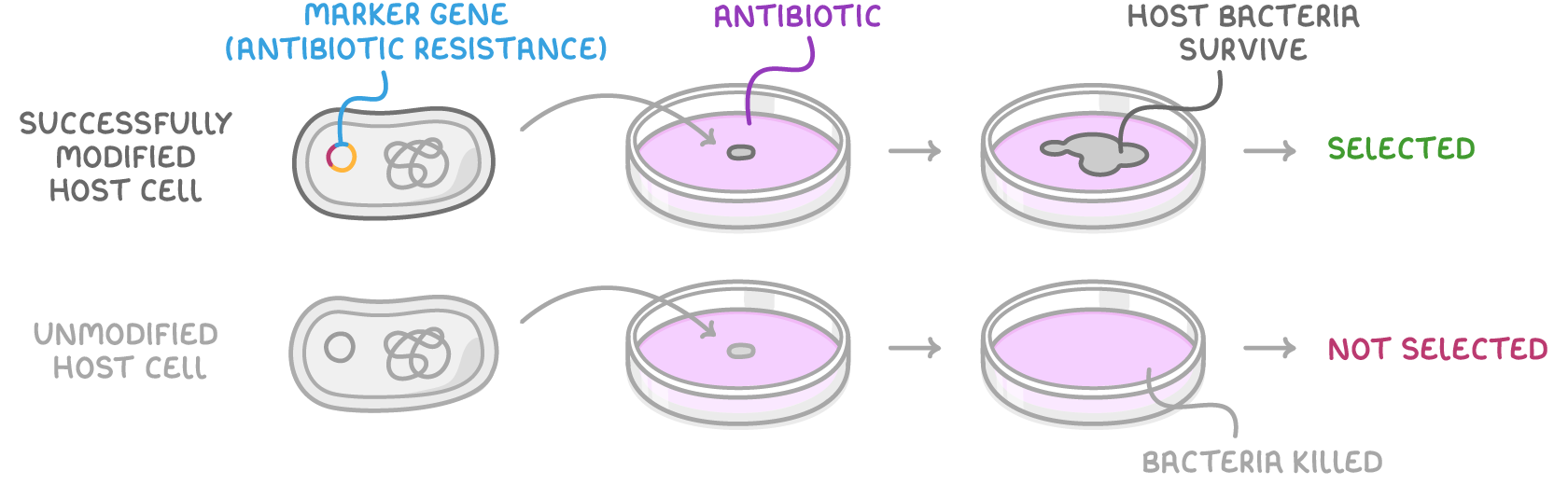
- A marker gene that codes for antibiotic resistance is inserted alongside the desired gene.
- The host bacteria are grown on a plate containing the antibiotic.
- Only the cells that took up the marker - and therefore the desired gene - survive and reproduce; the rest are killed.
GM bacteria make human insulin
- Making human insulin - the hormone used to treat diabetes - was one of the first and most important uses of genetic engineering.
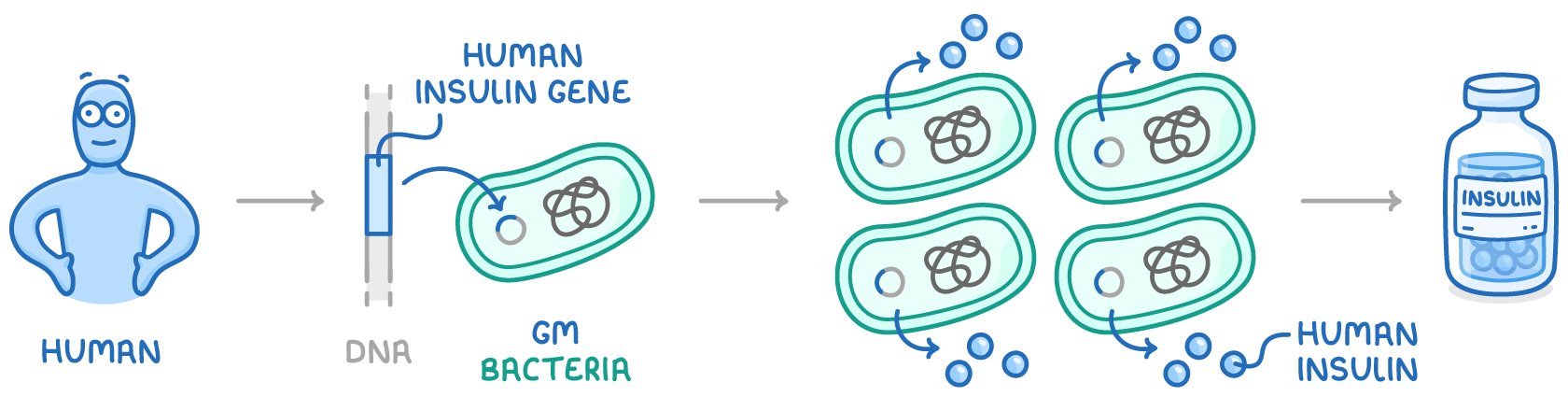
- The gene that codes for human insulin is transferred into bacteria, so the bacteria become genetically modified (GM) to carry the human insulin gene.
- Because the gene codes for insulin, the bacteria now make human insulin as they grow.
Producing insulin on a large scale
- The modified bacteria are grown in very large numbers.
- As they reproduce, they keep producing insulin, which is collected and used to treat people with diabetes.
- Growing huge populations of fast-reproducing bacteria means a large, steady supply of human insulin can be made.
- The insulin made this way is human insulin - identical to the insulin the body normally makes itself.
GM crops - Herbicide and insect (Bt) resistance
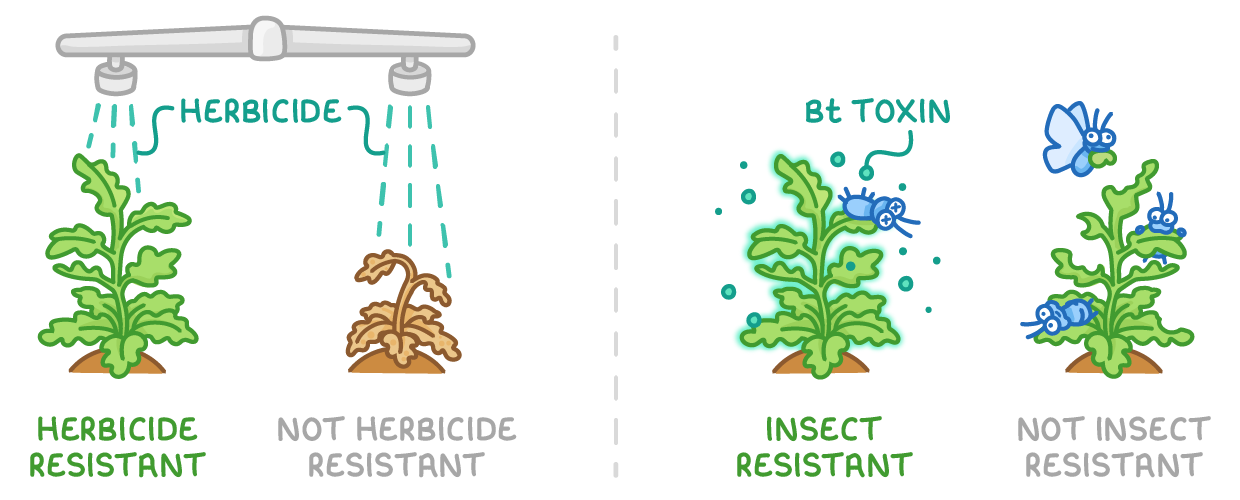
Crops can be genetically modified (GM) to protect their yield by giving them resistance to herbicides or to insect pests.
Herbicide resistance
- A herbicide-resistant crop carries a gene that lets it survive a particular weedkiller (herbicide).
- Farmers can then spray the whole field with that herbicide to kill the weeds competing with the crop, without harming the crop itself.
- Example: one type of soya has been modified to resist the herbicide glyphosate.
Insect (Bt) resistance
- An insect-resistant crop carries a gene that protects it from the insects that would normally eat it.
- A common example uses the Bt gene from the bacterium Bacillus thuringiensis, which makes a toxin harmful to certain insect pests.
- Crops such as maize and cotton carrying this gene are protected from insect larvae.
- Because the crop defends itself, fewer plants are eaten, so the crop is protected and the yield is higher.
TermDefinition
Genetic engineeringThe process of changing an organism's genome, usually by inserting a gene from another organism, to give it a desired characteristic.
Transgenic organismAn organism that contains genes transferred from a different species.
Restriction enzymeAn enzyme that recognises specific sequences of bases and cuts the DNA at those points.
Sticky endsShort tails of unpaired bases left at the ends of DNA cut by a restriction enzyme.
LigaseAn enzyme that joins matching sticky ends of DNA together.
PlasmidA small ring of DNA, separate from the main chromosome, found in bacteria and often carrying extra genes.
Recombinant plasmidA plasmid made of two different pieces of DNA joined together.
Vector (genetic engineering)A carrier, such as a plasmid or a virus, used to transfer a gene into a host cell.
Marker geneA gene, such as one for antibiotic resistance, inserted alongside the desired gene so that modified cells can be identified.
Key points to remember
How were these notes?