5.13 - Homeostasis
What homeostasis is, and the control-system model
- Homeostasis is the maintenance of a constant internal environment - regulating conditions inside the body and its cells to keep them steady in response to internal and external changes.
- It's important because cells only work properly within a narrow range of conditions.
- In particular, the enzymes that drive the body's reactions need the right temperature and pH - if conditions drift too far from normal it can be dangerous to health.
- Keeping conditions steady means responding to internal and external change while balancing what enters the body against what leaves it.
Conditions that must be kept steady
- Body temperature
- The concentration of glucose in the blood
- The body's water content
Each is kept near its normal level by an automatic control system, using both nervous and hormonal communication.
The three components of a control system
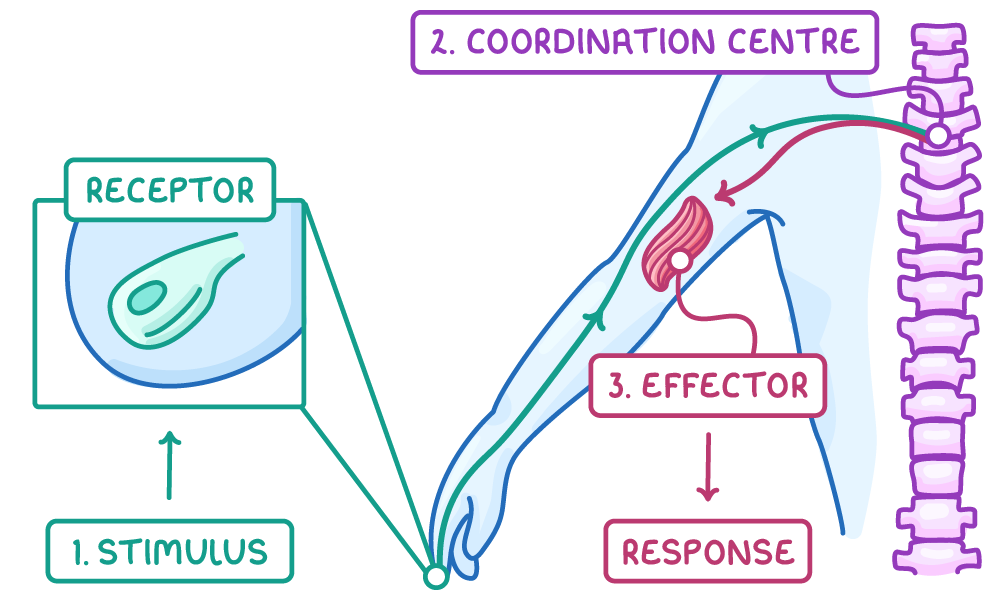
- Receptors - Cells that detect a change (a stimulus), e.g. a change in temperature or blood glucose. They can be on their own or grouped inside a larger sense organ.
- Coordination centre - Receives the information from the receptors, processes it, and decides on the response. Examples: the brain, the spinal cord, and the pancreas.
- Effectors - Carry out the response that counteracts the change. Effectors are muscles (which respond by contracting) or glands (which respond by secreting a substance such as a hormone).
Every coordinated response needs all three
- A stimulus is detected by a receptor.
- The coordination centre processes the information.
- The effector acts to counteract the change.
This same three-box pattern - receptor → coordination centre → effector - is shown below, and it lies behind every example of homeostasis, whatever condition is being controlled.
Negative feedback as a general principle
- Negative feedback is the mechanism an automatic control system uses to hold a condition steady.
- Whenever a level moves away from its normal value, a response is triggered that counteracts the change and brings the level back.
- Each condition has a normal value, or set point, that is best for it - for example, the set point for body temperature is around 37°C.
- Negative feedback works to keep the condition close to its set point, and it all happens automatically, without conscious thought.
The mechanism runs through the same three components every time
- Receptor - Detects that the level has gone too high or too low.
- Coordination centre - Receives and processes this information and organises a response.
- Effector - Produces the response that counteracts the change and restores the level towards normal.
- If the level was too high, the response lowers it.
- If the level was too low, the response raises it.
Overshooting and correction
- The effectors keep producing their response for as long as the coordination centre stimulates them, so a correction can overshoot and push the level too far the other way.
- When that happens, the receptor detects the new deviation and negative feedback simply starts again in the opposite direction.
- The result is that the condition is constantly nudged back towards its set point rather than being allowed to drift, staying within a narrow range around the normal level.
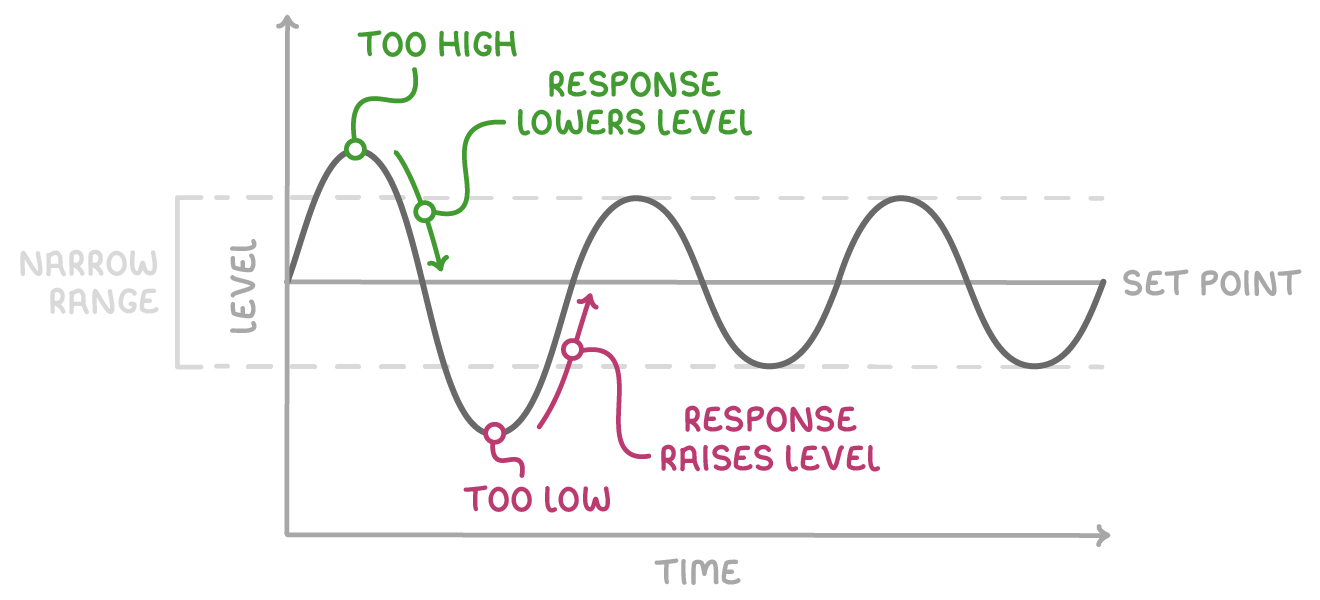
The level rises and falls over time, always pulled back towards the set point.
TermDefinition
HomeostasisThe maintenance of a constant internal environment (the conditions inside the body) despite internal and external changes.
StimulusA change in the internal or external environment that an organism detects and responds to.
ReceptorA cell or group of cells that detects a change in the internal or external environment.
Coordination centreA body part that receives and processes information from receptors to organise a response.
EffectorA muscle or gland that carries out a response to a stimulus.
Negative feedbackA control mechanism in which a change away from the normal level triggers a response that brings it back to normal.
Set pointThe normal value or ideal level for a condition in the body.
Key points to remember
How were these notes?