6.11 - Land Use
Land use and habitat destruction
- Land is a limited resource - the more of it humans take, the less is left for other organisms.
- Humans reduce the land available to wildlife by:
- Building towns and cities
- Quarrying to extract resources from the ground
- Farming
- Dumping waste
- As habitats are taken over, the species that lived there lose their homes, so the number and variety of organisms the area supports falls.
Pollution destroys habitats too
- Habitats are also destroyed by pollution entering rivers, lakes and the sea:
- Sewage
- Fertiliser washed off farmland
- Toxic chemicals from industry
- These can make freshwater and marine habitats unable to support the species that once lived there.
Destroying peat bogs
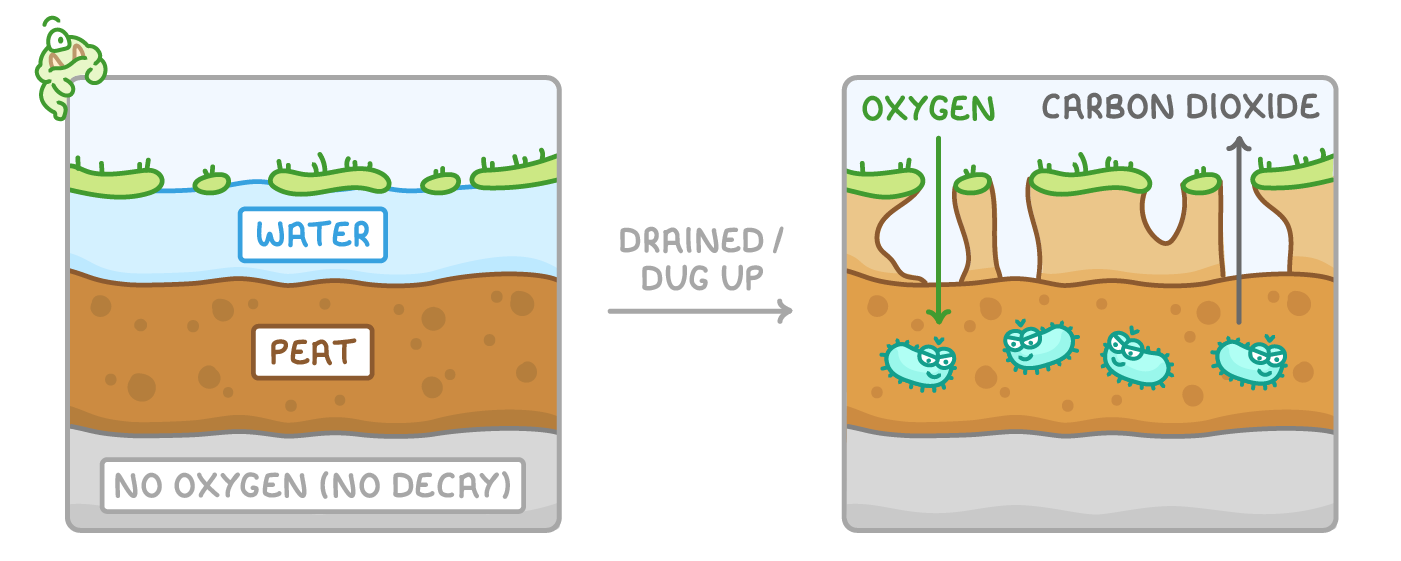
- A peat bog is an area of acidic, waterlogged ground with too little oxygen for microorganisms to decay dead plants.
- Partly rotted plant material builds up over time as peat, locking away the carbon the plants took in while alive.
- Peat bogs are drained to create farmland, and dug up so the peat can be sold as garden compost or burnt as fuel.
Destroying a bog has two effects:
- It removes a habitat, reducing the variety of plants, animals and microorganisms that lived there.
- It lets the stored carbon escape - as oxygen returns to the drained soil, microorganisms decay the peat, and the decay or burning of peat releases carbon dioxide into the atmosphere.
Deforestation
- Deforestation is the large-scale cutting down of forests.
- It's happening fast in tropical regions, where rainforests grow.
Why forests are cleared
- Farming - Clearing land to raise cattle or grow crops such as rice.
- Biofuels - Growing crops for plant-based fuels burned in place of fossil fuels.
- Logging - Harvesting the wood itself for building or for fuel.
The harm deforestation causes
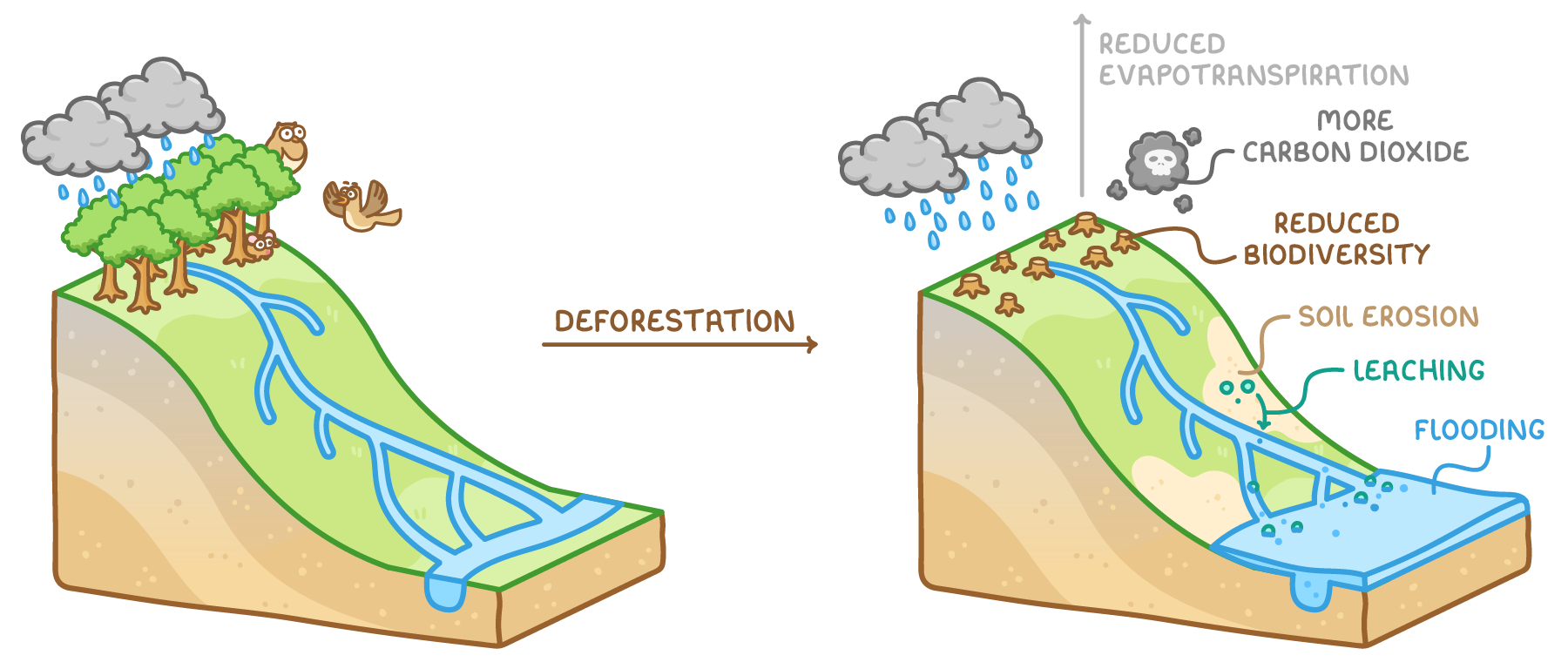
- More carbon dioxide in the atmosphere - Trees that are cut down can no longer photosynthesise and take in carbon dioxide, so more CO2 stays in the air. Clearing forests by burning also releases the carbon stored in the trees as CO2.
- Soil erosion and leaching - Removing tree cover exposes the soil, which is washed away by rain and has its minerals leached out.
- Disturbed water cycle - In some forests, losing the trees reduces evapotranspiration, disturbing the water cycle.
- Flooding - Loss of soil and tree cover can lead to flooding.
- Reduced biodiversity - Destroying a rainforest destroys a habitat that held a great variety of species, sharply reducing biodiversity and driving some species towards extinction.
TermDefinition
Peat bogAn area of acidic, waterlogged ground where a lack of oxygen prevents dead plants from fully decaying.
BiofuelA fuel made from living material, such as crop plants, that can be used in place of fossil fuels.
DeforestationThe large-scale cutting down of forests.
Key points to remember
How were these notes?