2.9 - Culturing Microorganisms
Growing microorganisms in the lab
- Growing microorganisms such as bacteria is called culturing.
- They're grown in a nutrient medium that supplies the proteins, carbohydrates, minerals, and vitamins they need to grow.
- The medium can be:
- A liquid, called nutrient broth
- A solid jelly, called nutrient agar
Growing bacteria on a solid medium
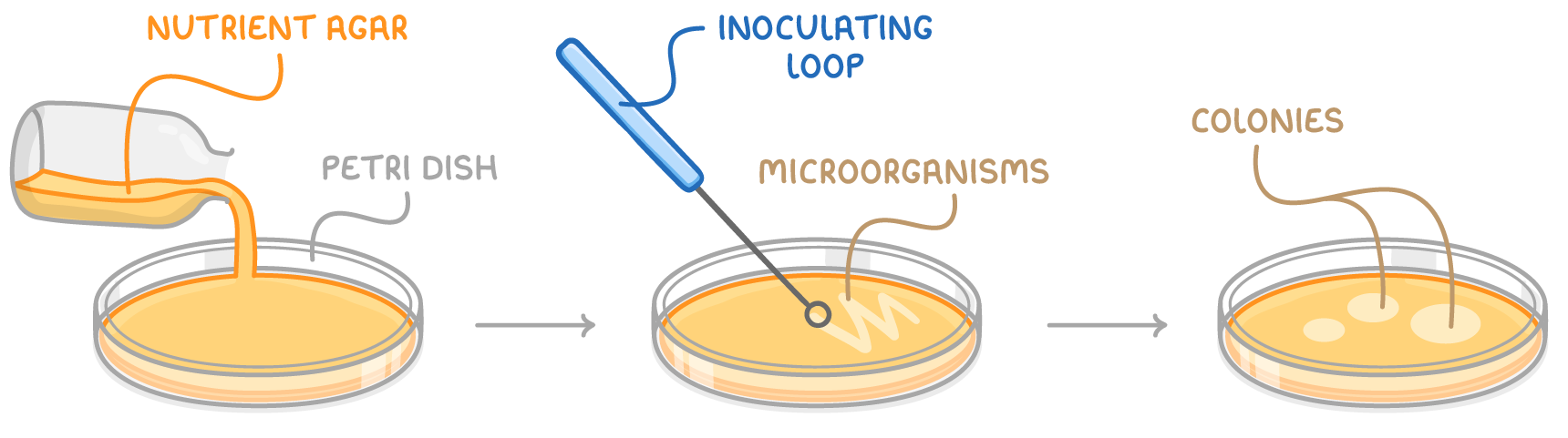
- Pour hot agar jelly into a shallow round plastic dish called a Petri dish.
- Once the jelly has cooled and set, transfer microorganisms onto its surface using a wire inoculating loop (or spread them evenly with a sterile pipette and spreader).
- The microorganisms then multiply on the medium.
Colonies and lawns
- A single bacterium left to grow on an agar plate divides again and again until it forms a visible group of bacteria called a colony.
- Spread evenly, the bacteria can instead form a continuous covering, or lawn, over the surface.
Incubation temperature and safety
- In a school laboratory, cultures of microorganisms are not incubated above about 25°C.
- This is a safety measure: at higher temperatures, harmful pathogens are much more likely to grow, so keeping the temperature to a maximum of around 25°C reduces that risk.
- In industry, where conditions are tightly controlled, cultures are often incubated at higher temperatures so they grow faster.
Aseptic technique
- When microorganisms are cultured, the culture must contain only the microorganisms being studied.
- Contamination by unwanted microorganisms - from the air, the equipment, or the worker's hands - would spoil the results and could allow harmful pathogens to grow.
- Aseptic technique is the set of procedures used to prevent this contamination.
The main steps
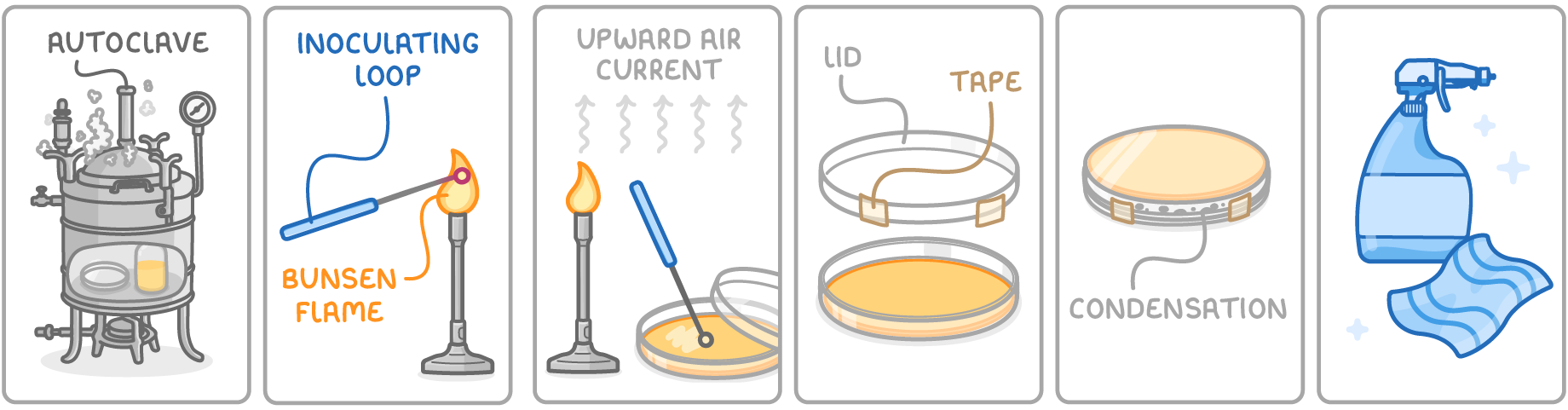
- Sterilise dishes and medium - The Petri dishes and culture medium are sterilised before use, for example by heating to a high temperature in an autoclave (which uses steam at high pressure to kill any microorganisms), so the culture starts free of stray microbes.
- Flame the inoculating loop - Pass the loop through a hot flame until it glows to kill any microorganisms on it, then let it cool before it touches the culture.
- Work near a lit Bunsen flame - The flame creates an upward current of warm air that draws airborne microorganisms away from the culture.
- Cover the dish loosely - After transferring the microorganisms, hold the lid at an angle or replace it quickly, then lightly tape it on rather than sealing it completely. This keeps microbes from the air out while still letting some air in. The oxygen in that air makes harmful anaerobic bacteria less likely to grow.
- Store the dish upside down - Drops of condensation then fall onto the lid instead of onto the agar surface.
- Clean up afterwards - Clean surfaces and hands, and sterilise used cultures and equipment again (for example by autoclaving) before disposal.
Calculating the area of a colony or clear zone
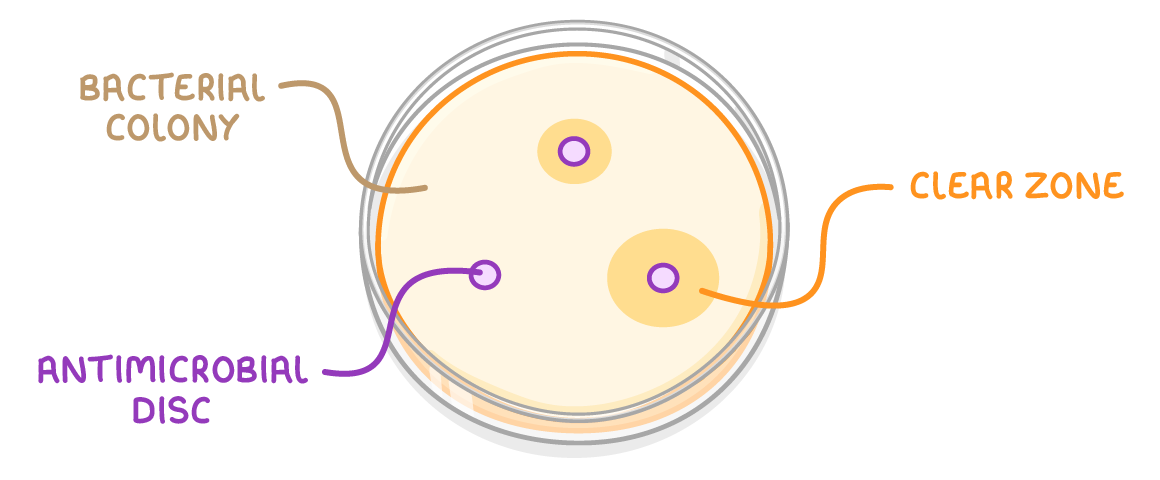
- A bacterial colony and a clear zone are both roughly circular, so their size is measured as the area of a circle.
- A clear zone is the region around an antimicrobial-soaked disc where the substance has stopped the bacteria growing, leaving the agar clear.
- The larger the clear zone, the more effective the substance has been against the bacteria.
- Measuring the area turns a rough by-eye comparison into a numerical one, so different colonies or treatments can be compared accurately.
Finding the area
Formula for area of a circle:
Where:
- = Radius, the distance from the centre to the edge, in millimetres (mm) or centimetres (cm)
- = A constant, about 3.14
Find by measuring the diameter across the colony or clear zone and halving it. Measure the diameter through the bottom of the closed Petri dish, without opening it, so the culture is not disturbed. The area comes out in square units, such as square millimetres (mm2) or square centimetres (cm2).
Worked example - Comparing two clear zones
Two antimicrobial discs are tested. Treatment A produces a clear zone 14 mm across; treatment B produces a clear zone 20 mm across. Calculate each area and state which treatment is more effective.
Step 1 - Find each radius
Treatment A: radius = 14 ÷ 2 = 7 mm
Treatment B: radius = 20 ÷ 2 = 10 mm
Step 2 - Apply the formula
Treatment A:
Treatment B:
Step 3 - Interpretation
Treatment B's clear zone (about 314 mm2) is roughly twice the area of treatment A's (about 154 mm2), so treatment B is the more effective of the two.
TermDefinition
CulturingGrowing microorganisms such as bacteria in a lab.
Culture mediumA liquid or gel containing the nutrients that microorganisms or cells need to grow.
ColonyA visible group of bacteria formed when a single bacterium divides repeatedly on a solid medium.
Aseptic techniqueA set of procedures used to prevent contamination by unwanted microorganisms.
Clear zoneThe region around an antimicrobial-soaked disc where the substance has stopped the bacteria growing. It is also called the zone of inhibition.
Key points to remember
How were these notes?