7.3 - Investigating Diffusion (Agar)
The experiment
Aim
To find out how the surface-area-to-volume ratio of a block affects the rate of diffusion into it, using agar cubes of different sizes. The agar is coloured with an indicator, so you can watch the acid diffuse in and time how long it takes to reach the centre.
Background
- Diffusion is the net movement of particles from where they are more concentrated to where they are less concentrated.
- Particles diffuse in through an object's surface and then have to travel to its centre.
- The surface-area-to-volume ratio is how much surface an object has for its size. The bigger the object, the smaller its surface-area-to-volume ratio, and the further it is to the centre.
- You can't see the acid particles diffusing, but the agar contains an alkali and an indicator that make it pink. As the acid diffuses in, it neutralises the alkali, so the pink fades from the outside inwards.
- So in this practical you time how long cubes of different sizes take to turn completely colourless, which is when the acid has reached the centre.
Variables
- Independent variable - The size of the agar cube, which sets its surface-area-to-volume ratio.
- Dependent variable - The time taken for the cube to turn completely colourless.
- Control variables - The concentration and volume of the acid, the temperature, and the agar, indicator, and alkali used.
Method
- Make the agar - Make up agar jelly containing phenolphthalein indicator and a little dilute sodium hydroxide, which turns it pink, and let it set in a tray.
- Cut the cubes - Cut cubes with sides of 1 cm, 2 cm, and 3 cm from the set agar, using a scalpel and a ruler on a tile, as accurately as you can.
- Add the acid - Put all the cubes into a beaker with enough dilute hydrochloric acid to cover them, and start a stopwatch. Stir gently so the acid reaches every face.
- Time each cube - Record how long each cube takes to turn completely colourless.
- Repeat the experiment - If you can, and find the mean time for each size of cube.
Safety
- Eye protection - The dilute hydrochloric acid and the sodium hydroxide in the agar are irritants, so wash off any splashes at once.
- Forceps - Lift the cubes in and out of the acid with forceps, not your fingers.
- Scalpel - Cut the agar on a tile with the blade pointing away from your hand.
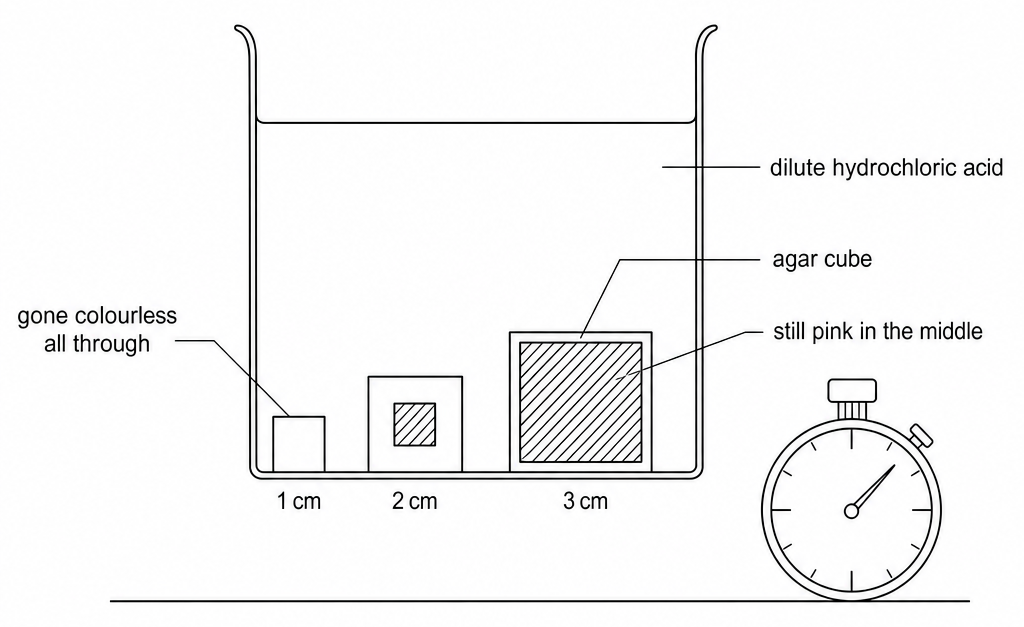
Worked example - Surface area to volume ratio and diffusion
A student cut three cubes from the same pink agar, with sides of 1 cm, 2 cm, and 3 cm. She dropped them into dilute acid at the same time, and timed how long each took to turn colourless.
| Cube side (cm) | Time to turn colourless (min) |
|---|---|
| 1 | 3 |
| 2 | 8 |
| 3 | 15 |
Work out the surface-area-to-volume ratio of each cube, and use it to explain the times.
Step 1 - Work out the surface area, volume, and ratio of the 1 cm cube
A cube has six square faces, so its surface area is 6 × (side × side), and its volume is side × side × side.
Surface area = 6 × (1 × 1) = 6 cm2
Volume = 1 × 1 × 1 = 1 cm3
So the ratio is 6:1.
Step 2 - Work out the ratio of the 2 cm and 3 cm cubes
- For the 2 cm cube, the surface area is 6 × (2 × 2) = 24 cm2 and the volume is 2 × 2 × 2 = 8 cm3, so the ratio is 24 ÷ 8 = 3, or 3:1.
- For the 3 cm cube, the surface area is 6 × (3 × 3) = 54 cm2 and the volume is 3 × 3 × 3 = 27 cm3, so the ratio is 54 ÷ 27 = 2, or 2:1.
Step 3 - Link each ratio to its time
The 1 cm cube has the highest surface-area-to-volume ratio (6:1) and turned colourless fastest, in 3 minutes. The 3 cm cube has the lowest ratio (2:1) and took longest, 15 minutes. So the higher the surface-area-to-volume ratio, the faster the acid diffuses all the way through.
Step 4 - Explain why the bigger cubes take longer
As the cubes get bigger, their surface-area-to-volume ratio falls. There is proportionally less surface for the acid to enter through, and a longer distance to the centre, so the acid takes longer to diffuse all the way through.
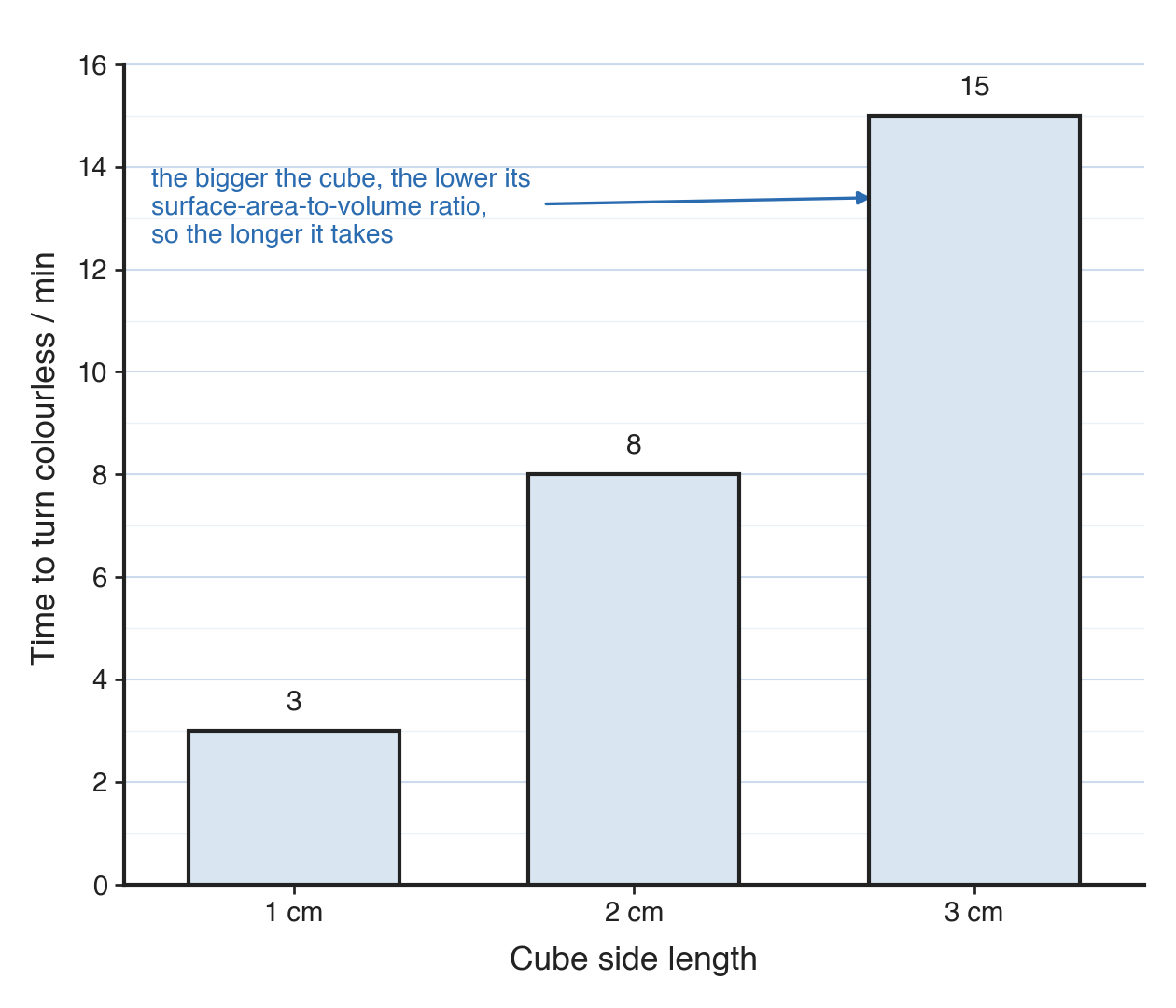
The times are not proportional to side length; the ratio controls them.
Common exam questions
Question 1
What does this experiment help explain about large animals?
Large animals have a small surface-area-to-volume ratio, so diffusion across their body surface is too slow to supply all their cells. This is why they need specialised exchange surfaces, such as lungs or gills, and a transport system.
Question 2
Why must all the cubes be cut from the same batch of agar?
So the concentration of the alkali and indicator is the same in every cube. Then the only thing changing the time is the size of the cube.
Question 3
Why is the acid kept at the same temperature for every cube?
Temperature affects the rate of diffusion, because warmer particles move faster. Keeping it the same makes sure only the size of the cube is changing the result.
Question 4
Give one reason the cubes might not turn colourless at exactly the times predicted.
The cubes may not be cut to an exact size, so their real surface-area-to-volume ratio differs slightly from the calculated one. Cutting them carefully with a ruler and scalpel reduces this.