7.11 - Investigating Transpiration (Potometer)
The experiment
Aim
To measure the rate at which a leafy shoot takes up water, and to find out how factors such as light, air movement (wind), humidity, and temperature affect the rate of transpiration.
Background
- Transpiration is the loss of water vapour from a plant, mostly by evaporation from the leaves through tiny pores called stomata.
- As water evaporates from the leaves, more water is pulled up the xylem to replace it. So the rate at which a shoot takes up water is very close to its rate of transpiration.
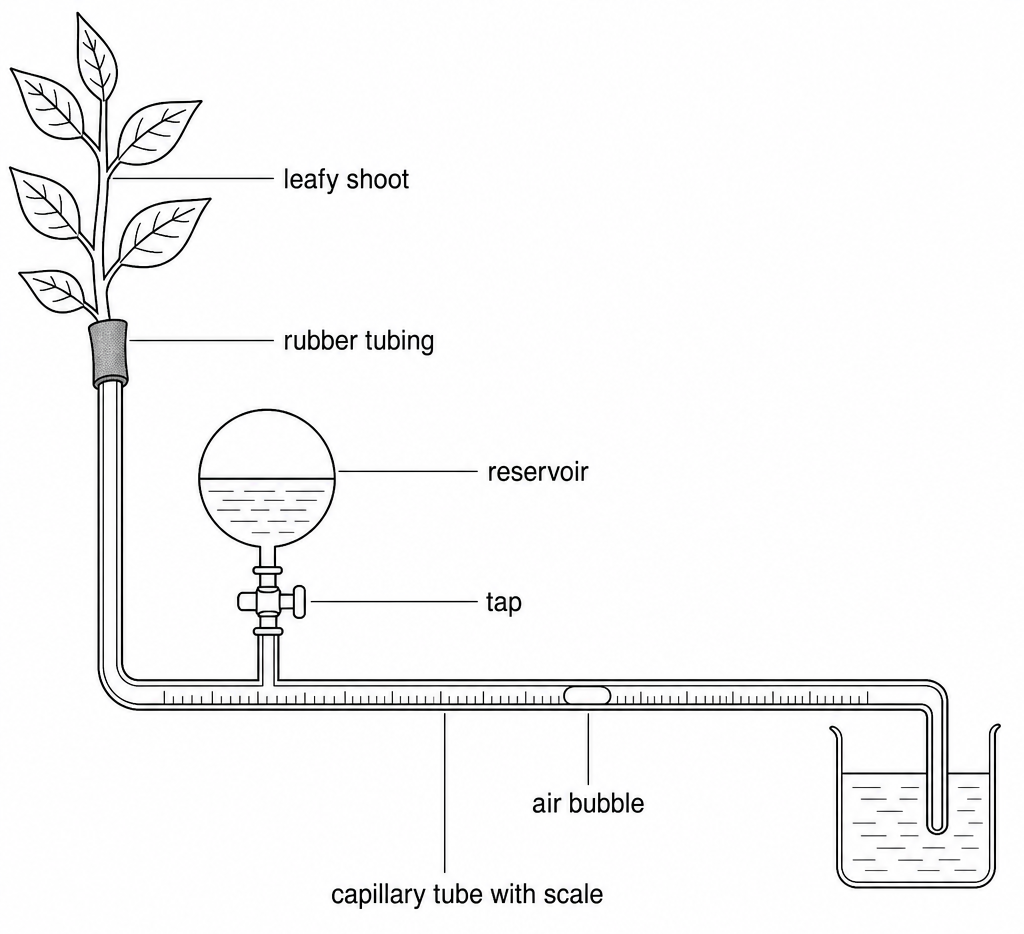
- You can't measure the water evaporating from the leaves directly, but you can measure how fast the shoot takes water up. A potometer does this by following an air bubble along a scale on a capillary tube.
- So in this practical you time how far the bubble moves in different conditions. The further and faster it moves, the faster the shoot is taking up water.
Variables
- Independent variable - The factor being tested (light intensity, air movement, humidity, or temperature), changed one at a time.
- Dependent variable - The distance the air bubble moves along the scale in a set time.
- Control variables - The same leafy shoot, the starting position of the bubble, the length of each run, and every condition apart from the one being tested.
Method
- Cut the shoot - Cut a leafy shoot from a plant under water, and at a slant.
- Assemble the potometer - Fill the capillary tube with water so there are no air bubbles, keeping the joints under water, and push the cut shoot into the rubber tubing. Seal every joint with petroleum jelly so the apparatus is airtight.
- Check for leaks - Lift the potometer out of the water, gently dry the leaves, and check nothing is leaking.
- Make an air bubble - Lift the open end of the capillary tube out of the beaker of water for a moment, then lower it back in.
- Time the bubble - Record the bubble's starting position on the scale, start the stopwatch, and measure how far the bubble moves in a set time, such as 10 minutes.
- Reset the bubble - Open the reservoir tap to push the bubble back to the start.
- Change one condition - For example switch on a lamp, aim a fan at the shoot, cover it with a plastic bag, or warm the room. Let the shoot settle for a few minutes, then time the bubble again. Repeat each condition and take a mean.
Safety
- Cutting the shoot - Use a scalpel or secateurs on a board, and cut away from your hand.
- Capillary tube - It's thin glass and breaks easily. Wet the rubber tubing and push the shoot in gently, and sweep up any broken glass with a brush, not your fingers.
- Spilt water - Wipe it up at once so the floor doesn't get slippery.
Worked example - Rate of transpiration from a potometer
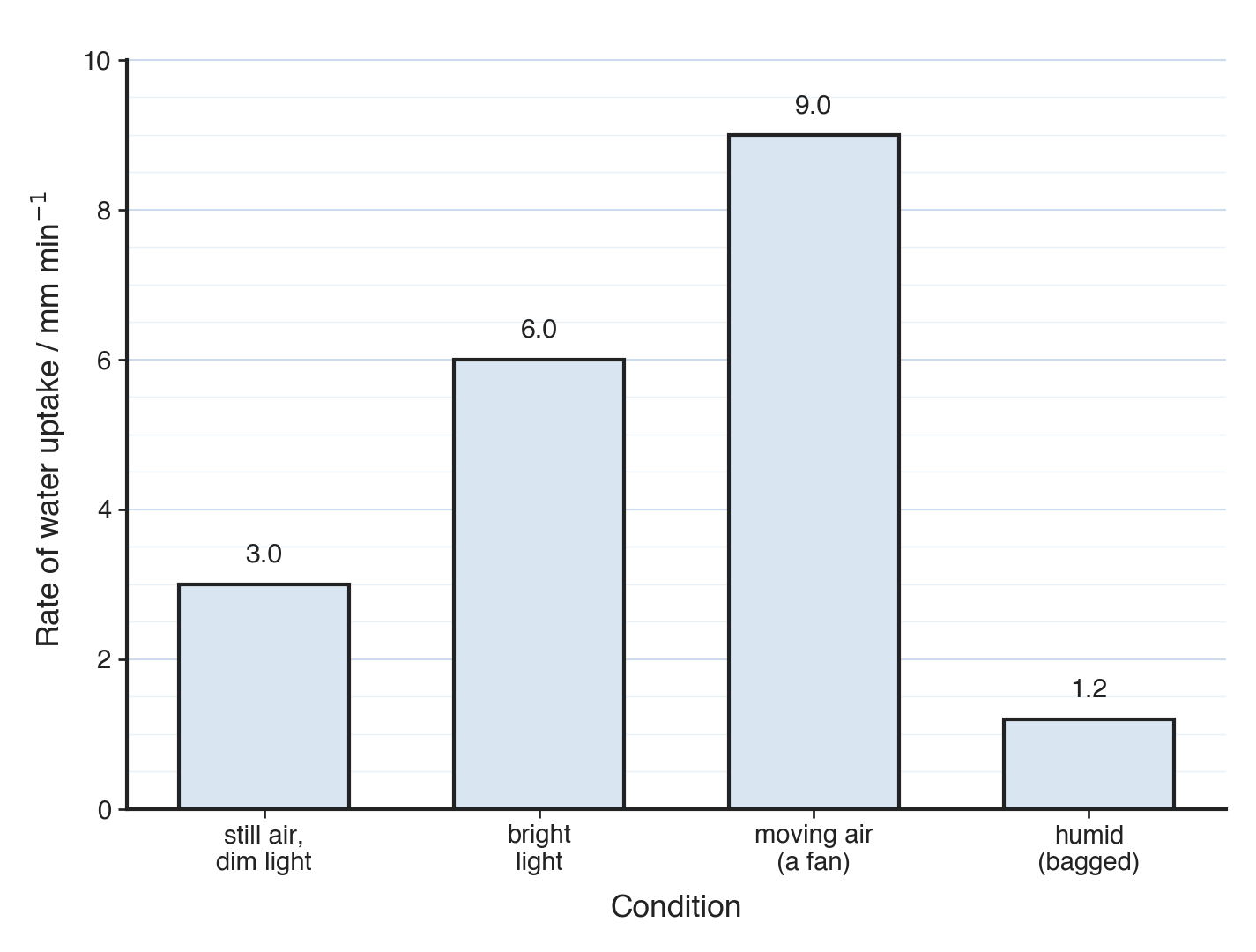
A student set up a potometer with a leafy shoot, and measured how far the air bubble moved in 10 minutes in each of four conditions. The capillary tube had an internal diameter of 1.0 mm.
| Condition | Distance bubble moved in 10 min (mm) |
|---|---|
| Still air, dim light | 30 |
| Bright light | 60 |
| Moving air (a fan) | 90 |
| Humid (bag over the shoot) | 12 |
For the bright light condition, calculate the rate of transpiration as a distance per minute and as a volume of water per minute. Then work out the rate in each condition and explain how the four compare.
Step 1 - Find the rate in bright light as a distance per minute
In bright light the bubble moved 60 mm in 10 minutes.
Step 2 - Turn the distance into a volume of water
The bubble moves because the shoot has pulled water along the tube, so the volume of water taken up is the cross-sectional area of the tube multiplied by the distance moved.
The diameter is 1.0 mm, so the radius is 1.0 ÷ 2 = 0.5 mm.
Divide by the time to get the rate as a volume, 47.1 ÷ 10 = 4.71 mm3/min.
Step 3 - Work out the rate in each condition
Divide each distance by 10 minutes.
- In still air and dim light, the rate is 30 ÷ 10 = 3.0 mm/min.
- In bright light, the rate is 60 ÷ 10 = 6.0 mm/min.
- In moving air, the rate is 90 ÷ 10 = 9.0 mm/min.
- In humid air, the rate is 12 ÷ 10 = 1.2 mm/min.
Step 4 - Explain how the conditions compare
- Bright light speeds transpiration up, because light opens the stomata wider.
- Moving air speeds it up most. The fan blows water vapour away from the leaves, which keeps the concentration gradient between the leaf and the air steep, so water keeps evaporating quickly.
- Humid air slows it right down. The air around the leaves already holds a lot of water vapour, so the gradient is small and little more water evaporates.
- So the shoot takes up water fastest when the air is bright, moving, and dry, and slowest when it's humid and still.
Common exam questions
Question 1
Why is the leafy shoot cut under water?
So that no air is drawn into the xylem. An air bubble in the xylem would break the column of water, and then water couldn't be pulled up the stem.
Question 2
Why is the stem cut at a slant?
To give a larger surface area for water to be taken up into the shoot.
Question 3
The potometer measures water uptake, not transpiration directly. Why are the two not exactly equal?
A small amount of the water taken up is used by the plant, for photosynthesis and to keep its cells firm. So slightly less water is lost as vapour than is taken up.
Question 4
Why is the shoot left for a few minutes in each new condition before the bubble is timed?
So the shoot has adjusted to the change, and the rate measured is the rate in the new condition.