3.12 - Ecosystems & Competition
Ecology vocabulary and levels of organisation
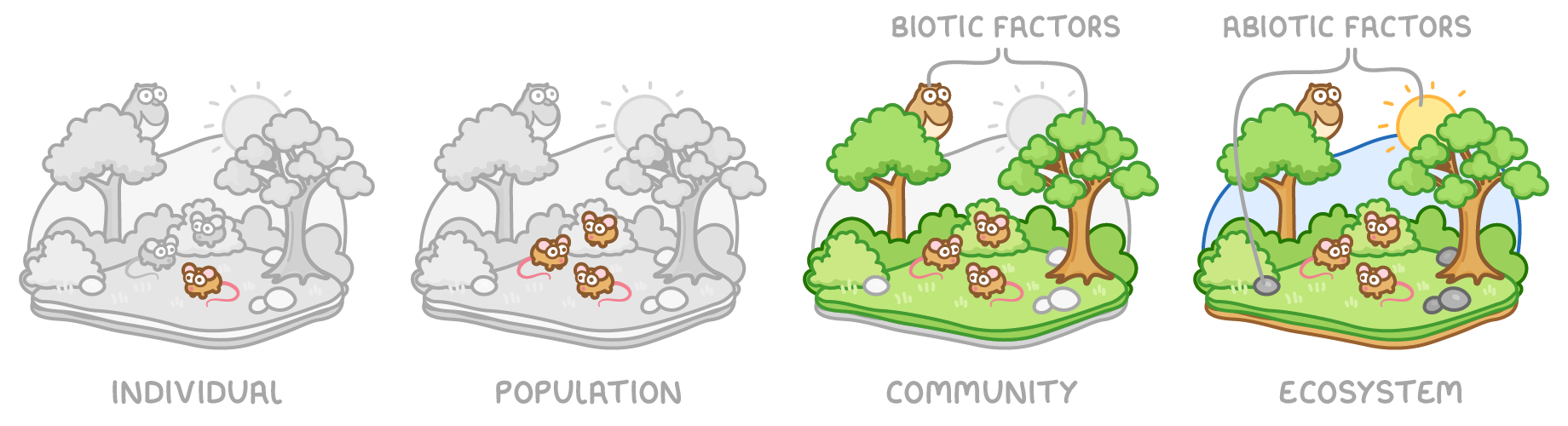
In ecology, organisms are studied at several levels of organisation, building up from the smallest to the largest.
The levels, from smallest to largest
- Individual organism - A single living thing, such as one mouse
- Population - All the organisms of one species living together in the same place at the same time, e.g. all the mice in a field
- Habitat - The place where an organism lives, such as a field, a forest, or a rocky shore
- Community - All the populations of different species living and interacting together in one habitat or ecosystem - not just the mice, but the owls, the plants, and every other species there
- Ecosystem - The interaction of a community of living organisms with the non-living parts of their environment
The variety of all the different species of organisms on Earth, or within an ecosystem, is called biodiversity.
Biotic and abiotic factors
- Biotic factors - The living parts of the environment
- Abiotic factors - The non-living parts of the environment
An ecosystem brings together the habitat, the community that lives in it, and the biotic and abiotic factors that act on it.
An organism's niche
- The niche is the particular role an organism plays within its community.
- It covers:
- The resources it needs, such as light and nutrients
- The conditions it can tolerate, such as temperature
- Its interactions with other organisms, including competition and predation
Competition for resources
- Every organism needs a supply of resources from its surroundings and from other organisms in order to survive and reproduce.
- These resources are limited, so organisms must compete for them.
- The organisms that compete most successfully for resources in short supply are most likely to survive, reproduce, and pass on their characteristics. Those that compete less successfully may not get enough to survive.
What organisms compete for
- Plants - Compete for light and space above ground, and for water and mineral ions from the soil
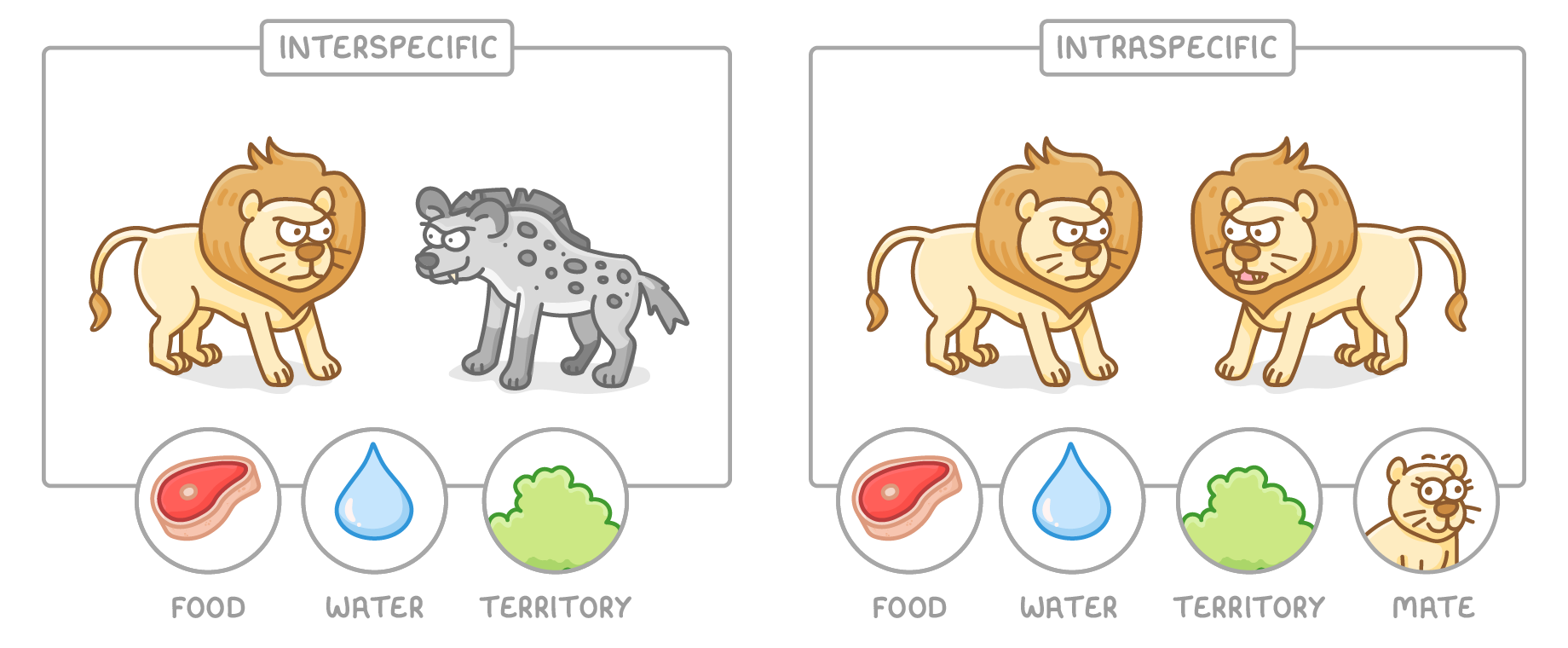
- Animals - Compete for food, water, territory (space to live in), and mates so they can breed
Two types of competition
- Interspecific competition - Competition between individuals of different species, such as lions and hyenas competing for the same prey
- Different species usually overlap in only one or a few of the resources they need, so this competition is for those shared resources only
- Intraspecific competition - Competition between individuals of the same species, such as male deer competing for mates
- Members of the same species need exactly the same set of resources, so they compete for all of them - this makes intraspecific competition more intense than interspecific competition
Interdependence
- Within a community, no species lives in isolation - each depends on other species in some way, for example for:
- Food
- Shelter
- Pollination of its flowers
- Dispersal of its seeds
- This mutual reliance of species on one another is called interdependence.
Two close relationships
- Mutualism - Both species benefit from the partnership
- Parasitism - One organism (the parasite) benefits at the expense of the other (its host)
How a change ripples through a community
- Because species in a community are linked, a change to one species can affect many others.
- If one population changes sharply, the effect spreads:
- Species that fed on it lose a food source and may decline
- Species it fed on may increase
- Removing a species entirely can affect the whole community.
- This is why a community with a wide variety of species tends to be more stable - the many connections between species help keep populations and conditions steady.
Food webs show the links
- A food web shows how a change in one population can knock on to all the others.
- The aim of studying interdependence is to predict these knock-on effects, rather than memorising particular examples.
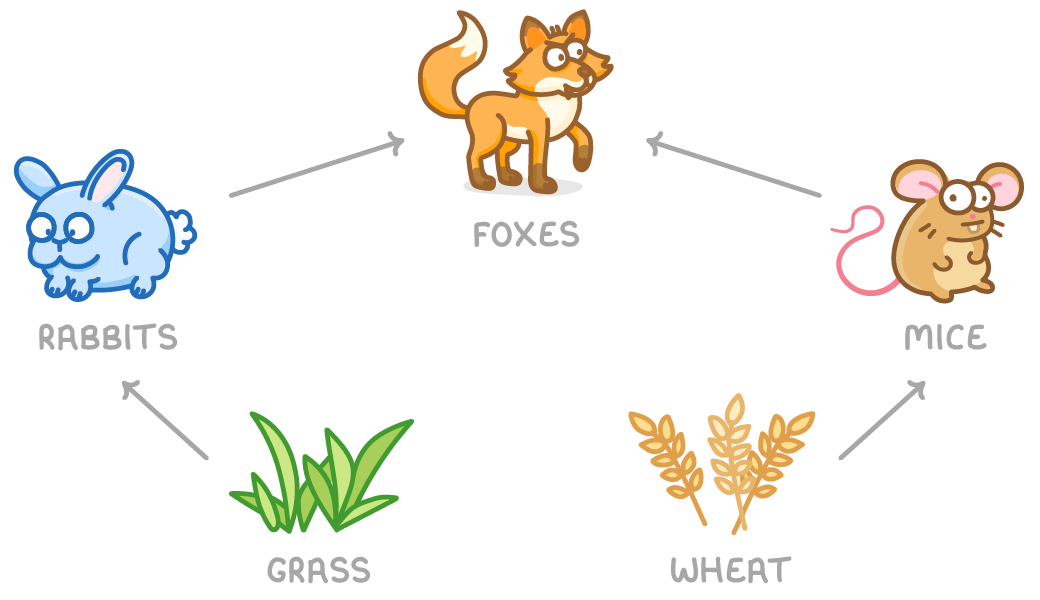
Arrows point from each organism to the one that eats it.
TermDefinition
PopulationAll the organisms of one species living together in the same place at the same time.
HabitatThe place where an organism lives.
CommunityAll the populations of different species living and interacting together in one habitat or ecosystem.
EcosystemThe interaction of a community of living organisms with the non-living parts of their environment.
Biotic factorA living part of the environment that affects organisms, such as predators or competition.
Abiotic factorA non-living part of the environment that affects organisms, such as temperature or light intensity.
NicheThe particular role an organism plays within its community.
BiodiversityThe variety of all the different species of organisms on Earth, or within an ecosystem.
Interspecific competitionCompetition between individuals of different species.
Intraspecific competitionCompetition between individuals of the same species.
InterdependenceThe way the species in a community depend on one another.
MutualismA relationship between two species where both benefit from the partnership.
ParasitismA relationship where one organism benefits at the expense of the other.
Key points to remember
How were these notes?