7.12 - Plant Responses & Tropisms
The experiment
Aim
To find out how the direction of a stimulus affects the direction in which seedlings grow, using either the direction of light (phototropism) or the direction of gravity (gravitropism).
Background
- A tropism is a growth response in which part of a plant grows towards or away from a stimulus. Growth towards the stimulus is called positive, and growth away from it is called negative.
- Shoots grow towards light (positive phototropism) and away from gravity (negative gravitropism), which sends them up into the light. Roots grow away from light and towards gravity (positive gravitropism), which sends them down into the soil.
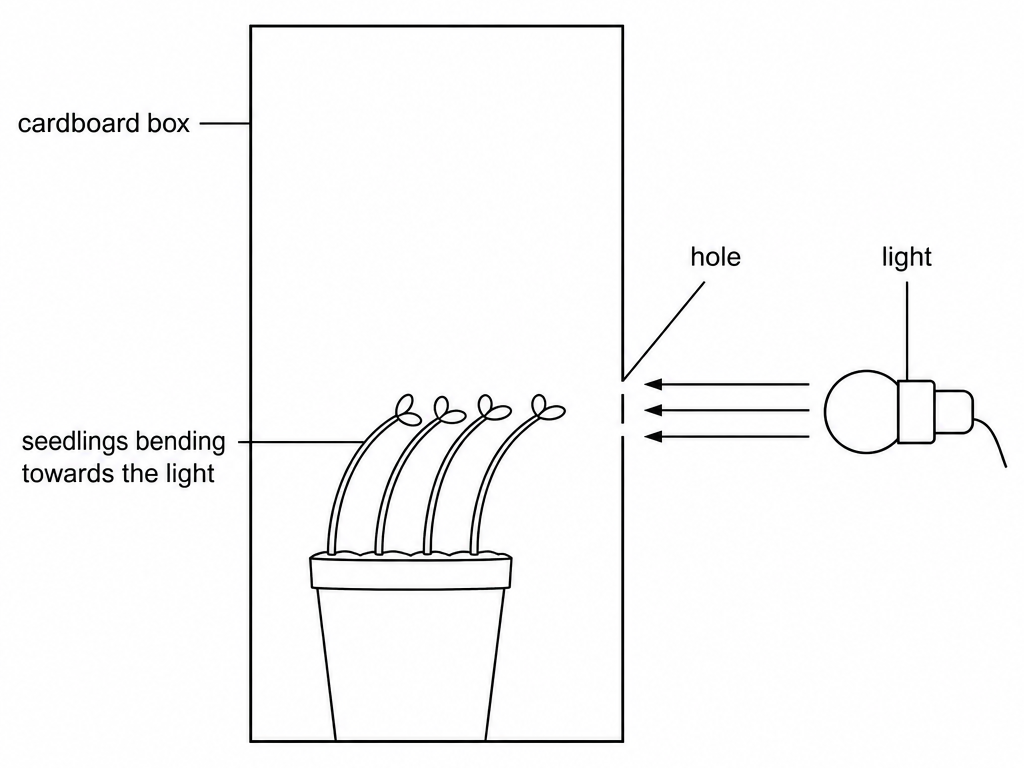
- These responses are controlled by a plant hormone called auxin. In a shoot lit from one side, auxin builds up on the shaded side and makes it grow faster than the lit side, so the shoot bends towards the light. In a root, auxin slows growth on the side where it collects, so a root lying on its side bends downwards, towards gravity.
- You can't see auxin at work, but you can see which way a shoot or root bends when the stimulus comes from only one direction.
- So in this practical you give seedlings light or gravity from one direction, and record which way their shoots and roots grow.
Variables
- Independent variable - The direction the stimulus comes from (light from one side, or gravity acting sideways when the seedlings are turned on their side).
- Dependent variable - The direction in which the shoots and roots grow.
- Control variables - The species and number of seeds, the amount of water, the temperature, and the length of time the seedlings are left.
Method - Light
- Grow the seedlings - Grow cress or mustard seeds on damp cotton wool or filter paper in Petri dishes, until they've just germinated and have small shoots.
- Set up three dishes - Put one in light from all sides, one inside a box with a single hole or slit so light comes from one side only, and one in complete darkness as a control.
- Leave the dishes - Keep the cotton wool moist, and leave the dishes for several days at the same temperature.
- Record the direction of growth - Record which way the shoots have grown in each dish.
Method - Gravity
- Grow the seedlings - Grow them in Petri dishes as for the light test.
- Turn some dishes on their side - Lay some dishes on their side, so gravity acts sideways, and keep others upright. Keep them all in the dark, so light can't affect the result.
- Set up a control - Put some seedlings on a klinostat.
- Record the direction of growth - After a few days, record whether the shoots have bent upwards and the roots downwards.
Safety
- Seeds - Wash your hands after handling them, because bought seeds are often coated with a fungicide.
- Lamps - Keep any lamp you use away from the damp dishes.
Common exam questions
Question 1
Cress shoots grew towards light coming from one side. Name this response and say whether it's positive or negative.
It's phototropism, and it's positive, because the shoots grew towards the light.
Question 2
Why were some seedlings kept in complete darkness?
As a control, to show that the shoots only bend when light comes from one direction. In the dark they grow straight up instead, so the bending must be a response to the direction of the light.
Question 3
What is a klinostat used for?
It slowly rotates the seedlings, so light or gravity acts on all sides equally. This cancels out any single direction, so it works as a control to show the bending is a response to the direction of the stimulus.
Question 4
Why are newly germinated seedlings used rather than older plants?
They're growing quickly at the tips of their shoots and roots, so the response happens fast and is easy to see within a few days.