1.7 - Sexual & Asexual Reproduction
Sexual and asexual reproduction
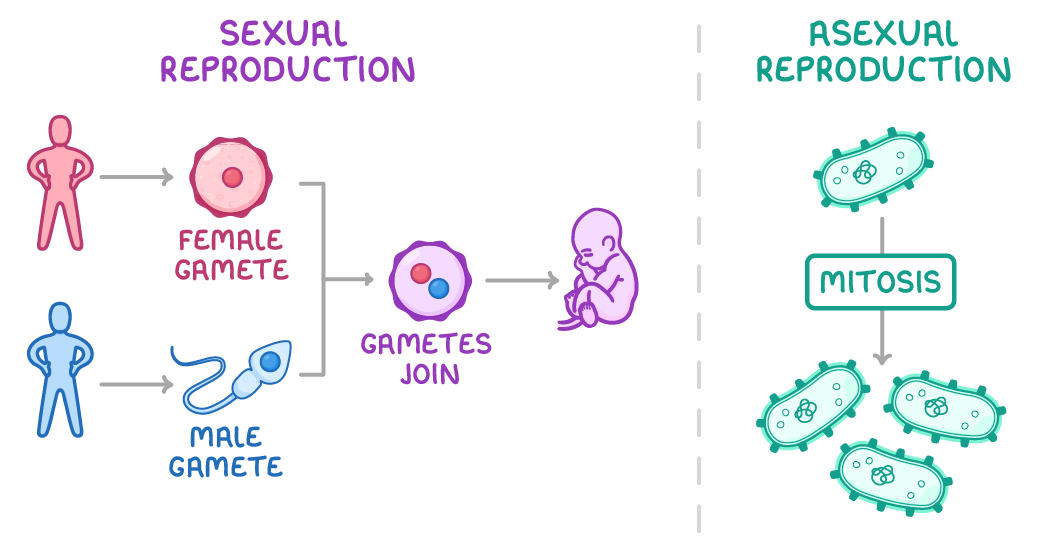
There are two ways living things reproduce: sexual and asexual.
Sexual reproduction
- Genetic information from two parents, a male and a female, is combined to produce offspring.
- Each parent produces special sex cells called gametes. Reproduction happens when the nucleus of a male gamete fuses with the nucleus of a female gamete, forming a single new cell called a zygote.
- Offspring receive a mixture of genetic information from both parents.
- They are therefore genetically different from each other and from either parent - this mixing leads to variation in the offspring.
Asexual reproduction
- There is only one parent. No gametes are involved and there is no joining of sex cells, so there is no mixing of genetic information.
- The parent produces new cells by mitosis - the type of cell division that makes genetically identical copies.
- Offspring are genetically identical to the parent and to one another. A group of genetically identical offspring produced this way are called clones.
- Examples:
- Bacteria reproduce asexually by splitting in two
- Many plants reproduce asexually too, e.g. a strawberry plant sending out runners that grow into new plants
- Some animals can also reproduce this way
How gametes are made
- Gametes are produced by a type of cell division called meiosis.
- Meiosis halves the chromosome number, so each gamete carries half the genetic information.
- When two gametes join at fertilisation, the full chromosome number is restored.
Gametes - The sex cells
- A gamete is a sex cell - one of the special cells that join together in sexual reproduction.
- Gametes differ from ordinary body cells because they carry only half the genetic information.
- When a male gamete and a female gamete fuse, the full amount of genetic information is restored.
- Sperm and egg cells are examples of specialised cells, each shaped for its particular job in reproduction.
Gametes in animals
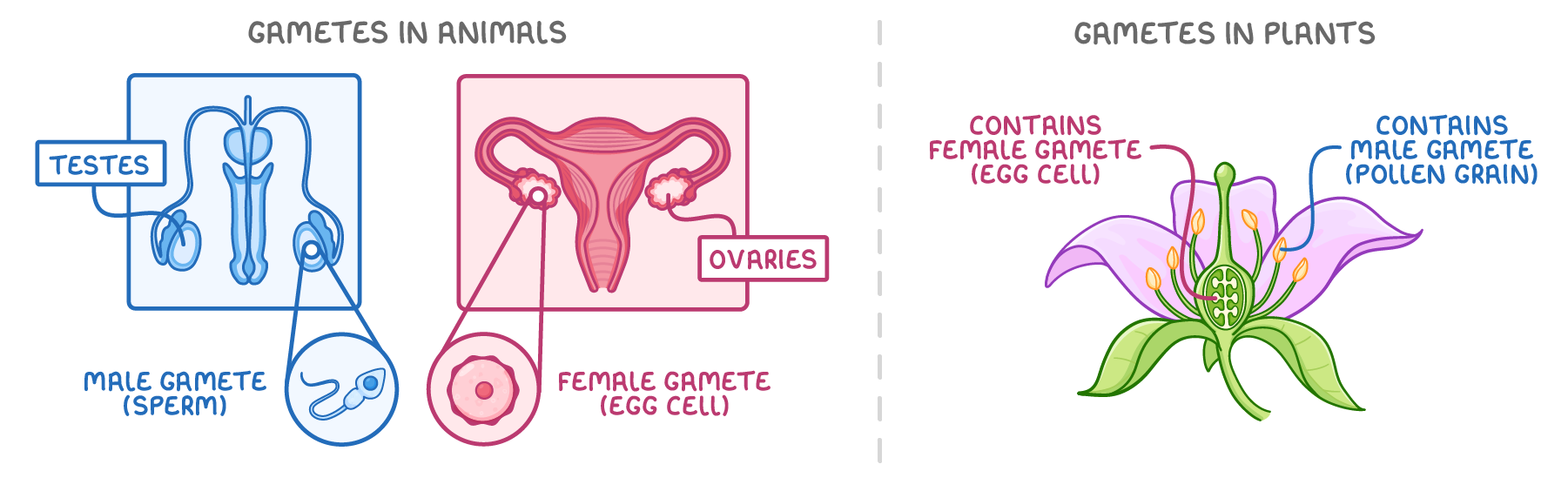
- Male gamete - The sperm cell, made in the male reproductive organs, the testes.
- Female gamete - The egg cell (also called the ovum), made in the female reproductive organs, the ovaries.
Gametes in plants
- Plants also reproduce sexually using gametes.
- Male gamete - Carried in a pollen grain.
- Female gamete - The egg cell found inside the flower.
Fertilisation - Forming the zygote and embryo
- Fertilisation is the fusion of the nucleus of a male gamete with the nucleus of a female gamete.
- When a sperm reaches an egg cell, the nucleus of the sperm fuses with the nucleus of the egg cell.
- Each gamete nucleus is haploid, carrying half the normal number of chromosomes, so when the two fuse the new cell has the full number again and is diploid.
- This single fertilised cell is called a zygote.
- After fertilisation, the zygote begins to divide by mitosis, making genetically identical copies of itself again and again.
- The single cell becomes a small ball of cells - the embryo, the very early stage of a new individual.
- Because the zygote received a mixture of chromosomes from both parents, the embryo inherits a combination of features from each of them.
- The random way the gametes combine at fertilisation is part of what produces variation between offspring.
From zygote to implantation in humans
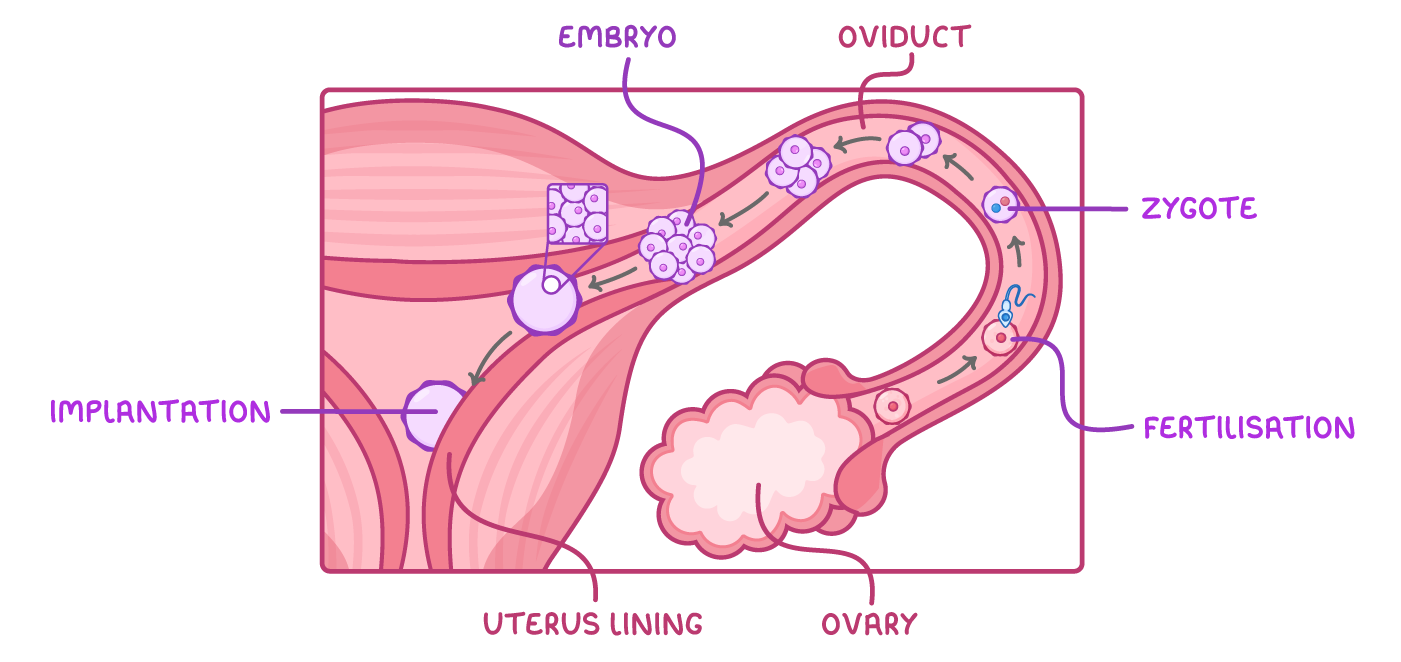
- Fertilisation takes place in the oviduct - the tube that carries the egg from the ovary.
- Once the zygote has formed there, it divides by mitosis many times into a ball of cells as it travels along the oviduct to the uterus.
- On reaching the uterus, the embryo sinks into the thick uterus lining and becomes attached - a step called implantation - where it can continue to develop.
TermDefinition
Sexual reproductionReproduction involving the fusion of the nuclei of two gametes, producing offspring that are genetically different from each other.
Asexual reproductionReproduction that involves only one parent and produces genetically identical offspring.
GameteA sex cell that carries half the number of chromosomes of an ordinary body cell.
CloneAn organism that is genetically identical to another organism, such as its parent.
FertilisationThe fusion of the nucleus of a male gamete with the nucleus of a female gamete.
HaploidDescribes a cell or nucleus that has a single set of chromosomes, which is half the normal number.
DiploidDescribes a cell or nucleus that has two sets of chromosomes, one set from each parent.
ZygoteThe single cell formed when the nuclei of a male gamete and a female gamete fuse at fertilisation.
Key points to remember
How were these notes?