5.11 - Contraception
Hormonal methods of contraception
- Fertility can be reduced using the hormones oestrogen and progesterone.
- These act on the events of the menstrual cycle to prevent an egg being released, or to stop sperm reaching it.
How each hormone reduces fertility
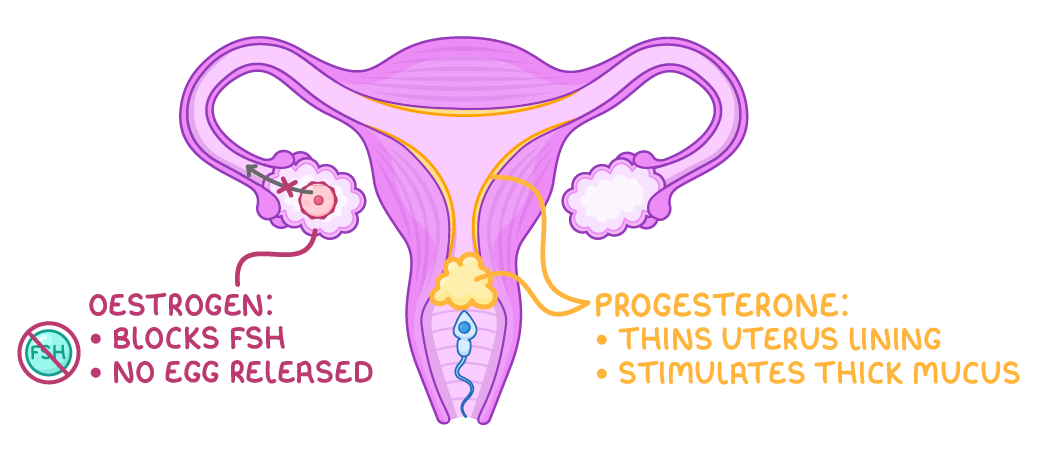
Oestrogen - Prevents the release of an egg:
- Naturally, oestrogen helps to trigger ovulation, but taking it every day keeps its level permanently high.
- A permanently high oestrogen level inhibits the production of FSH.
- Without the rise and fall of FSH, eggs stop developing and stop being released - and stay stopped for as long as the oestrogen is taken.
Progesterone - Reduces fertility in several ways:
- Stimulates thick mucus at the cervix (the entrance to the uterus), making it hard for sperm to get through and reach an egg.
- Thins the lining of the uterus, so a fertilised egg is less likely to implant.
- In many methods, also helps prevent ovulation by inhibiting the production of FSH and LH.
The main hormonal methods
- Combined oral contraceptive pill (the pill) - Contains both oestrogen and progesterone. Taken in a cycle of around 21 days on the pill followed by a short break. When taken correctly, it is over 99% effective.
- Progesterone-only pill (mini-pill) - Contains progesterone alone and must be taken every day.
- Contraceptive implant - A small flexible tube, about 4 cm long, inserted just under the skin of the arm. Releases progesterone slowly and can last up to three years.
- Contraceptive patch - Contains oestrogen and progesterone. Stuck to the skin; each patch lasts about one week.
- Contraceptive injection - Contains progesterone; each dose lasts about two to three months.
Non-hormonal methods of contraception
As well as hormonal methods, pregnancy can be prevented by:
- A physical or chemical barrier between the sperm and egg
- A device placed in the uterus
- Timing intercourse
- Surgery
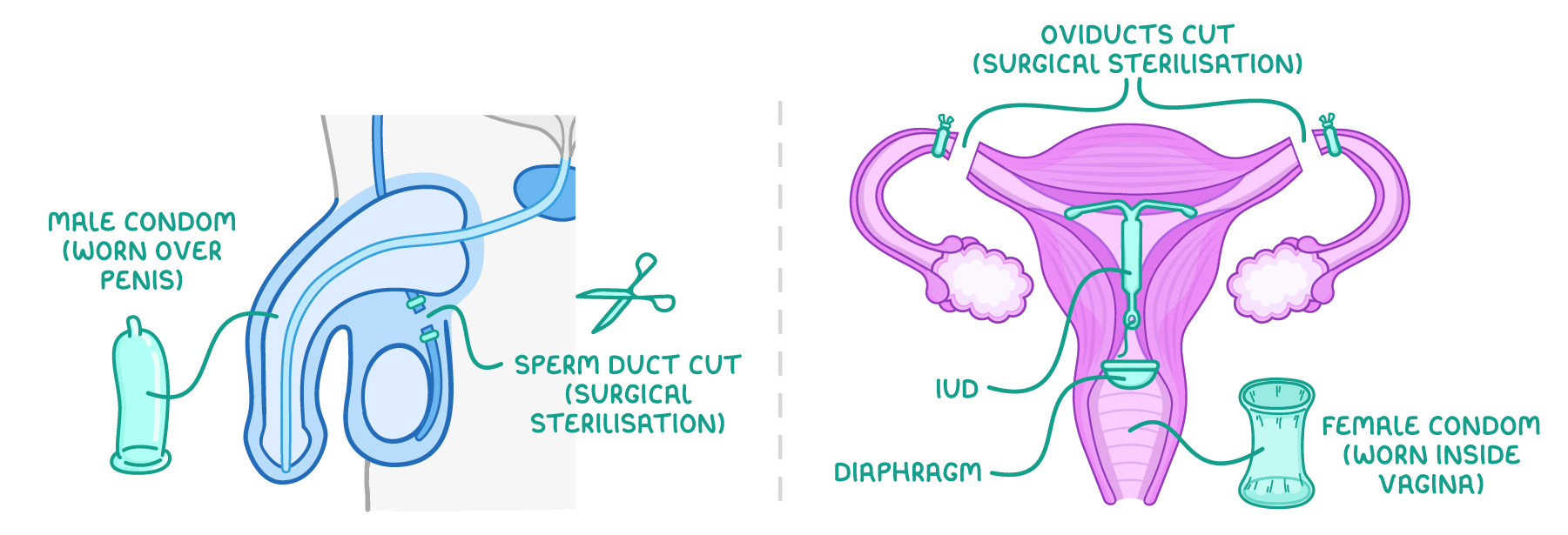
Barrier methods stop the sperm and egg meeting
- Condom - Worn over the penis during intercourse to stop sperm entering the vagina. Female condoms are worn inside the vagina. Typically around 95-98% effective.
- Diaphragm - A shallow, dome-shaped plastic cup that fits over the cervix (the opening of the uterus) to form a barrier. It must be used with a spermicide and is around 92-96% effective.
Spermicide
- Spermicide is a chemical that kills or disables sperm.
- It is used with a diaphragm, but can also be used on its own - although alone it is much less reliable, at only about 70-80% effective.
Intrauterine device (IUD)
- A small T-shaped device inserted into the uterus.
- Copper IUDs prevent sperm from surviving and alter the lining of the uterus so a fertilised egg cannot implant.
- There are also intrauterine systems that release progesterone.
- More than 99% effective and can stay in place for several years (up to about ten).
Natural methods and abstinence
- Natural methods involve avoiding intercourse on the days of the menstrual cycle when an egg may be in the oviduct and the woman is most fertile.
- They appeal to people who regard hormonal and barrier methods as unnatural, but they are not very reliable.
- Abstinence - Not having intercourse at all - is the only way to be completely certain that sperm and egg never meet.
Surgical sterilisation is a permanent method
- In a female, the oviducts (which carry eggs from the ovaries to the uterus) are cut or tied, so eggs cannot pass along them and sperm cannot reach an egg to fertilise it.
- In a male, a vasectomy cuts or ties the sperm ducts, so sperm cannot leave the testes to be ejaculated.
- Virtually 100% reliable, but very difficult or impossible to reverse, with a very small chance that cut tubes rejoin.
Evaluating the methods of contraception
No single method of contraception is best for everyone, so methods are weighed against each other on several points.
Effectiveness
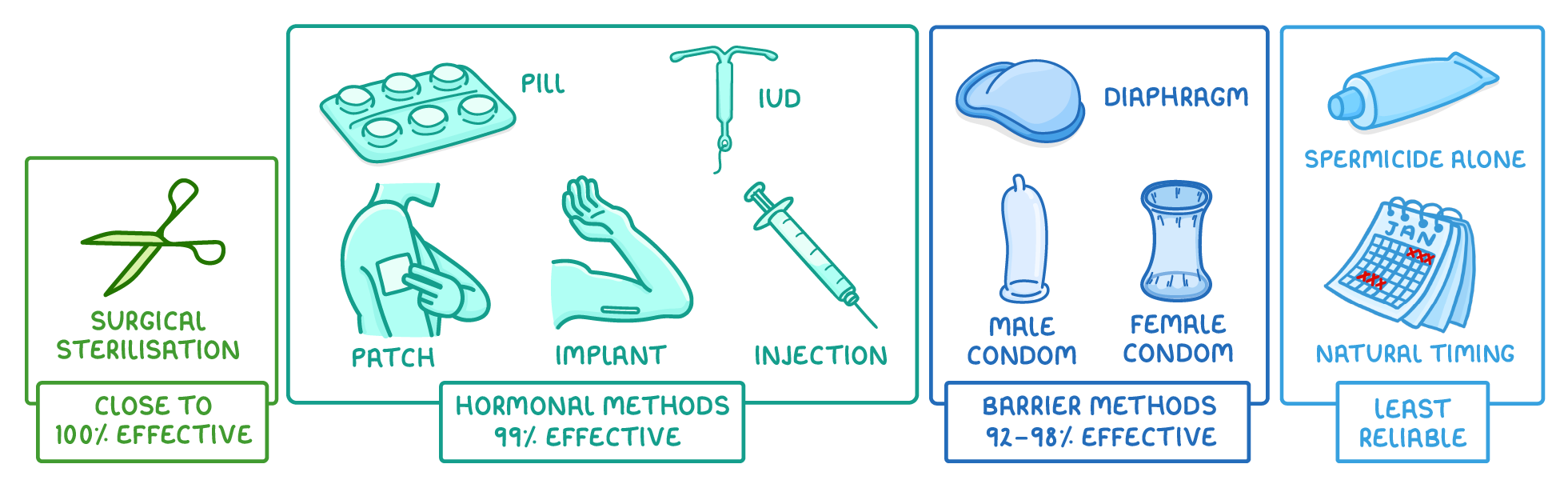
- Hormonal methods (the pill, implant, injection) and the IUD - Over 99% effective when used correctly.
- Surgical sterilisation - Close to 100% effective.
- Barrier methods (condoms, diaphragms) - Slightly less effective, around 92-98%.
- Natural timing methods and spermicide used alone - The least reliable.
How easy a method is to use wrongly
- Barrier and natural methods must be used correctly every single time - a split condom or misjudged timing causes failure.
- Some hormonal methods can also fail if not used properly, e.g. a missed pill or a patch not replaced on time.
- Long-acting methods (implant, injection, IUD) avoid this - once in place there's nothing to remember day to day, which some people prefer.
Side effects
- Hormonal methods can cause headaches, nausea, acne, mood changes, and weight gain, and may slightly raise the risk of blood clots.
- The progesterone-only pill tends to cause fewer side effects than the combined pill.
- Barrier methods have no such hormonal side effects.
Medical input needed
- Some methods need a prescription, or a procedure to fit a device or carry out sterilisation, which some people find off-putting.
- Condoms and spermicides can be obtained and used without seeing a doctor.
Protection against infection
- Only the condom also acts as a barrier to infections passed on during intercourse.
- None of the hormonal methods, the IUD, or sterilisation offers this.
Ethical and personal issues
- Some people object to certain methods on religious or moral grounds.
- This is why a range of methods exists to suit different needs and beliefs.
TermDefinition
SpermicideA chemical that kills or disables sperm.
VasectomyA surgical procedure for males that cuts or ties the sperm ducts to prevent sperm from being ejaculated.
Key points to remember
How were these notes?