6.9 - Classification
How classification has changed
- Classification systems have changed over time as scientists gained new tools and evidence.
- Early classification used observable characteristics - features you can see, such as how many legs an animal has or whether a plant flowers.
- As microscopes improved, this grew to include features visible only under magnification, such as cell structure.
- These characteristics were used to sort living things into the five-kingdom classification system, where organisms are first split into five large groups called kingdoms, then into smaller and smaller groups.
The rise of molecular evidence
- As biochemistry and genetics developed, scientists became able to work out the sequence of DNA bases in different organisms' genes, and of their RNA, and compare them.
- The more similar the base sequence of a gene is between two organisms, the more closely related they are.
- For example, human and chimpanzee DNA is about 94% the same, showing the two are close relatives.
- This evidence is far more precise than appearance alone, because it can show:
- Two organisms that look very similar are actually only distantly related.
- Two organisms that look different are in fact close relatives.
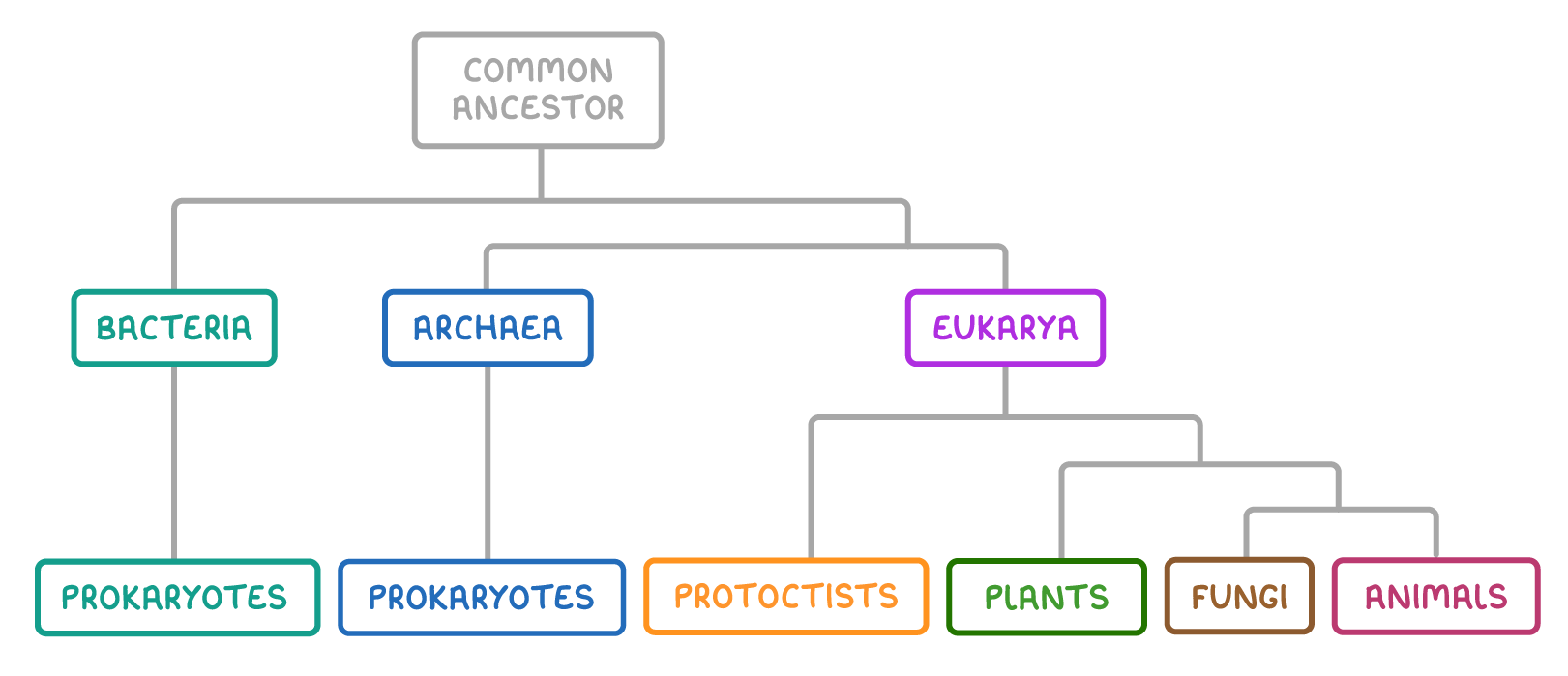
- These relationships are shown on an evolutionary tree (also called a phylogenetic tree), a branching diagram in which each branch point stands for a common ancestor. The more recently two species share a common ancestor, the more closely related they are.
The three-domain system
- Molecular evidence led to a rethink of how organisms are classified.
- Using RNA sequencing, the scientist Carl Woese found that some members of the prokaryote kingdom were far less closely related than had been assumed.
- He proposed a new top level of classification: three large groups called domains, placed above the kingdoms.
The three domains are:
- Archaea - Prokaryotic organisms once thought to be bacteria but genetically distinct, often living in extreme places such as hot springs and salt lakes
- Bacteria - The true bacteria
- Eukarya - All organisms with eukaryotic cells, including animals, plants, fungi, and protoctists
The five-kingdom scheme is still used, but the three domains now sit above it.
TermDefinition
DomainThe highest level of classification. Carl Woese introduced this level, dividing all organisms into three domains (Archaea, Bacteria and Eukarya).
Key points to remember
How were these notes?