4.6 - Specialised Cells & Differentiation
Specialised cells adapted to their function
- Most cells are specialised. This means they have a particular shape and set of sub-cellular structures that suit them to a specific job.
- This lets them carry out that job more efficiently than an unspecialised cell could.
Specialised animal cells
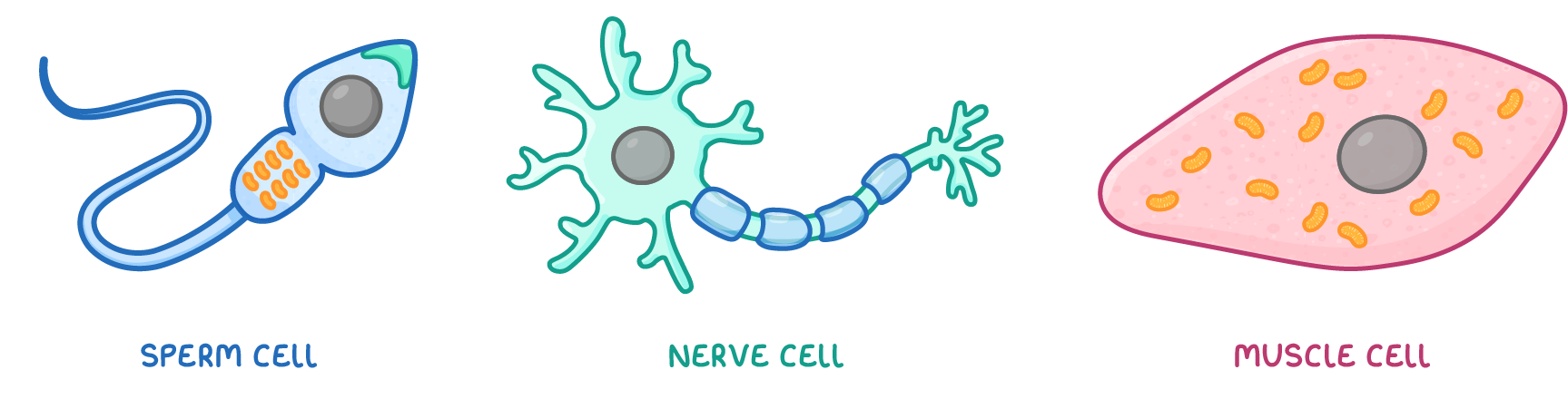
- Sperm cell - Carries the male DNA to the female egg.
- A long tail (flagellum) so it can swim to the egg
- A streamlined head to move easily
- Many mitochondria packed into the middle section to release the energy (from respiration) needed for the journey
- Enzymes in its head to digest through the egg's outer membrane
- Nerve cell (neurone) - Carries electrical signals from one part of the body to another.
- Very long, so it can carry signals over a large distance
- Branched at its ends to connect to other nerve cells and form a network throughout the body
- Muscle cell - Contracts to produce movement.
- Long, giving it room to contract
- Full of mitochondria to release the energy that contraction needs
Specialised plant cells
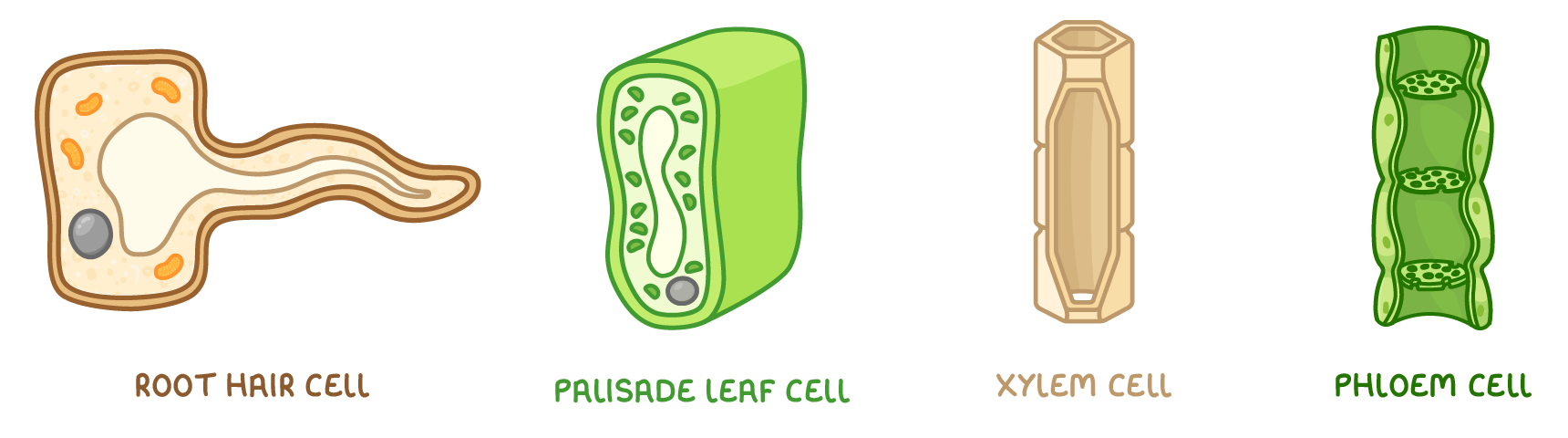
- Root hair cell - Absorbs water and mineral ions from the soil. It has a long projection that sticks out into the soil, giving a large surface area for absorption.
- Palisade leaf cell - Carries out most of the photosynthesis in a plant.
- Packed with chloroplasts
- Tall, so a large surface area is exposed for absorbing carbon dioxide
- Thin, so many cells can be fitted in near the top of the leaf, close to the light
- Xylem and phloem cells - Form the tubes that transport substances through a plant. They are long and joined end to end:
- Xylem cells are hollow in the centre
- Phloem cells have very few sub-cellular structures
- This lets water and dissolved food flow through them
Differentiation
- Differentiation (also called specialisation) is the process by which a cell changes to become specialised for a particular function.
- As a cell differentiates, it develops the sub-cellular structures that let it do its specific job - turning a general, unspecialised cell into a specialised one such as a nerve cell or a muscle cell.
- Having a range of specialised cells lets a multicellular organism work more efficiently than if all its cells were the same.
When differentiation happens - Animals vs plants
- Most differentiation happens as an organism develops from its earliest stages.
- The key difference is whether the ability to differentiate is kept:
- Animal cells - Most lose the ability to differentiate at an early stage, soon after becoming specialised
- Plant cells - Many never lose the ability and can differentiate throughout the plant's life, helping the plant keep growing new parts such as leaves and roots
- Because most mature animal cells can no longer differentiate freely, cell division in a mature animal is mainly used for repairing and replacing cells - for example making new skin cells or blood cells - rather than building new types of cell.
How differentiation works at the level of genes
- A cell differentiates by switching genes on and off.
- Every body cell contains the same full set of genes, but in a specialised cell most of those genes are switched off, so the cell makes only the particular proteins it needs for its job.
- Which genes stay switched on determines what type of specialised cell it becomes.
TermDefinition
Specialised cellA cell whose structure is adapted to perform a particular function.
DifferentiationThe process by which a cell changes to become specialised for a particular function.
Key points to remember
How were these notes?