7.5 - Culturing Microorganisms & Testing Antimicrobials
The experiment
Aim
To investigate how effective different antiseptics (or different concentrations of one antiseptic) are at stopping bacteria growing, measured by the clear zone left around each.
Background
- Bacteria spread over agar jelly in a Petri dish grow into a visible layer, called a lawn.
- An antiseptic kills bacteria or stops them growing.
- Unwanted microorganisms from the air, your hands, or the equipment would grow too. Aseptic technique keeps them out, so only the bacteria you added grow.
- You can't see the antiseptic acting on the bacteria, but you can see where they haven't grown. Around a disc soaked in antiseptic there is a clear zone of inhibition with no bacteria.
- So in this practical you measure the clear zone around discs soaked in different antiseptics. The bigger the clear zone, the more effective the antiseptic.
Variables
- Independent variable - The type of antiseptic, or its concentration.
- Dependent variable - The area of the clear zone around each disc.
- Control variables - The type and amount of bacteria, the size of the paper discs, the agar, and the incubation temperature and time.
Method
- Sterilise the loop - Pass the inoculating loop through a Bunsen flame, and work near the flame so the air around you stays clear of stray microbes.
- Spread the bacteria - Spread the bacteria evenly over the sterile agar in a Petri dish.
- Add the discs - Soak equal-sized paper discs in the different antiseptics, and one more in sterile water as a control. Place them on the agar well apart.
- Tape and turn the dish - Tape the lid on, but not all the way round, and turn the dish upside down.
- Incubate - Leave the dish at 25 °C for one to two days.
- Measure the clear zones - Measure the diameter of the clear zone around each disc, and work out its area.
Safety
- Sterilised equipment - Use only sterilised agar, dishes, and loops, and pass the loop through the flame after use as well as before.
- Never open an incubated dish - The cultures are sterilised in an autoclave before they're thrown away.
- Clean up - Disinfect the bench and wash your hands when you finish.
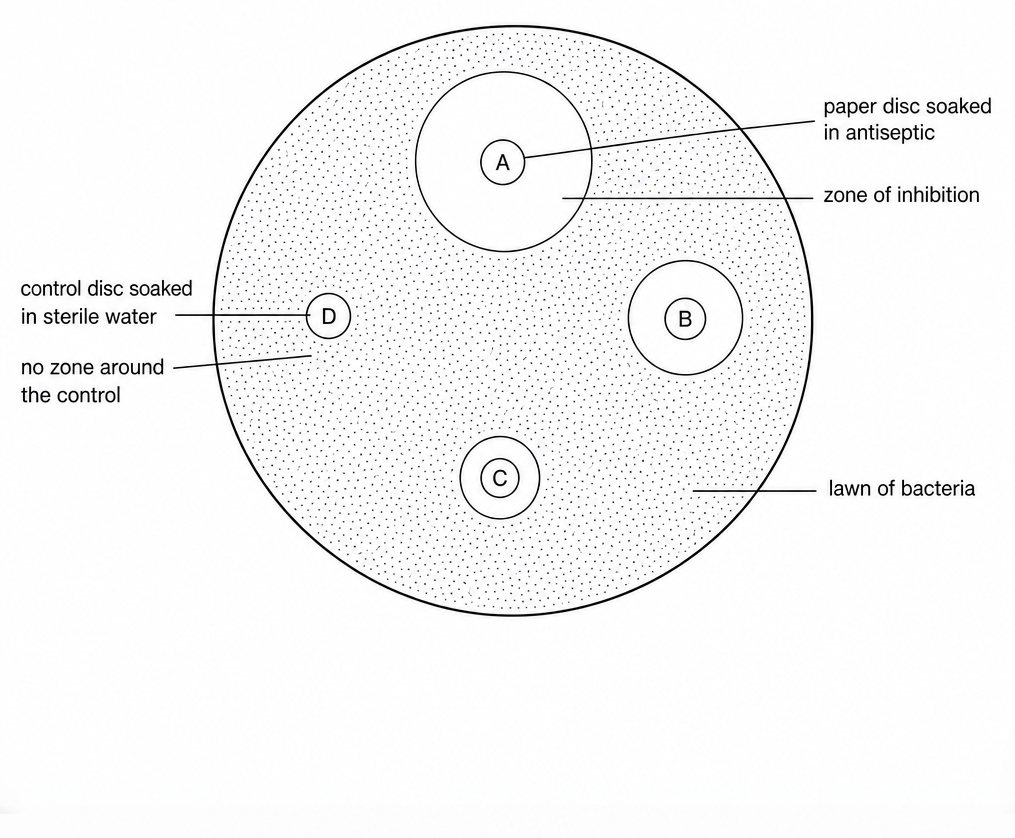
Disc D has no zone, so the zones come from the antiseptic, not the paper.
Worked example - Area of a clear zone
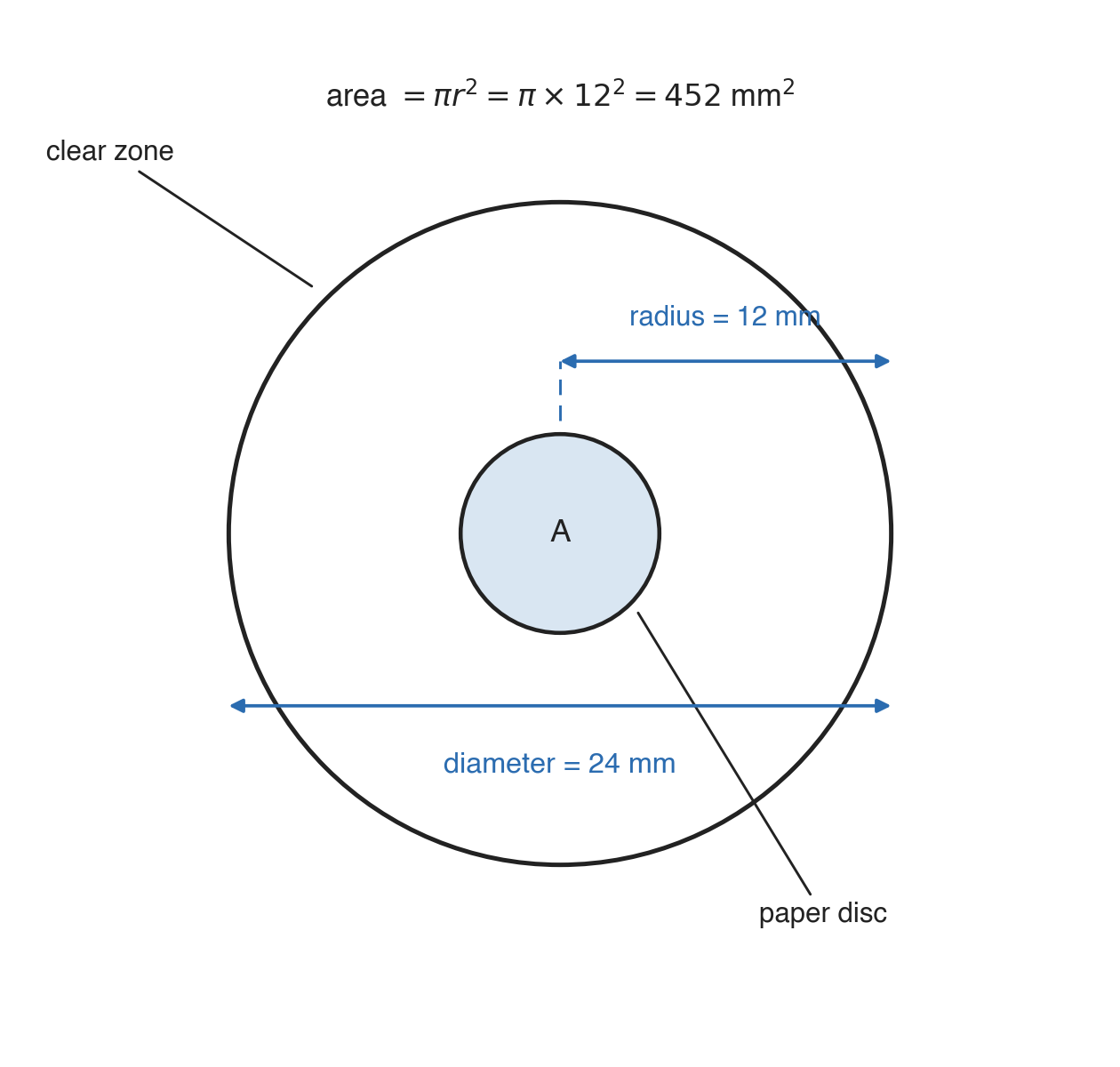
A student tested antiseptics A and B on a lawn of bacteria. After incubation, the clear zone around the disc soaked in antiseptic A was 24 mm across, and the clear zone around the disc soaked in antiseptic B was 12 mm across.
Find the area of each clear zone, and use the areas to decide which antiseptic is the more effective.
Step 1 - Find the radius of antiseptic A's zone
The 24 mm is the diameter, all the way across, so the radius is half of it.
24 ÷ 2 = 12 mm
Step 2 - Find the area of antiseptic A's zone
Step 3 - Find the area of antiseptic B's zone
Antiseptic B's zone is 12 mm across, so its radius is 12 ÷ 2 = 6 mm.
Step 4 - Decide which antiseptic is more effective
Antiseptic A's clear zone (452 mm2) has four times the area of antiseptic B's (113 mm2), so antiseptic A is the more effective at stopping the bacteria.
Common exam questions
Question 1
Why are the plates incubated at 25 °C and not at 37 °C?
To reduce the risk of growing harmful bacteria (pathogens), which grow best at human body temperature.
Question 2
Why is the lid taped on but not sealed all the way round?
Taping keeps microbes from the air out, but leaving a gap lets oxygen in, so harmful anaerobic bacteria are less likely to grow.
Question 3
Why is one disc soaked only in sterile water?
It's a control, to show that any clear zone is caused by the antiseptic and not by the disc itself.
Question 4
Why is the inoculating loop passed through a flame first?
To sterilise it, killing any microbes on it so they don't contaminate the culture.