2.1 - Health & Disease
Health and the factors that affect it
- Health is the state of physical and mental wellbeing - and, as the World Health Organisation puts it, of social wellbeing too, and not merely the absence of disease or infirmity.
- Being healthy is about more than just not being ill: someone who is physically fit can still be unhealthy if they have mental health problems or are socially isolated.
- A disease is a condition that impairs the normal functioning of an organism, and is one of the major causes of ill health.
- Both animals and plants can get diseases.
Causes of disease and ill health
- Infection by a pathogen - A pathogen invades the organism
- A mutation in an organism's genes
- Environmental conditions - E.g. a plant that doesn't get enough light won't grow properly
- Diet, lifestyle or life situation - A person's day-to-day circumstances
A disease shows itself through symptoms - changes in the organism that indicate disease is present - although these aren't always obvious, especially in the early stages.
Other factors that affect health
- Diet - A good, balanced diet gives the body what it needs, whereas a poor diet harms both physical and mental health
- Stress - Being under constant stress can cause health problems
- Life situation - This includes whether a person can get hold of medicines to treat illness and the things that help prevent it
Communicable and non-communicable disease
Diseases fall into two groups, depending on whether they can spread between organisms.
Communicable (infectious) diseases
- Can spread from one organism to another - between people, or between animals and people.
- Are caused by pathogens.
- Examples: measles and malaria.
Non-communicable diseases
- Cannot be passed between organisms.
- Tend to last a long time and get worse slowly.
- Examples: asthma, cancer, and coronary heart disease.
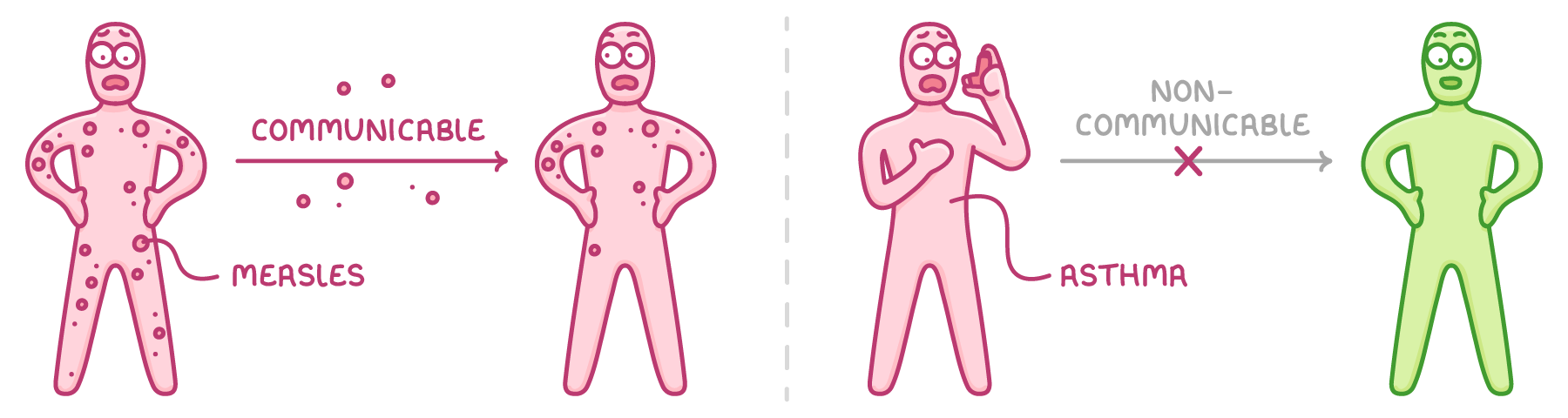
How diseases interact
- Different types of disease can interact, so that having one disease makes another more likely.
- A disease can also leave the body weakened, making it more susceptible to others.
Four main ways diseases interact
- Immune system problem - Reduces the body's ability to defend itself against pathogens, raising the risk of communicable diseases such as influenza. For example, HIV damages the immune system, so a person with HIV who is then infected with the tuberculosis bacterium cannot fight it off and the disease progresses rapidly.
- Viruses triggering cancers - Some viruses living in cells can trigger cancers. Infection with HPV (human papillomavirus) causes most cases of cervical cancer.
- Immune reactions triggering allergies - An immune reaction set off by infection with a pathogen can trigger allergies, such as skin rashes or worsened asthma.
- Physical ill health leading to mental illness - Severe physical ill health can lead to mental illness, such as depression, particularly when it affects a person's ability to carry out everyday activities.
TermDefinition
HealthThe state of physical, mental and social wellbeing, and not just the absence of disease.
DiseaseA condition that impairs the normal functioning of an organism.
SymptomA change in an organism that indicates disease is present.
Communicable diseaseA disease caused by a pathogen that can be passed from one organism to another.
Non-communicable diseaseA disease that cannot be passed from one person to another.
Key points to remember
How were these notes?