5.9 - Family Pedigrees
Reading a family pedigree
- A family pedigree (also called a family tree or pedigree diagram) is a chart showing how a characteristic - usually an inherited disorder like cystic fibrosis - is passed down through the generations of one family.
- Once you understand how it's set out, you can work out each person's phenotype (affected or unaffected) and their genotype, including who is a carrier.
- The example used here is cystic fibrosis, a characteristic caused by a recessive allele.
Reading the symbols
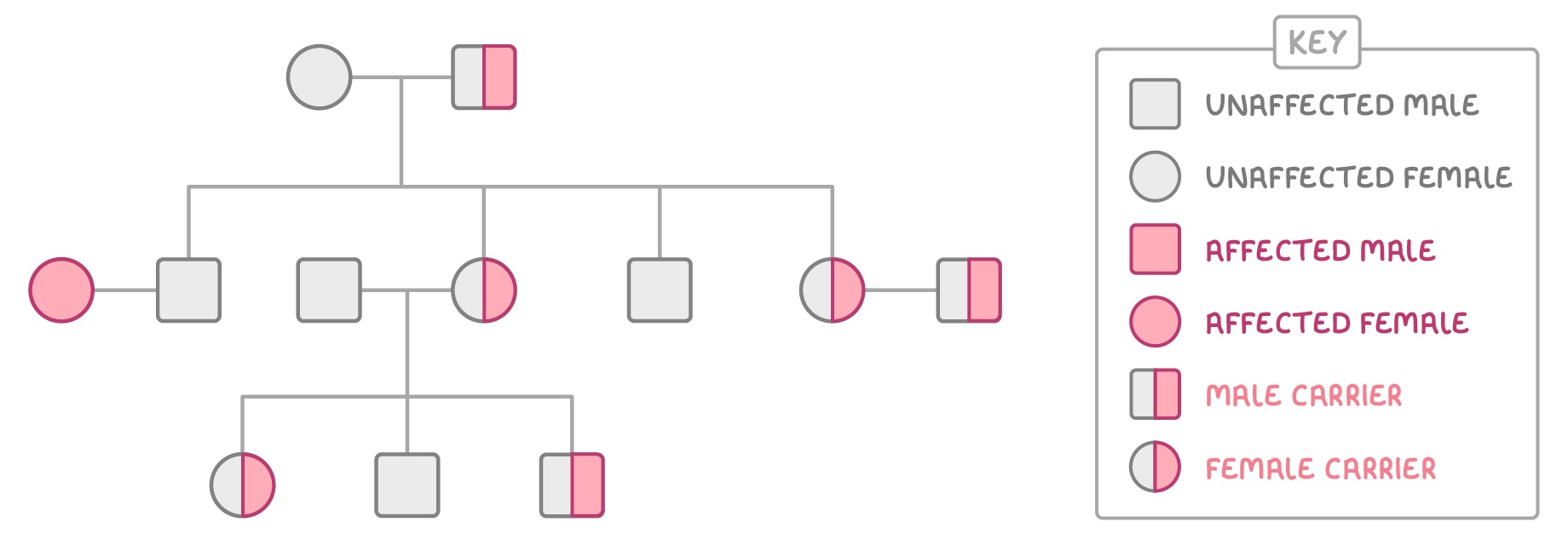
- Every pedigree comes with a key - the symbols never have to be memorised, you just read the key.
- The usual convention is:
- Square - A male
- Circle - A female
- Unshaded shape - A person who does not have the characteristic
- Fully shaded shape - A person who does have it
- Half-shaded shape - A carrier, who has one copy of the recessive allele but doesn't show the characteristic, so can pass it on without having it
Reading the layout
- The chart is arranged in rows, and each row down is a new generation - top row the grandparents, next row their children, next their grandchildren.
- A horizontal line joining two people means they're a couple.
- A vertical line drops from a couple down to their children.
- Someone who has married into the family from outside is joined to their partner by a horizontal line, even though they belong to a different family.
- Reading the shading against the key gives each person's phenotype.
Working out genotypes
- Once you know whether the characteristic is dominant or recessive, the pattern lets you work out each person's genotype.
- You can confirm cystic fibrosis is recessive straight from the tree: many of the family carry the allele but don't have the disorder, which would be impossible if a single copy were enough to show it.
For a recessive characteristic, the genotype follows directly from each phenotype:
- Affected - Must be homozygous recessive (ff), because two copies are needed to show it
- Carrier - Unaffected but able to pass the allele on, so must be heterozygous (Ff)
- Unaffected, not a carrier - Must be homozygous dominant (FF)
Other points:
- You can also reason backwards: if two unaffected parents have an affected child, both parents must each have carried a hidden recessive allele, so both are carriers (Ff).
- Working through the tree person by person this way lets you label everyone with both a phenotype and a genotype.
- For a characteristic caused by a dominant allele the pattern looks different - there are no carriers, because a single copy of a dominant allele already shows in the phenotype.
Working out probabilities from a pedigree
- Once you've read a pedigree to find people's genotypes, you can predict the chance of a particular outcome in the next child.
- The step specific to a pedigree is reading the two parents' genotypes off the tree first: deduce each one's genotype from whether they are affected, a carrier or unaffected, then treat it as an ordinary genetic cross between those two genotypes.
- The proportions of offspring genotypes give the probabilities for the child.
- This works for any pair of parents in the pedigree, and for either a recessive or a dominant characteristic: deduce the parents' genotypes, cross them, and read the probability of each outcome off the result.
Example - Two carriers (Ff × Ff)
- Take a couple on a cystic-fibrosis pedigree who are both unaffected carriers, so each is read off the tree as heterozygous (Ff).
- Crossing Ff × Ff gives four equally likely combinations: FF, Ff, Ff and ff.
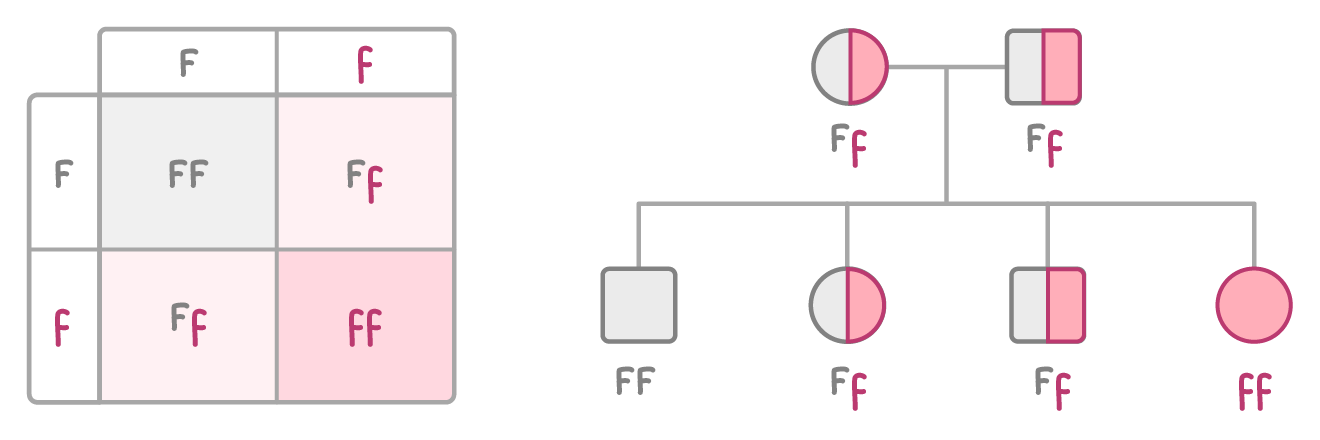
For any one child, the chances of each outcome are:
| Outcome | Genotype | Chance |
|---|---|---|
| Unaffected, not a carrier | FF | 1 in 4 (25%) |
| Unaffected carrier | Ff | 1 in 2 (50%) |
| Has cystic fibrosis | ff | 1 in 4 (25%) |
That's a ratio of 1 unaffected : 2 carriers : 1 affected, which can equally be given as percentages. Reading the pedigree is what tells you the parents are both carriers in the first place.
Probabilities, not certainties
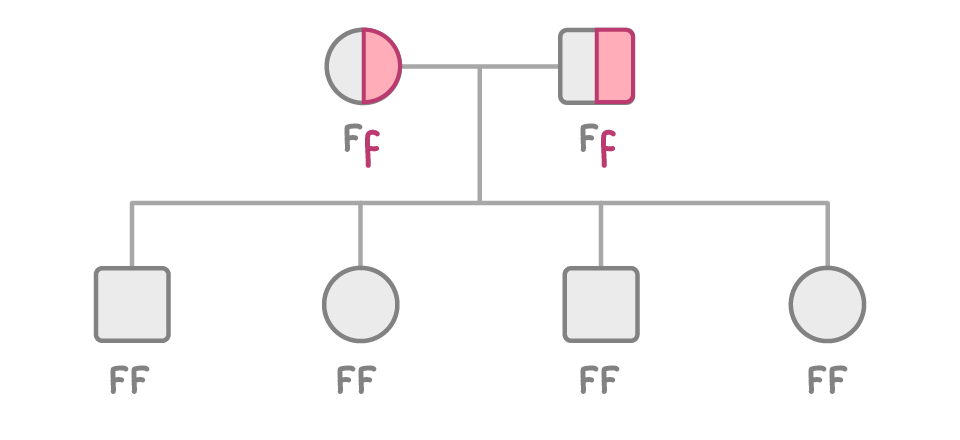
- Each child is a separate, independent event with the same 1 in 4 chance of being affected.
- So a couple could, for example, have several children who are all unaffected even though the predicted risk for each one was 25%.
TermDefinition
Family pedigreeA chart showing how a characteristic is passed down through the generations of one family.
CarrierA person who has one copy of a recessive allele. They do not show the characteristic it causes, but can pass the allele on to their children.
Key points to remember
How were these notes?