6.22 - Pregnancy Testing
Monoclonal antibodies in pregnancy testing
- A monoclonal antibody can be made to bind to one specific chemical, so it can be used to detect that chemical in a sample.
- The everyday example is the pregnancy test. It detects HCG, a hormone found in a woman's urine only when she is pregnant.
How the test stick works
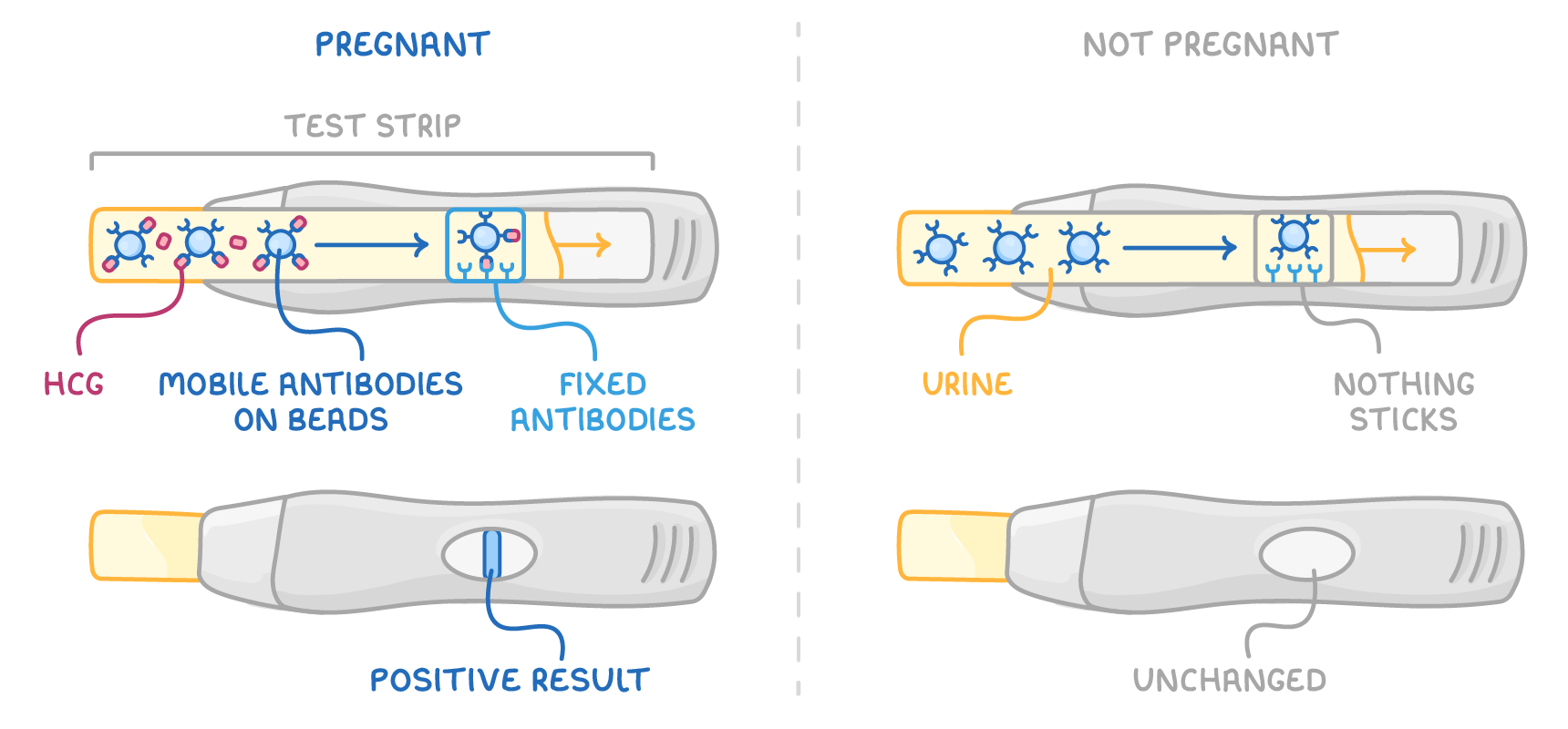
- The end that's urinated on carries antibodies to HCG attached to coloured (blue) beads - these antibodies and beads are free to move.
- Further along, a test line has more antibodies to HCG stuck firmly in place so they can't move.
If the woman is pregnant:
- HCG in the urine binds to the antibodies on the beads.
- The urine carries the beads and hormone along the stick to the test strip.
- The hormone binds to the fixed antibodies, holding the beads there and turning the test line a colour.
If she is not pregnant:
There's no HCG, so the beads are washed past the fixed antibodies and nothing sticks - the strip stays unchanged.
The same idea detects other substances
This is a lateral-flow test. Using different antibodies, the same idea can detect other substances - such as the antigens on a pathogen.
TermDefinition
Monoclonal antibodyAn antibody produced by a single clone of cells, so that all copies are identical and bind to the same specific antigen.
HCGA hormone found in a woman's urine only when she is pregnant.
Key points to remember
How were these notes?