3.5 - The Endocrine System
What a hormone is
- A hormone is a chemical messenger.
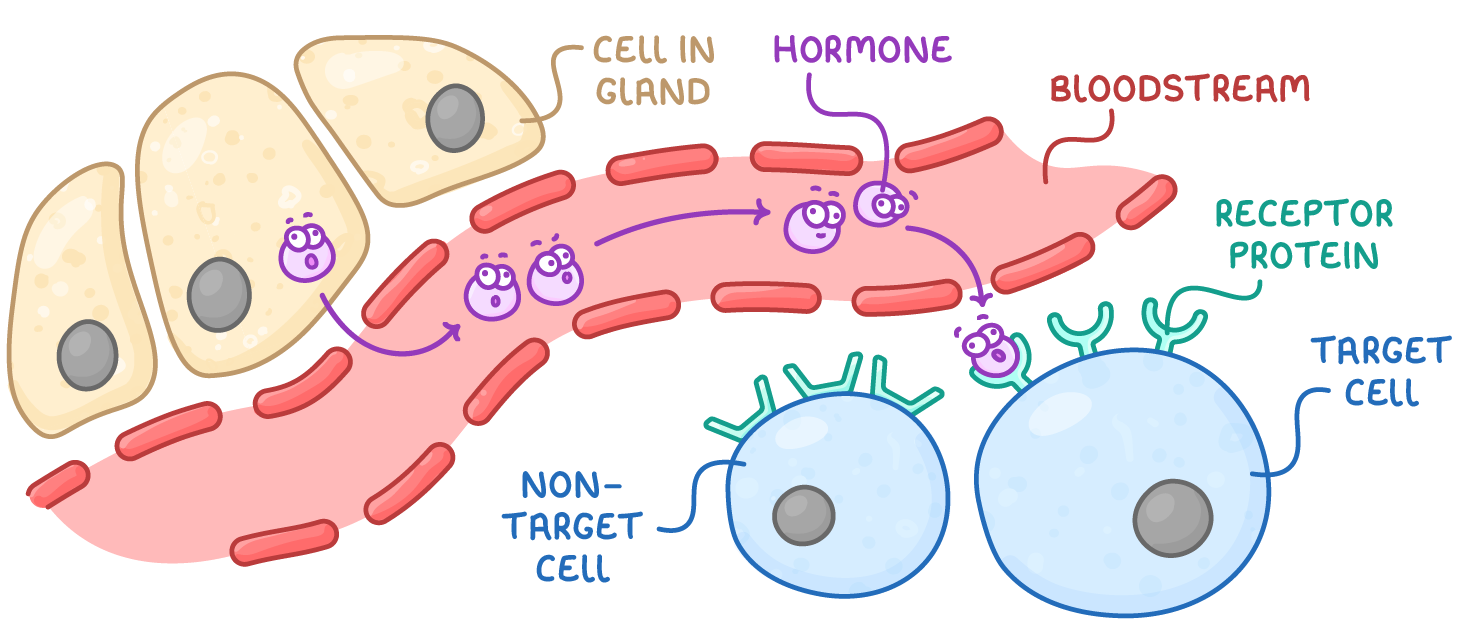
- It is made by a gland and released directly into the blood, which carries it around the body.
- Although a hormone travels everywhere in the blood, it does not affect every cell - it only acts on certain cells called target cells, found in particular organs or tissues.
- An organ or tissue that contains a hormone's target cells is its target organ or target tissue.
Why a hormone acts only on its target cells
- Target cells carry receptor proteins that are complementary to that specific hormone - shaped to fit it.
- Only a cell with the matching receptor can detect the hormone and respond to it.
- Cells without the receptor, called non-target cells, are unaffected even though the hormone reaches them in the blood.
- When a hormone binds to the receptor on a target cell, it triggers a change inside that cell - the cell's response.
The endocrine system
- Hormones are made by glands called endocrine glands, which together make up the endocrine system.
- Because hormones are carried in the blood rather than along nerves, they control processes in the body that need steady, ongoing adjustment.
Comparing nervous and hormonal control
- The body has two systems for sending information and controlling responses: the nervous system and the endocrine (hormonal) system.
- Both do a similar job - they carry messages that bring about responses in the body - but they work in different ways.
- The differences come down to speed, how long the effect lasts, and how widely it acts.
How the two systems differ
| Feature | Nervous control | Hormonal control |
|---|---|---|
| Message carried by | Electrical impulses along neurones | Chemicals carried in the blood |
| Speed | Very fast | Slower to take effect |
| Duration | Short-lived | Long-lasting |
| Area affected | Precise/localised - a particular muscle or gland | General/widespread - cells across the body |
Which response suits which system
- Nervous suits responses that must happen at once and then stop - e.g. pulling a hand away from something hot.
- Hormonal suits processes that need steady, ongoing control rather than a single quick response.
- Quick tip for telling which system is responsible: a very quick, brief response is usually nervous, while a response that builds up or lasts a long time is usually hormonal.
TermDefinition
HormoneA chemical messenger that controls a process in an organism. In animals, hormones are made by glands and carried in the blood to target organs.
Target cellA cell with specific receptor proteins that allow it to detect and respond to a hormone.
Endocrine glandA gland that produces hormones and releases them directly into the blood.
Endocrine systemThe network of glands that produce and release hormones to control ongoing processes in the body.
Key points to remember
How were these notes?