1.7 - Aerobic & Anaerobic Respiration
What respiration is and what it is for
- Respiration is the process that releases energy from glucose. It goes on in every living cell - in animals, plants, and microorganisms - all the time.
- It's not the same as breathing. Respiration is a series of chemical reactions inside cells, each controlled by enzymes, that break glucose down and transfer its energy into a form the cell can use.
- Because it happens continuously in every cell, living things have a constant supply of energy for everything they do.
ATP - The cell's energy currency
- The energy released is carried within the cell by a molecule called ATP.
- The reactions of respiration release energy from glucose and use it to make ATP. The cell then uses ATP to power its activities.
What cells use the energy for
- Contracting muscles - Lets animals move
- Building larger molecules from smaller ones - Such as making proteins from amino acids
- Cell division - Making new cells, and synthesising new substances for growth and repair
- Transmitting nerve impulses
- Active transport - Moving substances across cell membranes
- Keeping body temperature steady - In mammals and birds, when the surroundings are cold
Respiration is exothermic
- Respiration is an exothermic reaction, which means it transfers energy to the surroundings.
- Some of this energy is released as heat.
Aerobic respiration
- Aerobic respiration is respiration that uses oxygen.
- It's the most efficient way to release energy from glucose, transferring far more energy per glucose molecule than respiration without oxygen.
- Because it releases the most energy, it's the form of respiration cells use whenever enough oxygen is available.
- It happens all the time in the cells of plants and animals.
The reaction
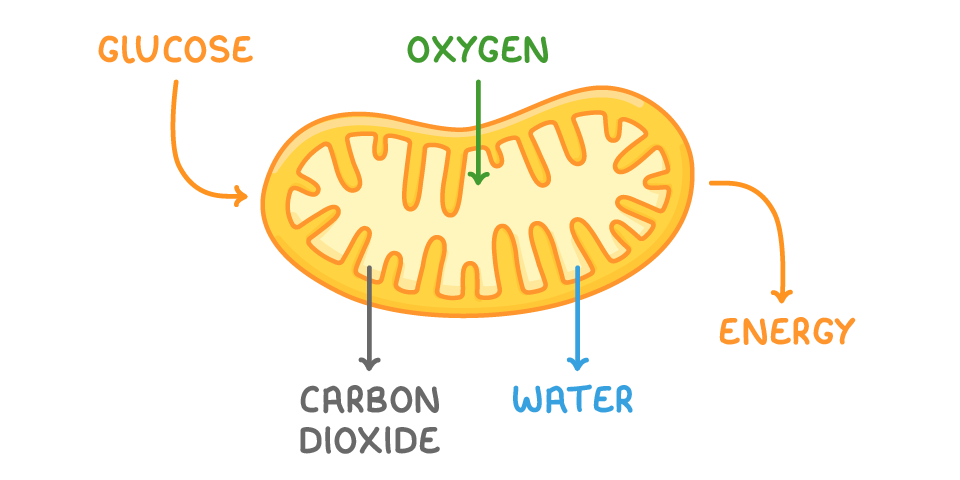
- Glucose reacts with oxygen and is fully broken down, releasing energy.
- The waste products are carbon dioxide and water.
The word equation is:
glucose + oxygen → carbon dioxide + water (+ energy released)
Where it happens
- Most of the reactions take place inside the mitochondria - the structures in the cell where aerobic respiration is carried out.
- Cells that need a lot of energy tend to contain large numbers of mitochondria.
Anaerobic respiration
- Anaerobic respiration is the release of energy from glucose without using oxygen ("anaerobic" means "without oxygen").
- Because there's no oxygen, the glucose is only partially broken down rather than fully oxidised.
- This releases much less energy per glucose molecule than aerobic respiration - it is far less efficient.
- Cells use it when they can't get enough oxygen - for example, a muscle working very hard during vigorous exercise.
In animal cells
Glucose is broken down to lactic acid.
glucose → lactic acid (+ energy released)
The lactic acid builds up in the muscles during hard exercise.
In yeast and plant cells
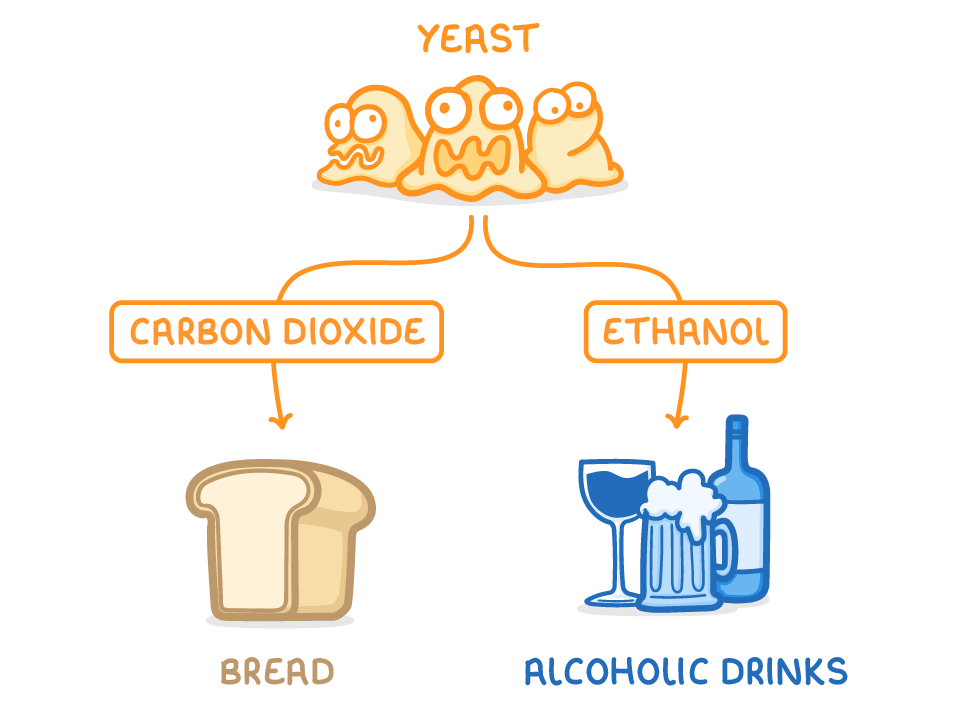
Instead of lactic acid, anaerobic respiration produces ethanol (alcohol) and carbon dioxide.
glucose → ethanol + carbon dioxide (+ energy released)
- Anaerobic respiration in yeast is called fermentation. Yeast are single-celled organisms.
- Fermentation by yeast is widely used in food and drink production:
- The carbon dioxide released makes bread rise.
- The ethanol produced is the alcohol in beer and wine.
Metabolism - Building up and breaking down molecules
- A cell is the site of a great many chemical reactions happening all the time, each one controlled by an enzyme.
- Metabolism is the sum of all these reactions in a cell or in the whole body.
- These reactions fall into two types: building-up reactions (small molecules joined into larger ones) and breaking-down reactions (large molecules split into smaller ones).
Building-up reactions
Small units are joined together to make large storage and structural molecules:
- Glucose → carbohydrates - Many glucose molecules are joined to make starch (stored by plants), glycogen (stored by animals), and cellulose (used by plants to build cell walls)
- Glucose + nitrate ions → proteins - Glucose is combined with nitrate ions to make amino acids, which are then joined together to build proteins
- Glycerol + fatty acids → lipids - These are joined to make lipids, and excess energy from food can be stored as fat
Breaking-down reactions
Large molecules are split into smaller ones:
- Glucose is broken down in respiration to release energy.
- Excess amino acids from protein cannot be stored, so they are broken down to form urea. This is carried to the kidneys and removed from the body in the urine.
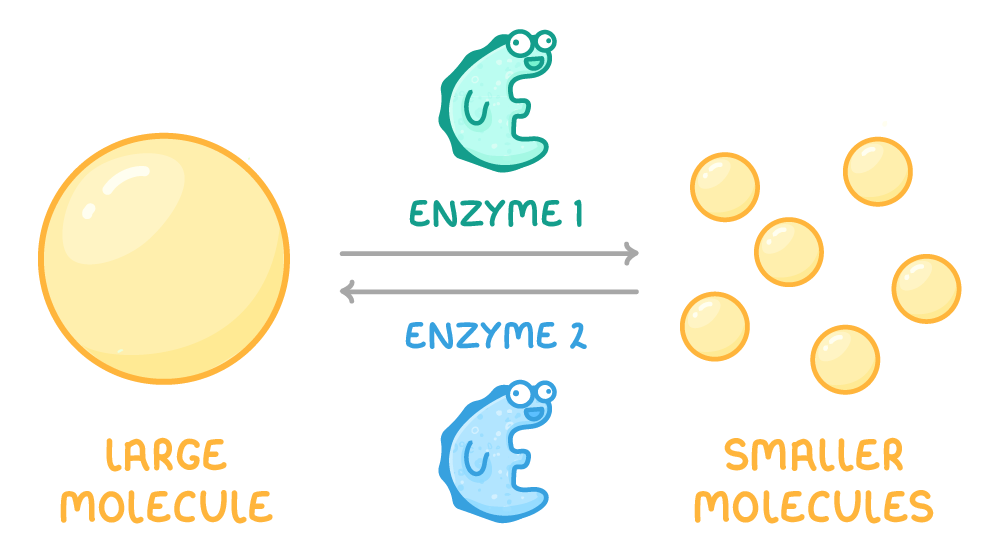
Building up and breaking down are separate reactions, each with its own enzyme.
TermDefinition
RespirationThe chemical reactions in cells that break down nutrient molecules, such as glucose, to release energy for metabolism (all the chemical reactions in an organism).
ATPA molecule that carries energy to the parts of a cell that need it, made using energy from respiration (or from light in photosynthesis).
Aerobic respirationRespiration that uses oxygen to break down glucose completely, releasing energy.
Anaerobic respirationThe release of energy from glucose without using oxygen.
FermentationAnaerobic respiration in yeast and other microorganisms, which breaks down sugars to release energy.
MetabolismThe sum of all the chemical reactions that happen in a cell or in the whole organism.
Key points to remember
How were these notes?