1.6 - Enzymes
What an enzyme is
- Living cells carry out thousands of chemical reactions that must happen quickly and be carefully controlled.
- Raising the temperature would speed reactions up, but inside a living thing it can't be raised far without damaging the cells, and it would speed up unwanted reactions too.
- Instead, cells make enzymes - biological catalysts that speed up the rate of a particular reaction without being changed or used up, so they can be used again and again.
Enzymes are proteins with an active site
- Enzymes are large proteins: long chains of amino acids.
- The order of the amino acids makes the chain fold into a particular three-dimensional shape.
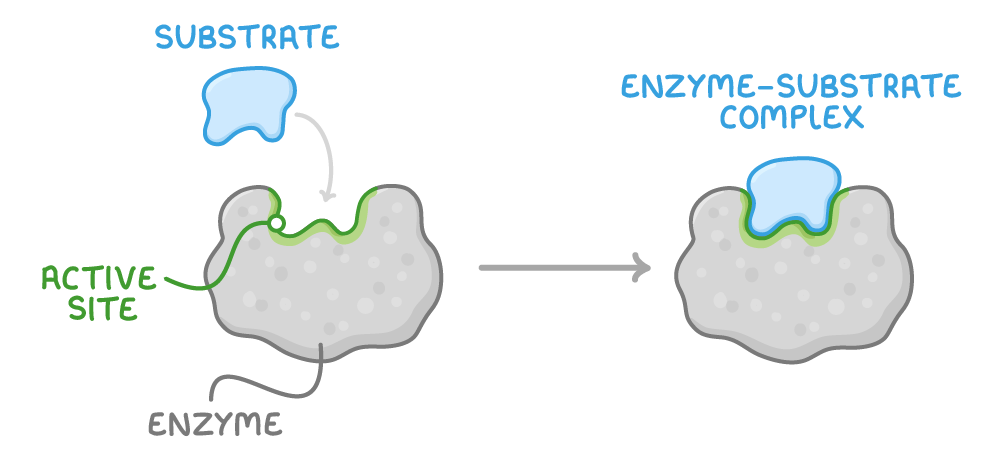
- Part of that shape is a pocket called the active site, where the reaction happens.
How an enzyme works
- The substance an enzyme acts on is its substrate.
- The substrate binds to the active site to form an enzyme-substrate complex.
- During the reaction the substrate is either split apart or joined together, and the products are released - leaving the enzyme unchanged and ready to be used again.
- Enzymes can both break large molecules down (degradation reactions) and build small molecules up (synthesis reactions).
Specificity and the lock-and-key model
- Each enzyme usually catalyses only one reaction - a property called specificity.
- This is because the active site has a particular shape, so only a substrate whose shape is complementary to the active site can bind to it - fitting like a key fits a lock. This is the lock-and-key model.
- If the substrate's shape doesn't match the active site, the reaction is not catalysed - which is why one enzyme works on one substrate and not on others.
How temperature affects enzyme rate
- Temperature has a strong effect on how fast an enzyme works.
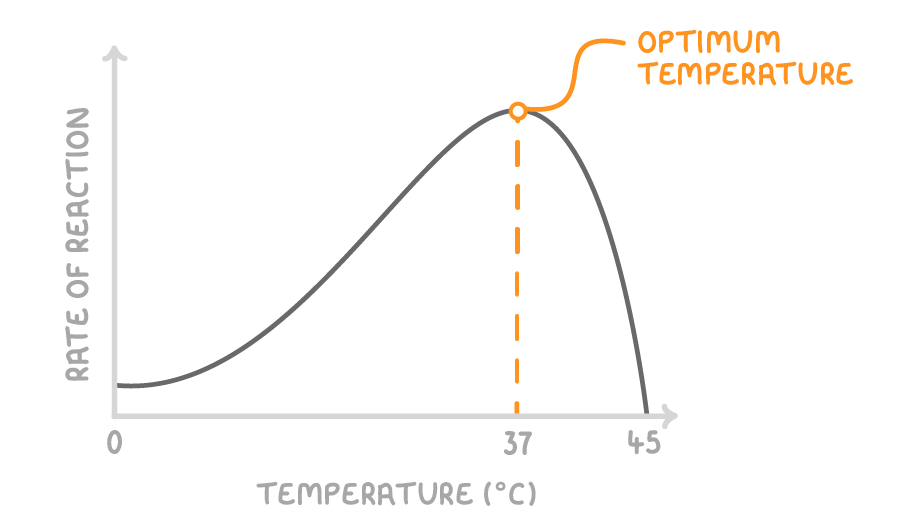
- As the temperature is raised from cold, the rate of reaction increases at first - the enzyme and substrate molecules move about more, so they meet and react more often.
- Every enzyme has an optimum temperature, the temperature at which it works fastest. For many human enzymes this is around body temperature.
Above the optimum - Denaturation
- Above the optimum the rate does not keep rising - it falls, and quite quickly.
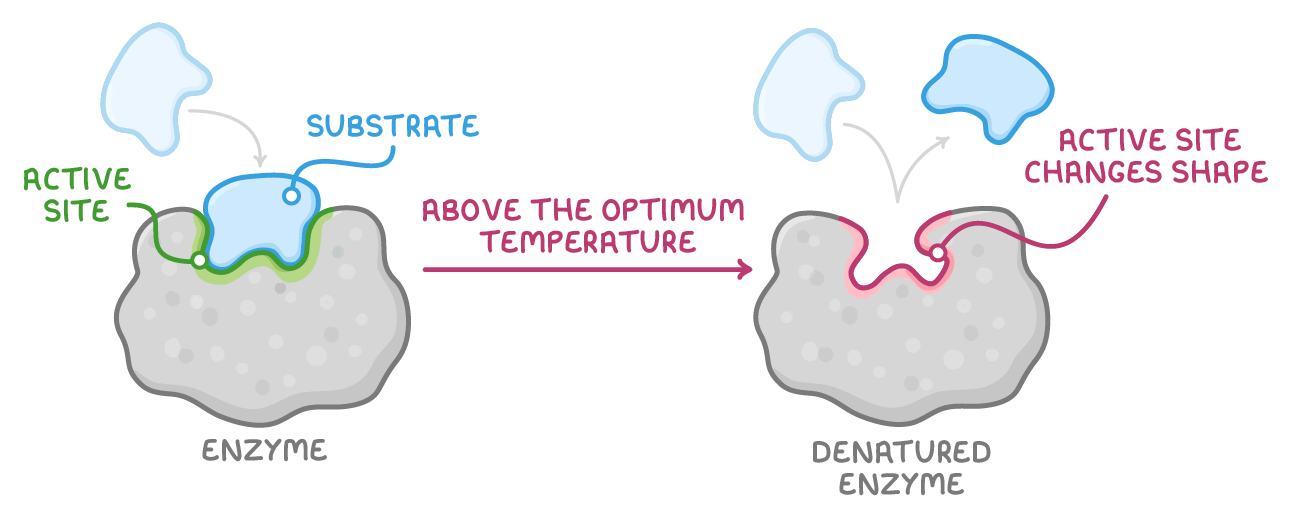
- If the enzyme gets too hot, some of the bonds holding its folded shape together break.
- This changes the shape of the active site, so the substrate no longer fits, and the enzyme can no longer catalyse the reaction.
- An enzyme damaged in this way is said to be denatured.
- Denaturation is permanent - the enzyme does not return to its working shape if it is cooled again, and boiling denatures most enzymes.
The shape of the graph
- A graph of rate against temperature rises to a peak at the optimum temperature.
- It then drops away steeply as the enzymes denature.
How pH affects the rate
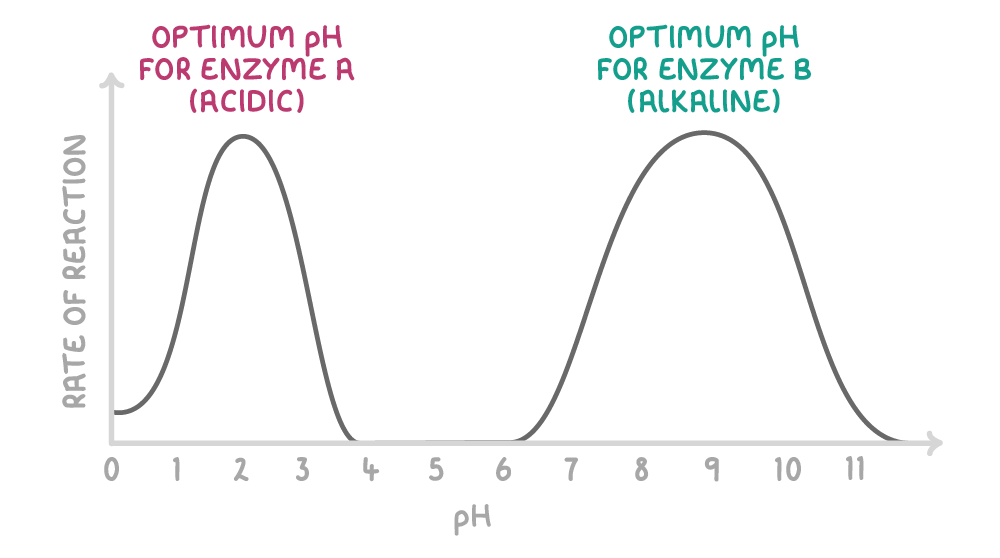
- Each enzyme has a pH at which it works fastest, called its optimum pH.
- For many enzymes the optimum is around neutral (pH 7), but it isn't the same for every enzyme:
- Some work best in acidic conditions.
- Others work best in alkaline conditions.
- The optimum matches the part of the body where the enzyme is found.
Moving away from the optimum
- If the pH becomes too acidic or too alkaline, the rate of reaction falls.
- The wrong pH interferes with the bonds that hold the enzyme's folded shape together.
- This changes the shape of the active site, so the substrate no longer fits properly.
- If the pH is far enough from the optimum, the active site is changed so much that the enzyme is denatured and stops working.
A graph of rate against pH therefore peaks at the optimum pH and falls away on either side of it.
TermDefinition
EnzymeA biological catalyst that speeds up a specific chemical reaction without being changed or used up.
Active siteThe pocket in an enzyme where the substrate binds and the reaction happens.
SubstrateThe substance an enzyme acts on.
Enzyme-substrate complexThe temporary structure formed when a substrate binds to the active site of an enzyme.
SpecificityThe property of an enzyme that allows it to catalyse only one reaction.
Lock-and-key modelThe idea that an enzyme's active site fits only one substrate, like a key fitting a lock (their shapes are complementary).
Optimum temperatureThe temperature at which an enzyme works fastest.
DenaturedDescribes an enzyme whose active site has permanently changed shape, so the substrate no longer fits and the enzyme no longer works.
Optimum pHThe pH at which an enzyme works fastest.
Key points to remember
How were these notes?