5.11 - The Work of Mendel
Mendel's breeding experiments
- Gregor Mendel was an Austrian monk who studied inheritance in his monastery garden in the mid-19th century.
- He noticed how characteristics in pea plants were passed from one generation to the next.
- He carried out thousands of careful breeding experiments across several characteristics - such as plant height, seed shape, and flower colour.
- His results became the foundation of modern genetics.
The pea-plant height crosses
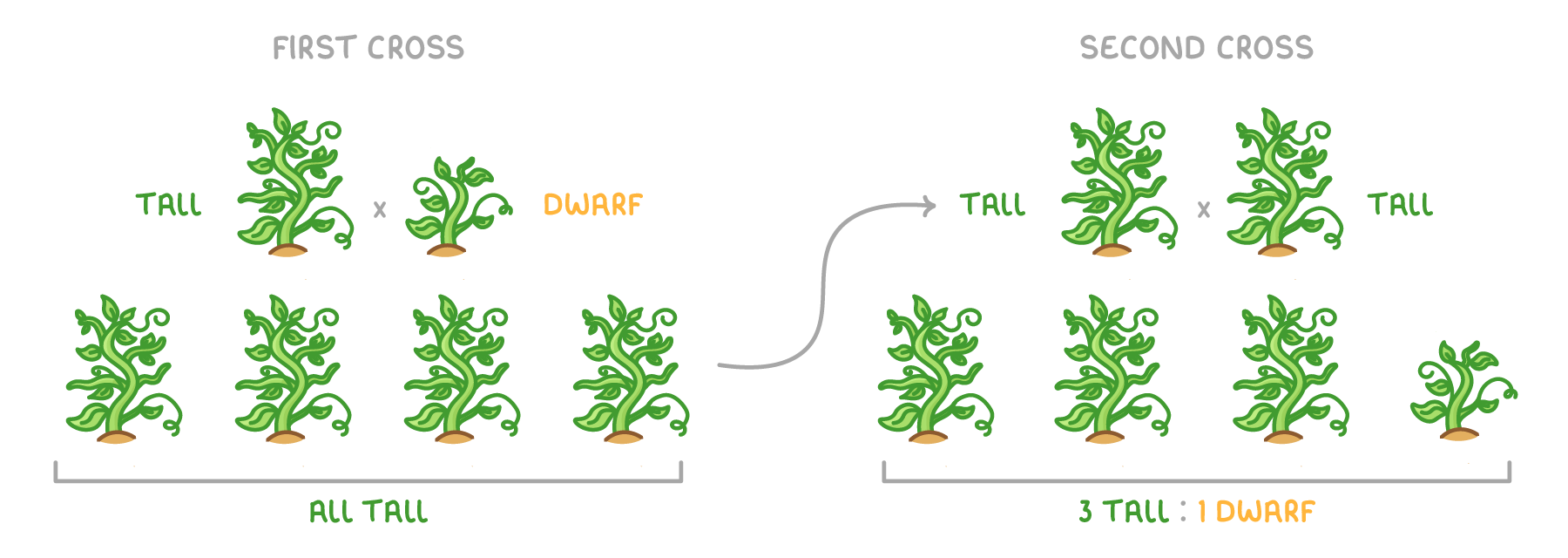
- First cross - A tall pea plant crossed with a dwarf pea plant. All the offspring were tall - none were dwarf.
- Second cross - Two of those tall offspring crossed together. The offspring were a mixture: about three-quarters tall and about one-quarter dwarf - a ratio of 3 tall : 1 dwarf.
- The same consistent pattern appeared for every characteristic he studied - for example, purple flower colour was dominant over white.
Mendel's three conclusions
- Each characteristic is determined by separately inherited "hereditary units" (also called inherited factors).
- These units are passed to offspring unchanged, with one unit for each characteristic coming from each parent - so every individual carries two units for a characteristic, one from each parent.
- A unit can be dominant or recessive. When an individual inherits both a dominant and a recessive unit, the dominant one is expressed. The recessive characteristic only appears when both inherited units are recessive.
How the conclusions explain the crosses
- The unit for tall was dominant over the unit for dwarf, so a plant carrying one of each looked tall.
- A dwarf plant appeared only when an offspring received the recessive dwarf unit from both parents.
- This is why a few dwarf plants reappeared in the second cross, even though every plant in the first set of offspring was tall.
- Mendel knew nothing of chromosomes or genes, but the units he described - and their two contrasting forms - are what we now call genes and alleles.
Why Mendel's work was recognised only later
- When Mendel published his findings, they were completely new and scientists of the time had no way to make sense of them.
- Nobody yet knew anything about genes, DNA, or chromosomes, so there was no known mechanism his "hereditary units" could correspond to.
- His ideas couldn't be properly understood or accepted, so the importance of his discovery went unrecognised during his lifetime - only after his death did other scientists realise how significant his work had been.
How later scientists confirmed his ideas
Using Mendel's work as a starting point, the discoveries of many later scientists gradually built up our modern understanding of inheritance:
- Late 1800s - Scientists became familiar with chromosomes and could observe how they behaved during cell division.
- Early 20th century - They noticed a striking similarity between the behaviour of chromosomes and the way Mendel's "units" must behave when passed from parent to offspring.
- This led to the proposal that the units were located on the chromosomes - these units are what we now call genes.
- 1953 - The structure of DNA was determined, allowing scientists to work out exactly how genes carry information and control characteristics.
Step by step, the work of many scientists turned Mendel's careful observations into modern genetics - so that an unexplained pattern in pea plants became the basis of gene theory.
Key points to remember
How were these notes?