4.3 - Decay & Decomposition
Factors affecting decay
- Dead plant and animal material is broken down, or decayed, by microorganisms - mainly bacteria and fungi.
- As they feed on the dead material, they break it down and release the nutrients it contains (such as nitrates and other minerals) back into the soil, where living plants can take them up again.
Saprophytes and extracellular digestion
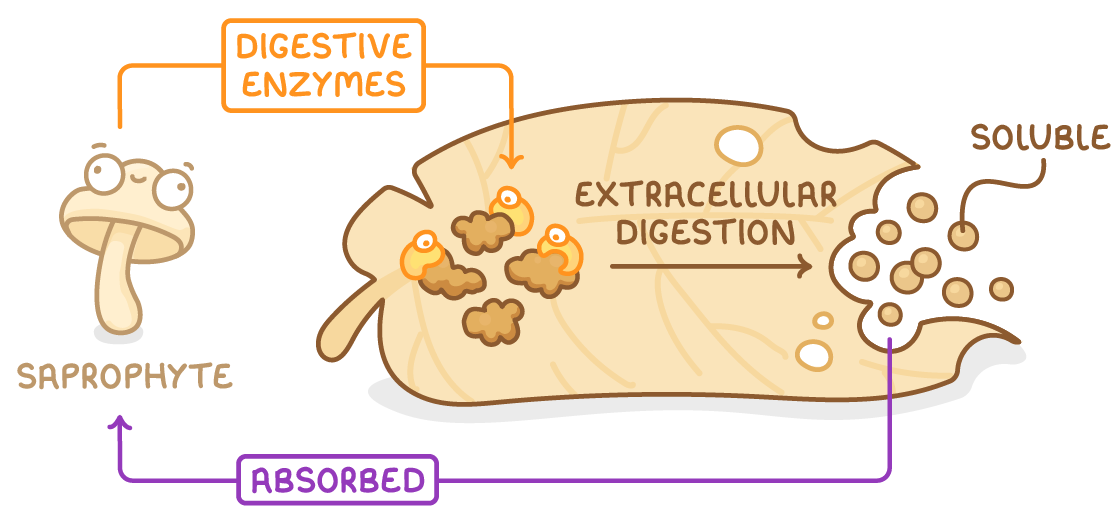
- Some microorganisms, called saprophytes, secrete digestive enzymes onto the dead material.
- They digest it outside their bodies (extracellular digestion), then absorb the soluble products.
- The partly broken-down material left in the soil is called humus.
Three conditions that affect the rate of decay
- Temperature - Microorganisms rely on enzymes, which work faster as it gets warmer:
- Too hot and the enzymes are denatured, so decay slows or stops.
- In the cold, the microorganisms grow and work very slowly.
- Water - Microorganisms need moisture to grow and to dissolve their food, so decay is faster in damp conditions and very slow in dry ones.
- Oxygen - Most decay microorganisms respire aerobically, so they work faster when there is plenty of oxygen.
These three conditions are also why food can be preserved by keeping it cold, dry, or sealed away from oxygen - each one slows the microorganisms down.
Aerobic vs anaerobic decay
- When there is no oxygen, decay still happens, but is carried out by different microorganisms respiring anaerobically.
- Anaerobic decay is usually slower than aerobic decay, because the microorganisms release less energy without oxygen.
- Whether decay is aerobic or anaerobic depends on the conditions:
- Plenty of oxygen favours the faster aerobic decomposers.
- Waterlogged or sealed-off material, where oxygen cannot reach, is broken down anaerobically instead.
Calculating the rate of decay
- The rate of decay tells you how fast dead material is being broken down.
- It's worked out like any other rate: the change in a measured quantity divided by the time it took.
- The quantity usually measured is the mass of the decaying material, which falls as the material rots away.
Formula for rate of decay
Comparing two conditions
- Comparing the rate in two conditions shows how a factor affects decay.
- A sample decaying at 3 g per day in the warm against one at 1 g per day in the cool is rotting three times as fast.
- This shows the higher temperature has sped up the decomposers.
Reading decay from a graph
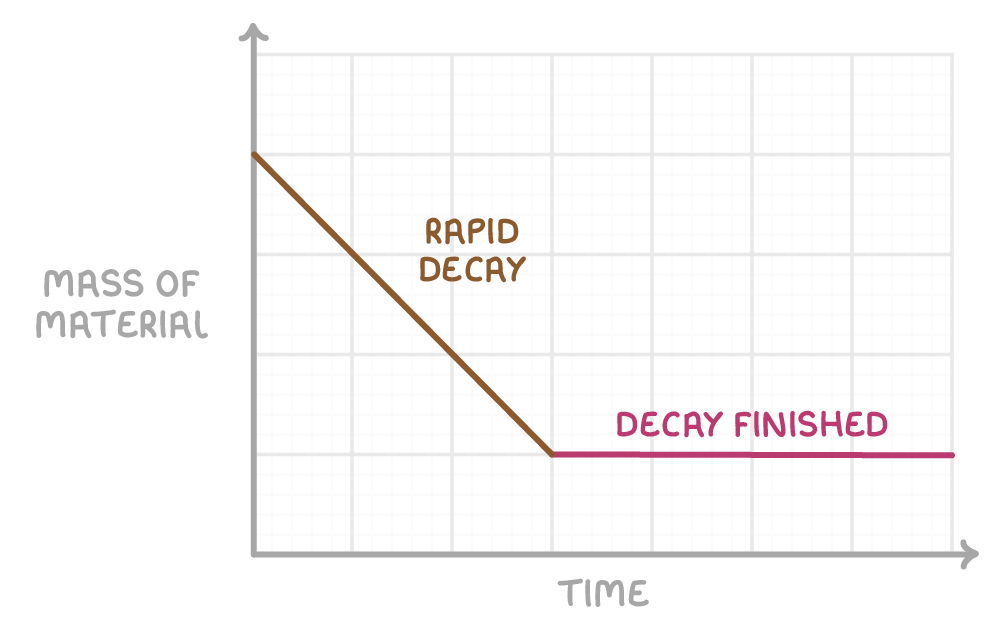
- Plot the data with time along the bottom and mass of the material up the side, choosing scales that spread the points across the grid.
- The steepness of the line (gradient) shows how fast decay is going:
- A steep part means rapid mass loss, so rapid decay.
- A line that levels off means decay has slowed or finished.
- Reading the gradient at any point gives the rate of decay at that moment.
Worked example - Rate of decay of a sample
A sample of material loses 24 g over 8 days. Calculate its rate of decay.
Step 1 - Formula
Step 2 - Substitution and calculation
TermDefinition
SaprophyteA microorganism that feeds on dead material by secreting digestive enzymes onto it and absorbing the soluble products.
Extracellular digestionDigestion that happens outside an organism's cells. The organism releases enzymes onto its food and then absorbs the soluble products.
HumusThe partly broken-down material left in the soil after decay.
Key points to remember
How were these notes?