5.10 - Sex Determination
Sex chromosomes and the inheritance of sex
- The nucleus of every ordinary body cell contains chromosomes arranged in pairs - 23 pairs in humans (46 in total). The two chromosomes in a pair carry the same genes, with a gene for each characteristic in the same position on both, except for the sex chromosomes of a male (X and Y), which are different.
- 22 pairs are the ordinary chromosomes, called autosomes. These carry the genes for the body's characteristics, such as eye colour and blood group.
- The 23rd pair are the sex chromosomes, which decide whether a person is male or female.
The sex chromosomes
- There are two kinds of sex chromosome:
- The X chromosome
- The Y chromosome, which is smaller
- The combination of sex chromosomes determines whether a person is biologically female or male:
- XX - Female
- XY - Male
How sex is inherited
Sex inheritance can be shown with a genetic cross (a Punnett square), using the sex chromosomes in place of ordinary alleles.
- The parents are a female (XX) and a male (XY).
- The mother is XX, so every egg carries an X.
- The father is XY, so half his sperm carry an X and half carry a Y.
- The egg always provides an X, so it is the sperm that decides the sex of the child:
- A sperm carrying an X gives an XX child, who develops as female.
- A sperm carrying a Y gives an XY child, who develops as male.
Crossing XX with XY gives four equally likely combinations:
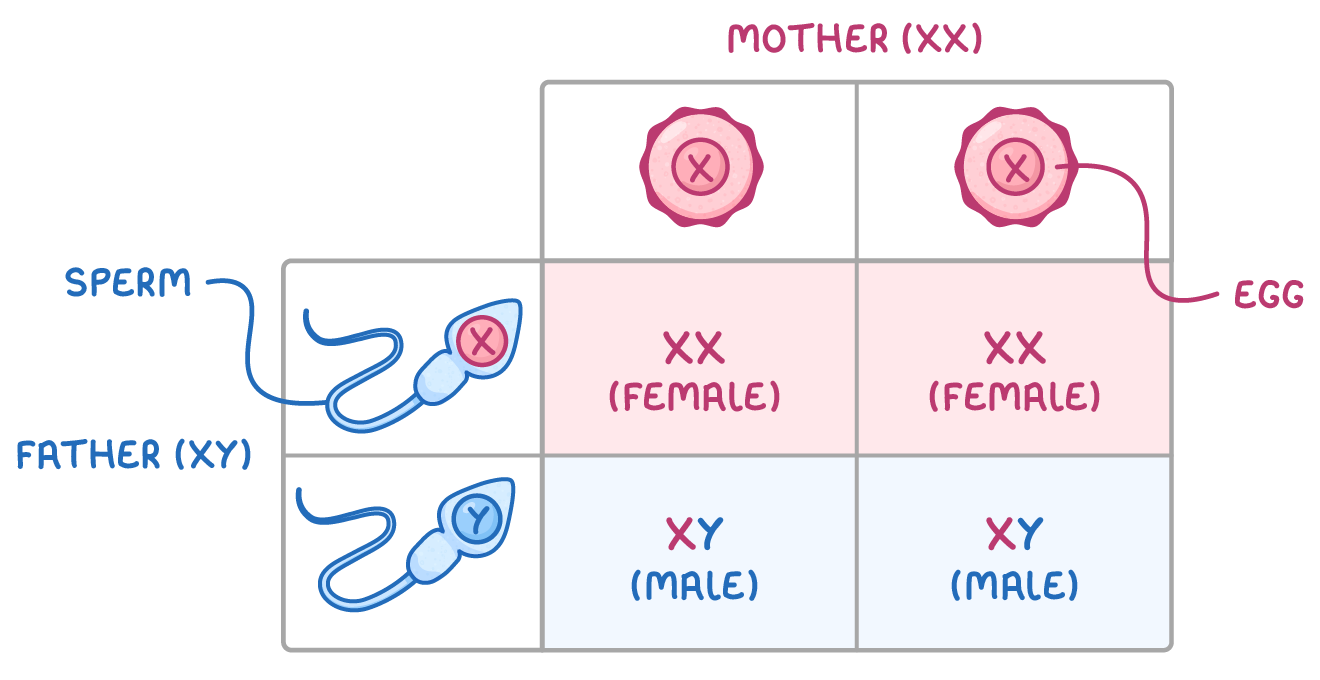
- Two are XX (female) and two are XY (male), so there's an equal chance of a female or a male - a 1:1 ratio, the same as a 50% chance of each at every birth.
- This is a probability, not a guarantee: over many births the numbers of girls and boys come out roughly equal, but one family could by chance have children who are all the same sex.
TermDefinition
AutosomeA chromosome that is not a sex chromosome. A human body cell has 22 pairs of autosomes.
Sex chromosomeA chromosome that decides whether a person is biologically male or female.
Key points to remember
How were these notes?