7.10 - Reaction Time
The experiment
Aim
To measure a person's reaction time using the ruler-drop test, and to find out how a factor, such as caffeine, practice, or a distraction, affects it.
Background
- A reaction time is how long it takes to respond to a stimulus.
- A reaction time is too short to time well with a stopwatch, but you can measure how far a falling ruler drops before someone catches it. The further it falls, the longer the person took to react.
- A falling object speeds up in a known way, so the distance can be turned into a time in seconds.
- So in this practical you measure how far a ruler falls before it's caught, turn the mean distance into a reaction time, and see how changing one factor affects it.
Variables
- Independent variable - The factor being tested, for example whether the person has had a caffeinated drink, how many times they've practised, or whether they're being distracted.
- Dependent variable - The reaction time, worked out from the distance the ruler falls before it's caught.
- Control variables - The same ruler, the same person catching, the same hand, the same starting position, and no warning of when the ruler will drop.
Method
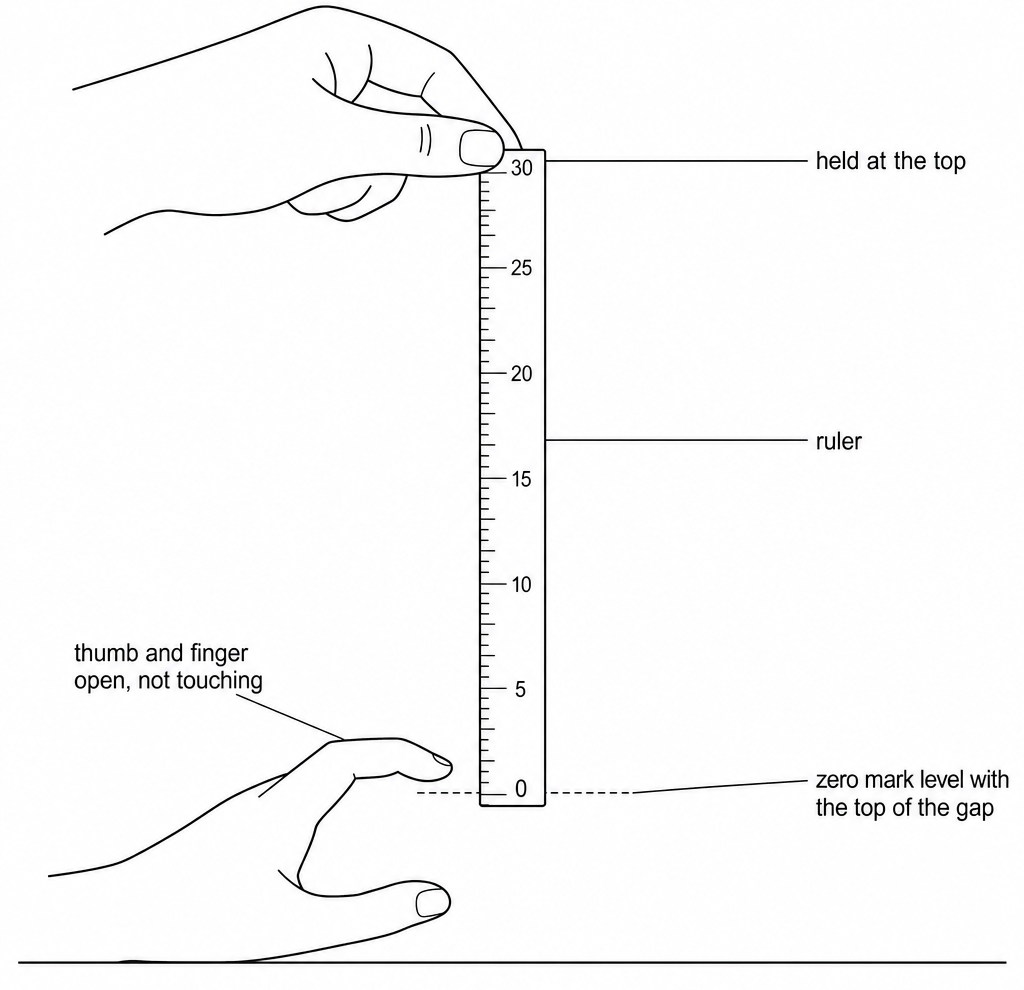
- Get into position - The person catching rests their forearm on the edge of a table, with their hand over the edge and their thumb and first finger open.
- Hold the ruler - A second person holds the ruler upright, with the zero mark level with the gap between the thumb and finger.
- Drop the ruler - The second person lets go without any warning.
- Catch it - The person closes their thumb and finger on the ruler as quickly as they can.
- Read the distance - Read the mark on the ruler level with the top of the thumb. This is the distance the ruler fell.
- Repeat - Do the test several times, such as five, and work out the mean catch distance.
- Change one factor - Test the same person again, for example after a caffeinated drink, and compare the two means.
Safety
- Sit down - Do the test sitting, with the forearm resting on the table, so nobody lunges or falls reaching for the ruler.
- Volunteers - Nobody should be pressured to take part.
- Caffeine - Give it only to a volunteer who agrees to it and has no health condition it could affect. Keep it to one normal drink, with no more caffeine for the rest of the day.
Worked example - Reaction time from the ruler-drop test
A student did the ruler-drop test five times. Her catch distances were 18, 22, 20, 19, and 21 cm. She then had a cup of coffee and did the test again, and her mean catch distance fell to 15 cm. This conversion table was worked out from the equation , with = 9.8 m/s2.
| Catch distance (cm) | Reaction time (s) |
|---|---|
| 5 | 0.10 |
| 10 | 0.14 |
| 15 | 0.17 |
| 20 | 0.20 |
| 25 | 0.23 |
| 30 | 0.25 |
Find her reaction time before the coffee, check it with the equation, and say what effect the coffee had.
Step 1 - Work out the mean catch distance
Add the distances and divide by how many there were.
Step 2 - Convert the mean distance to a time
A catch distance of 20 cm reads across to 0.20 s on the table, so her reaction time is about 0.20 seconds.
Step 3 - Check the time with the equation
Use , with the distance in metres (20 cm = 0.20 m) and = 9.8 m/s2.
This matches the table, which is where the table's numbers come from.
Step 4 - Compare the reaction time after coffee
After the coffee her mean catch distance was 15 cm, which the table gives as 0.17 s. That's 0.20 − 0.17 = 0.03 s faster. The shorter reaction time suggests the caffeine made her respond faster, though to be sure you'd need to repeat the test on more people.
Common exam questions
Question 1
Why is the ruler dropped without any warning?
So the person can't anticipate the drop and guess when to close their hand. You want to measure their reaction to the stimulus, not a lucky guess.
Question 2
Name the stimulus and the response in this test.
The stimulus is seeing the ruler begin to fall. The response is closing the thumb and finger to catch it.
Question 3
Suggest why the catch distance isn't a perfectly accurate measure of reaction time.
It's hard to read the exact mark at the instant the ruler is caught, and the person may partly anticipate the drop. So there's some uncertainty in each reading.