3.14 - Regulating Blood Glucose
Why blood glucose is controlled
Body cells need the amount of glucose (a sugar) in the blood kept steady - too much or too little stops cells working properly and can be dangerous to health.
How glucose enters and leaves the blood
- Glucose in - Enters the blood from the gut whenever carbohydrate-containing food is digested and absorbed in the small intestine.
- Glucose out - Removed by the normal metabolism of cells, which use glucose in respiration; much more is removed during vigorous exercise.
Storing excess glucose
- Excess glucose is converted to glycogen (a storage carbohydrate) and kept in the liver and the muscles.
- Once those stores are full, the rest is stored as lipid (fat) in the tissues.
The pancreas monitors blood glucose
- Because glucose is constantly going into and out of the blood, its concentration would swing up and down without a control system.
- The pancreas does the controlling: it constantly monitors the concentration of glucose in the blood and responds to keep it within a narrow, healthy range.
Insulin and glucagon control blood glucose
- Blood glucose concentration is controlled by the pancreas, using two hormones that work in opposite directions.
- Insulin lowers a high level; glucagon raises a low level. Between them they can correct a change in either direction.
Insulin lowers a high blood glucose level
- When blood glucose rises too high - e.g. after a meal containing carbohydrate - the pancreas detects the change and secretes insulin (a protein) into the blood.
- Insulin travels to the liver and muscles and makes glucose move out of the blood and into their cells.
- In those cells, some glucose is respired and the excess is converted into glycogen and stored.
- With glucose taken out of the blood and stored as glycogen, blood glucose concentration falls back towards normal.
Glucagon raises a low blood glucose level
- When blood glucose falls too low - e.g. during fasting or vigorous exercise - the pancreas secretes glucagon into the blood.
- Glucagon acts on the liver, where glucose was earlier stored as glycogen.
- It makes the liver turn its stored glycogen back into glucose and release it into the blood.
- As glucose is added to the blood, the concentration rises back towards normal - the exact opposite of what insulin does.
Controlling blood glucose by negative feedback
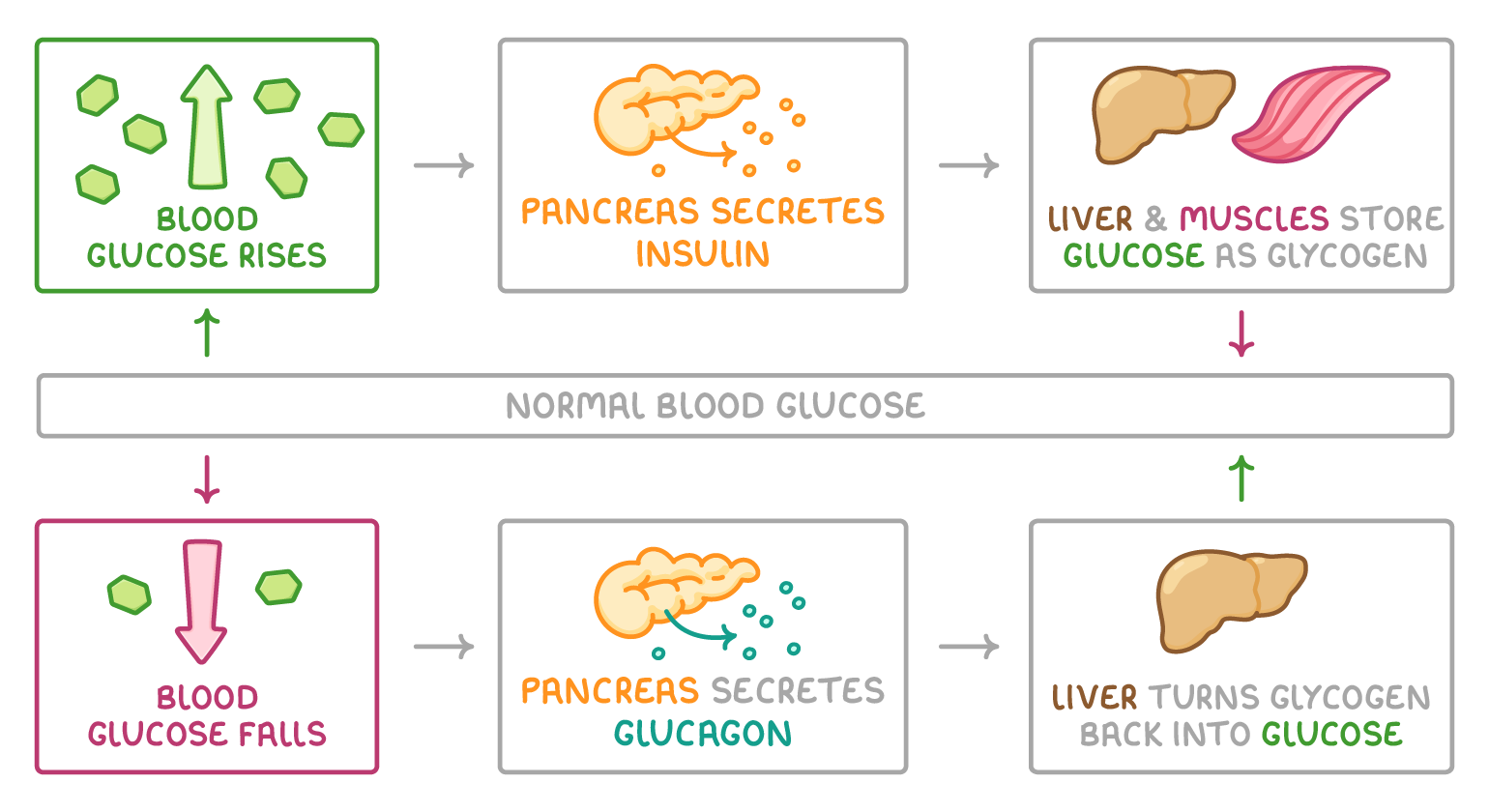
- The pancreas holds blood glucose steady by negative feedback: whenever the level moves away from normal, a response is triggered that pushes it back.
- It uses two hormones, insulin and glucagon, which work antagonistically - they have opposite effects, so between them they can correct a change in either direction.
- Each correction removes the original change, which switches off the hormone that caused it. So blood glucose is constantly nudged back to its normal value rather than drifting away.
When blood glucose rises too high
- The pancreas secretes insulin.
- Glucose is moved into the liver and muscles and stored as glycogen.
- The blood glucose level comes back down.
When blood glucose falls too low
- The pancreas secretes glucagon.
- The liver turns glycogen back into glucose and releases it.
- The blood glucose level comes back up.
TermDefinition
GlycogenA storage carbohydrate used to keep excess glucose in the liver and muscles.
PancreasAn organ that produces digestive enzymes and also monitors blood glucose concentration, releasing hormones to control it.
InsulinA hormone secreted by the pancreas that lowers blood glucose concentration.
GlucagonA hormone secreted by the pancreas that raises blood glucose concentration.
Negative feedbackA control mechanism in which a change away from the normal level triggers a response that brings it back to normal.
Key points to remember
How were these notes?