6.6 - Food Security
Food security and increasing yields
- The world's human population is rising quickly.
- To keep feeding everyone, the amount of food produced globally must rise as well - so that each person still has enough food that is safe to eat and has the right balance of nutrition.
- Food security - Reliable access to enough safe, nutritious food for everyone.
Why farmers focus on raising yield
- There is a limited amount of land available for farming, and it isn't possible to keep clearing more and more land for crops and livestock.
- So the main way to produce more food is to raise the yield - the amount of food produced from a given area of land in a given time.
- Farmers use a range of techniques to increase the yield of their crops and animals, producing more food from the same area without simply taking over more land.
Factors affecting food security
Food security means having enough food to feed a population. Several biological factors affect it, on top of the rising population itself.
Changing diets towards meat and fish
- As people in wealthier countries become better off, their diets change to include more meat and fish.
- Producing meat and fish is a less efficient use of land than growing crops: energy and biomass are lost at each step up a food chain.
- A given area of land feeds far more people when it grows crops directly than when it rears grazing animals.
- Grazing animals are often fed crops that people could have eaten themselves.
Pests, pathogens, and environmental change
- New pests and pathogens - insects, bacteria, fungi, and viruses - can emerge and damage crops and livestock. This reduces yields and can sometimes cause widespread famine.
- Environmental change caused by human activity can reduce how well crops grow, including:
- A changing climate and altered rainfall patterns
- Soil pollution
Sustainability and costs
- Farming must be sustainable - meeting today's needs without harming future generations' ability to meet theirs.
- Growing crops for biofuels competes for land that could grow food.
- High input costs - seeds, fertilisers, fuel, and machinery - can make food production too expensive to maintain in some areas.
- Conflict over food and water can disrupt supply further.
Fertilisers
- Plants need mineral ions from the soil to grow properly:
- Nitrogen - For making proteins
- Phosphorus
- Potassium
- When a crop grows, it takes these mineral ions out of the soil, leaving the soil short of them for the next crop.
- Farmers add fertiliser to replace the missing mineral ions, or to provide extra - this boosts plant growth and so raises the crop yield.
Natural and artificial fertilisers
- Natural - Such as farmyard manure, slurry or compost. They release nutrients slowly and improve the soil.
- Artificial - Made industrially and usually rich in nitrogen, phosphorus and potassium (NPK). They're easy to apply and their mineral content is easy to measure accurately.
Problems caused by fertilisers
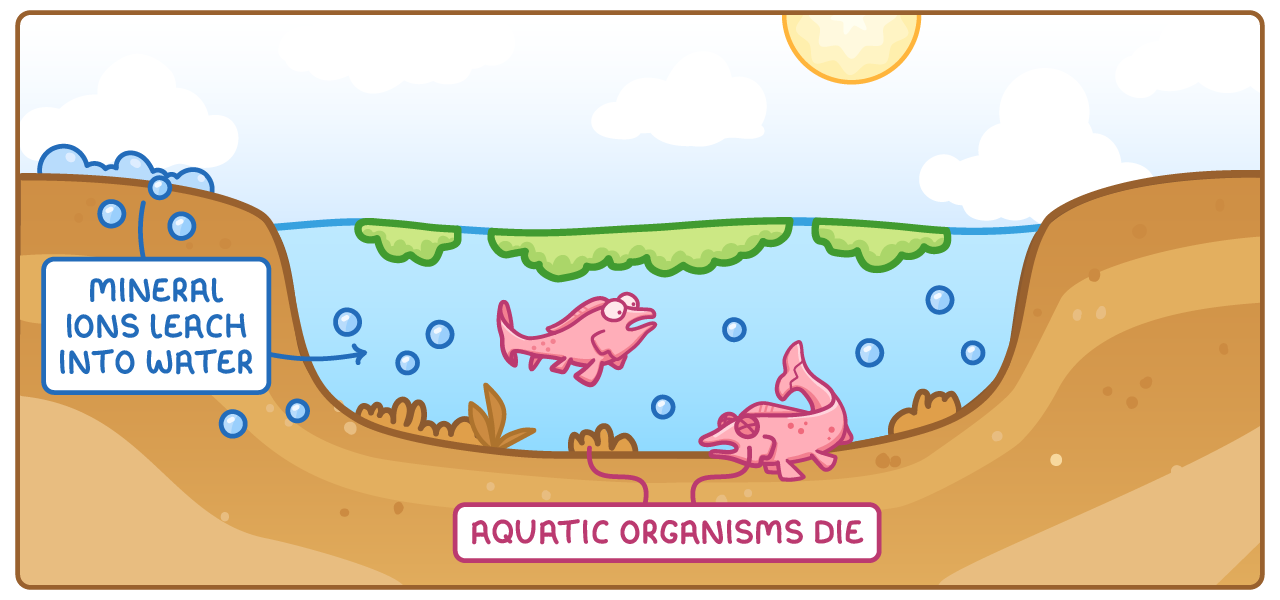
- If too much fertiliser is applied and it rains, the soluble mineral ions are easily washed off the fields.
- They leach into rivers and lakes, where the excess nutrients can lead to the death of aquatic organisms.
Pesticides and bioaccumulation
- Pesticides are a form of chemical pest control - sprayed onto crops to kill the pests that damage them.
- Fewer plants are lost, so the yield rises.
Types of pesticide
- Insecticides - Kill insects
- Herbicides - Kill weeds
- Fungicides - Kill fungi
Drawbacks of pesticides
- Often poisonous to humans, so they must be used carefully to keep the amount left in food below a safe level.
- Many harm wildlife that aren't pests, such as bees and ladybirds. This can leave less food for animals higher up the food chain.
Bioaccumulation
- Some pesticides are not broken down and persist in the bodies of organisms that take them in.
- When a sprayed plant is eaten, the pesticide passes into the animal, then into whatever eats that animal.
- At each stage up the food chain, the concentration of pesticide in the organisms increases.
- Eventually organisms at the top can receive a lethal dose.
- This build-up of a toxic substance in living organisms along a food chain is called bioaccumulation.
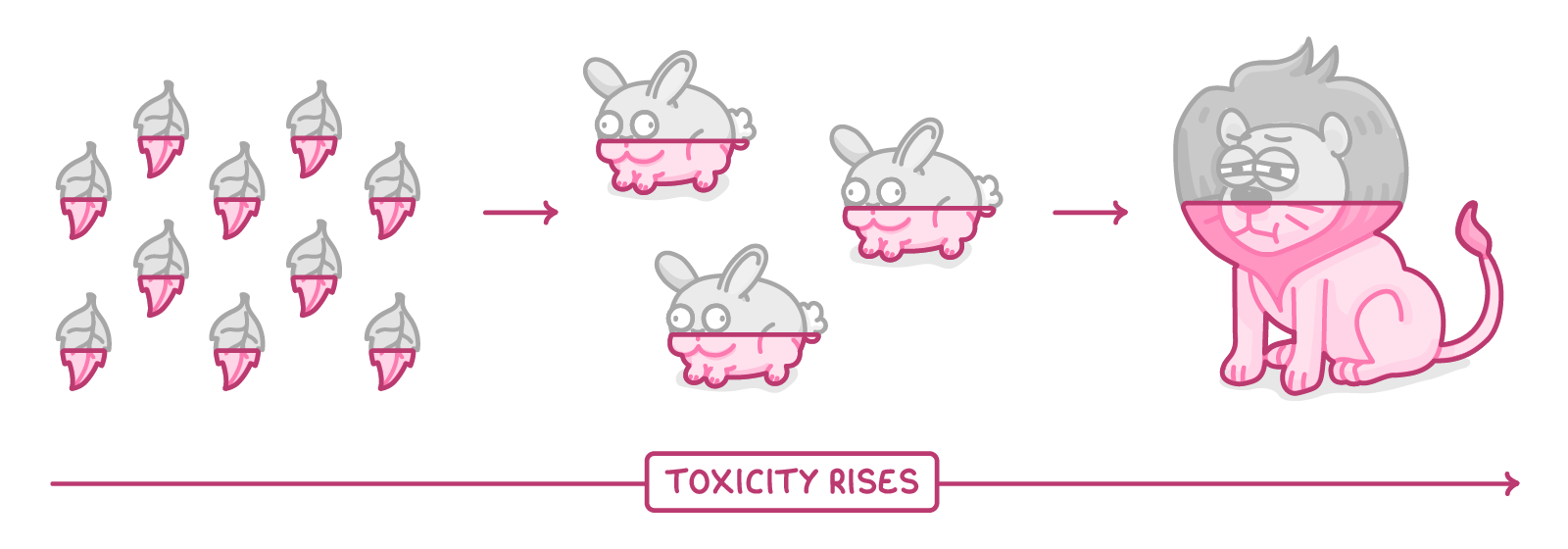
Pink shows the pesticide, more concentrated at each step up the food chain.
Biological control
- Biological control is an alternative to chemical pesticides: instead of spraying poison, farmers use other living organisms to reduce the numbers of a pest.
- This is done either by encouraging organisms already in the area or by adding new ones.
Types of helpful organism
- Predators - Such as ladybirds that eat aphids
- Parasites - Such as flies whose larvae develop on or in a host insect and eventually kill it
- Disease-causing organisms - These infect the pest
Advantages over pesticides
- No chemicals used - Means less pollution and less risk to people eating the food
- No toxic chemicals passing along food chains
- Longer-lasting effect - Spraying often has to be repeated, but biological control can last longer
The risk of introducing new organisms
Biological control does carry a risk: introducing a new organism into an ecosystem can cause problems of its own.
Example: cane toads were brought into Australia to eat the beetles damaging crops, but the toads became a major pest themselves - they poison the native animals that try to eat them.
Hydroponics
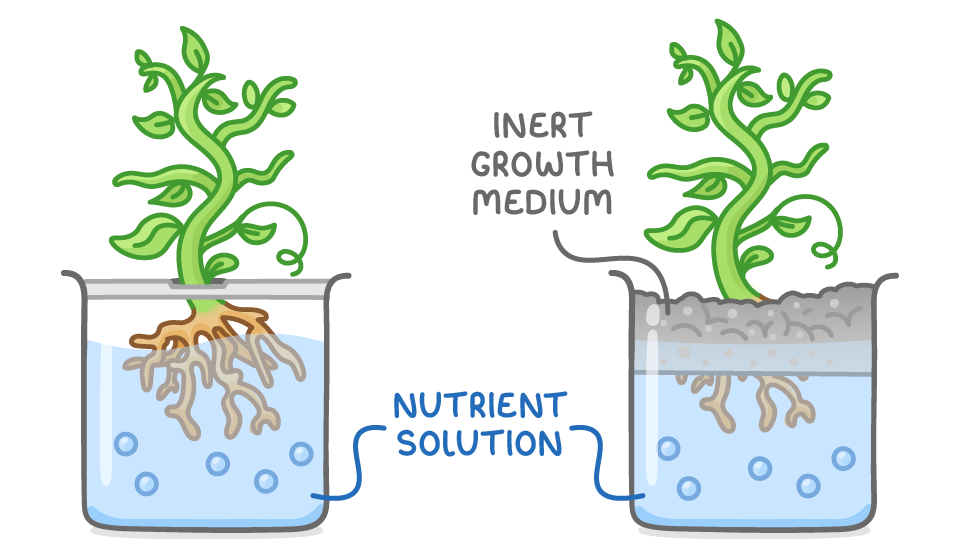
- Hydroponics is a way of growing plants in a nutrient solution - water with fertilisers dissolved in it - rather than in soil.
- The plants are supported in one of two ways:
- Their roots dangle directly in the solution.
- They're planted in an inert growth medium (e.g. gravel, coir (coconut fibre) or perlite) that holds them up while the roots take in the solution.
Where it's used
- Commonly used to grow glasshouse tomatoes and other salad crops on a commercial scale.
- Also used to grow crops where soil farming is difficult or impossible - e.g. areas with harsh climates or barren soil.
Advantages and disadvantages
| Advantages | Disadvantages |
|---|---|
| Pests and diseases can be controlled more effectively. | A lot of fertiliser has to be added. |
| Nutrient levels can be controlled precisely, giving plants exactly what they need for maximum growth. | Set-up cost of the system can be very high. |
| Delivers much higher yields. | If a disease gets into the system it can spread quickly and badly damage the whole crop. |
TermDefinition
Food securityReliable access to enough safe, nutritious food for everyone.
YieldThe amount of food or other useful product obtained, for example from a given area of land in a given time.
BioaccumulationThe build-up of a toxic substance in living organisms along a food chain, because it is not broken down or excreted.
Biological controlUsing a living organism, such as a predator or parasite, to reduce the numbers of a pest or pathogen.
HydroponicsA way of growing plants in a nutrient solution rather than in soil.
Key points to remember
How were these notes?