3.9 - Fertility Treatment
Treating infertility with fertility drugs and IVF
- Infertility means a couple cannot have a baby naturally. There are several possible causes.
- Several of these problems can be helped with hormones.
Causes of infertility
- In a woman - no eggs released - She may not release eggs, or not release them regularly. Her FSH level (the hormone that normally makes eggs mature in the ovaries) may be too low for any egg to mature, so none is released.
- In a woman - blocked oviducts - The oviducts that carry eggs from the ovary to the uterus may be blocked, stopping the egg getting through.
- In a man - A low sperm count, or being unable to deliver sperm.
Fertility drugs
- FSH and LH can be given to a woman to stimulate her eggs to mature and to trigger ovulation (the release of an egg).
- One such drug is clomifene, which makes the body release more FSH and LH so that an egg matures and is released.
- By knowing when she will ovulate, the couple can try to conceive naturally at the right time.
- A woman given a fertility drug may then become pregnant in the normal way.
In vitro fertilisation (IVF)
If a fertility drug alone does not work, in vitro fertilisation (IVF) can be used. "In vitro" means the egg is fertilised outside the body, in the laboratory.
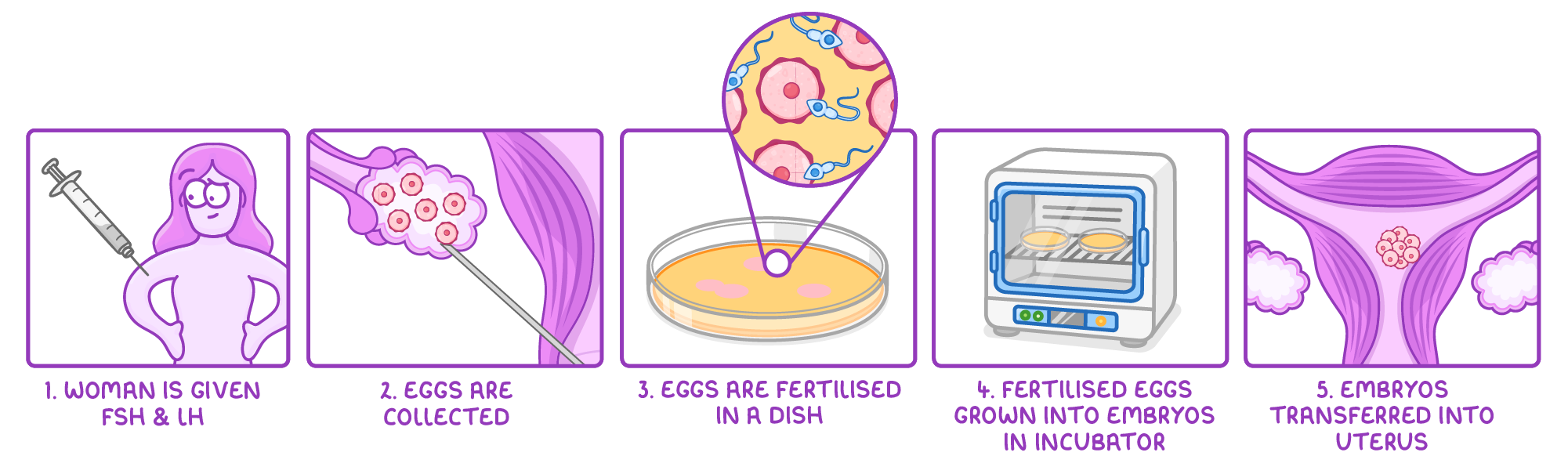
It involves several steps:
- The woman is given FSH and LH to stimulate several eggs to mature at once, so more than one egg can be collected.
- The mature eggs are collected from her ovaries.
- The eggs are fertilised in the laboratory using sperm from the man.
- The fertilised eggs are grown into embryos in an incubator.
- When the embryos are tiny balls of cells, one or two are transferred into the woman's uterus (womb) to improve the chance of a pregnancy. Beforehand, she is given hormones so the lining of her uterus is at the right stage for an embryo to implant.
Evaluating fertility treatment
- Fertility treatment gives a couple who could not otherwise conceive the chance to have a baby of their own - this is its clear benefit.
- But it has real drawbacks that must be weighed against that benefit.
Emotional, physical, and financial drawbacks
- Low success rates - A couple may go through the treatment several times without a pregnancy resulting.
- Emotionally stressful - Especially when attempts fail.
- Physically demanding - Some women react badly to the hormones they are given, with effects such as abdominal pain, vomiting, and dehydration.
- Expensive - Each cycle may have to be repeated.
The risk of multiple births
- Transferring more than one embryo, or stimulating several eggs, can lead to a multiple birth (twins or triplets).
- Multiple births carry a higher risk to both the mother and the babies, including a greater chance of miscarriage or of the babies being born early.
- This is why usually only one or two embryos are placed into the uterus - to balance the chance of success against the risk of a multiple pregnancy.
Ethical issues
- IVF often produces more embryos than are used, and the unused embryos are eventually destroyed. Some people object to this because they regard each embryo as a human life, or a potential human life.
- There is concern that embryos could be screened before being implanted - to check for abnormalities, but potentially also to select preferred characteristics such as the sex of the baby - which some people consider wrong.
TermDefinition
InfertilityBeing unable to have a baby naturally.
ClomifeneA fertility drug that makes the body release more FSH and LH so that an egg matures and is released.
In vitro fertilisation (IVF)A technique in which eggs are fertilised by sperm outside the body, in a laboratory.
Key points to remember
How were these notes?