2.8 - Exchange Surfaces
Features of a good exchange surface
- A large multicellular organism can't supply all its cells by diffusion across its outside surface, so it uses specialised exchange surfaces - places adapted to move substances in and out quickly.
- Whatever the substance being exchanged, the same features make an exchange surface effective.
Large surface area
- A large surface area lets a lot of the substance diffuse across at once.
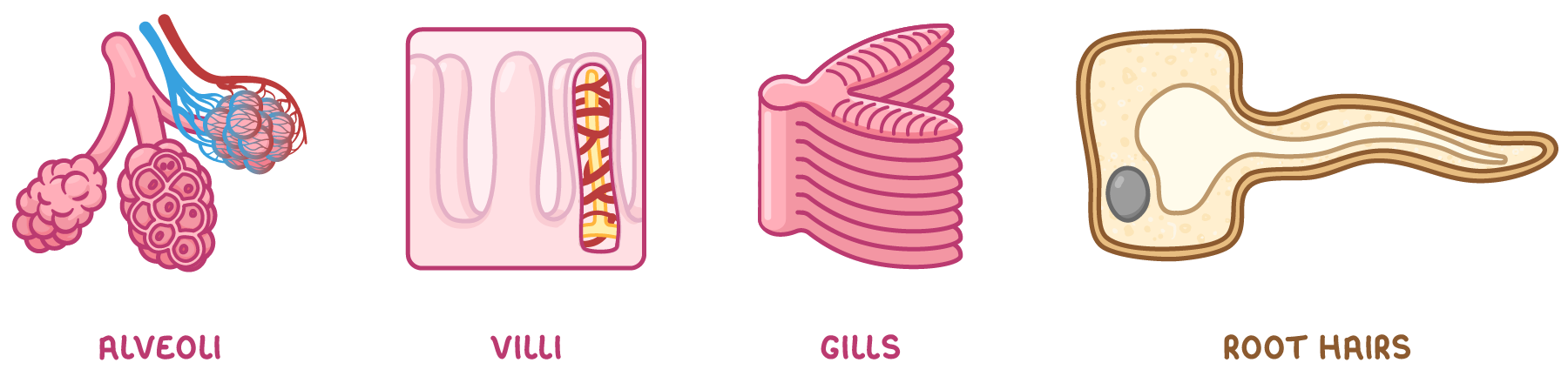
- This is usually achieved by folding the surface into many small structures, for example:
- Millions of tiny air sacs (alveoli) in the lungs
- Finger-like projections (villi) lining the small intestine
- The thin plates of a fish's gills
- The many root hairs on a plant root
Thin surface
- A good exchange surface is thin, often only one or two cells thick.
- Substances then have only a very short distance to diffuse across it, so exchange is fast.
Steep concentration gradient
- Keeping a steep concentration gradient across the surface means substances keep diffusing in the right direction.
- Good blood supply - In animals, blood flowing past the surface constantly brings fresh supply to one side and carries the exchanged substance away from the other, so the difference in concentration stays large.
- Ventilation or a moving medium - Where the surface exchanges gases it is often ventilated (air moved in and out, as in the lungs) or has another moving medium passing over it (such as water flowing across a fish's gills), keeping the gradient steep.
- Moist surface - Many exchange surfaces are moist, which lets gases dissolve so they can cross more easily.
TermDefinition
Specialised exchange surfaceA part of an organism adapted to exchange substances efficiently with the environment.
Key points to remember
How were these notes?